





SPEAK WITH A SPECIALIST
800-462-0071

I WANT TO

Gold Demand Trends for 2023

Gold Demand Trends for 2023

Gold Continues Its Upward Trajectory

Gold is having a very good year and the trend is likely to continue to 2024. The global nature of the gold market has allowed different sectors and locations to support an overall rise in gold demand and prices. Central bank, investment, and jewelry demand are creating a supportive environment for gold prices. The London Bullion Market Association (LBMA) gold price averaged $1,976 during the second quarter – a record high. That’s 6% higher than last year and 4% higher than the previous record in 2020.1

Jewelry

Jewelry consumption improved despite high gold prices with a 3% increase over 2022. The overall rise was attributed to rebounding sales in China and Turkey. Analysts foresee holiday related spending supporting a continued rise to the end of the year.2

Investment

Bar and coin investment increased by 6% in H1 (the first half of the year). The increase was largely due to markets in the US and Turkey. In the US, investment demand was fueled by the banking crisis and the volatile debt ceiling negotiations. Momentum carried the market through to the end of the first half of the year.3

Over the counter investment (buying directly from a dealer) jumped in the second quarter. Sales hit 335 tons, with gold coins leading the way in year-over-year retail growth. In China, bar and coin investment grew 32% from last year.4

Meanwhile, US investors continued to show a strong appetite for bars and coins. H1 demand was 65 tons, the strongest half-yearly total since 2008 (the year of Global Financial Crisis). The collapse of Silicon Valley Bank and Signature Bank created shockwaves that sent investors scrambling to buy physical bullion products. US Mint coin sales reflect this upsurge in demand. Sales of American Eagles and Buffaloes reached almost 1 million ounces by the end of June. Compare that with annual sales of 1.4 million ounces over the full year 2022.5

There is a sense that investment interest remains piqued. Demand will likely rise as we approach the 2024 presidential election campaigns and if any signs of banking instability re-emerge.

Central Banks

The World Gold Council’s latest Gold Demand Trends report shows that gold benefited from record central bank buying in the first half of the year. Central bank buying in H1 reached 387 tons. Buying slowed down in the second quarter, but a strong first quarter sealed the deal. Gold purchases are widespread among emerging and developed countries.

H1'23 Central Bank Demand6

Massive central bank purchases are continuing the trend from last year. In 2022, central banks added an eye-catching 1,136 tons of gold, worth about $70 billion, to their stockpiles. According to World Gold Council data, it was the largest amount bought, until this year, since 1950.7

Analysts forecast central bank buying will remain strong thru to the end of the year. The global de-dollarization wave is pushing demand. Sanctions on Russia have other countries reducing their reliance on the dollar. They are turning to gold for reserves instead.

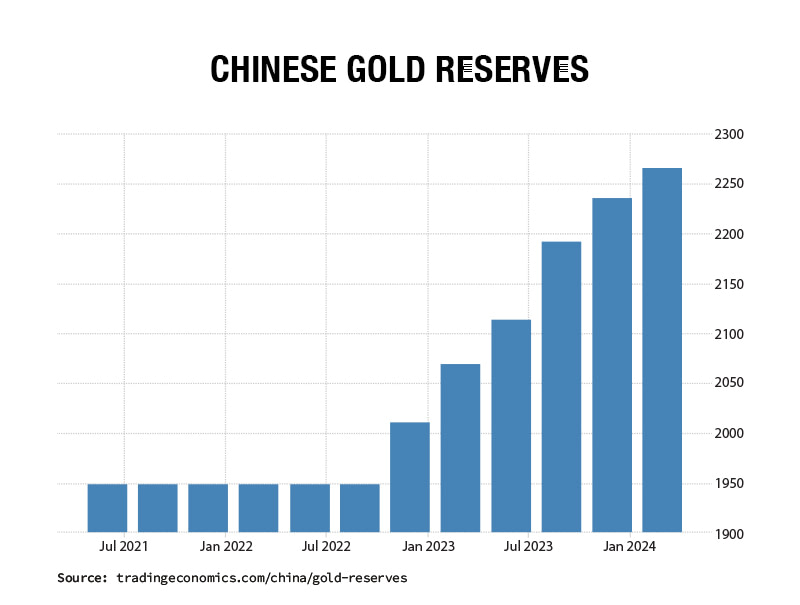
Chinese analysts noted that due to an accelerating global de-dollarization trend, the current “gold rush” shows no signs of stopping. It is expected to continue in the coming months. As of June 2023, gold reserves held by the People’s Bank of China (PBC) reached 1,926 tons. That marked an increase of 680,000 ounces compared to the previous month. This makes the eighth consecutive month of rising gold purchases by the PBC.8

The US Federal Reserve’s aggressive interest rate hikes since early 2022 have exerted significant devaluation pressure on non-dollar currencies. Under this circumstance, only increasing gold reserves can help other countries stabilize the exchange rates of their currencies, said Chinese bank analysts.

Rating agency Fitch Ratings’ recent downgrade of the US credit rating has also sped up the de-dollarization movement. This surge in investor risk aversion could further drive-up gold prices.

Louise Street, Senior Markets Analyst at the World Gold Council, commented:

“Record central bank demand has dominated the gold market over the last year and, despite a slower pace in Q2, this trend underscores gold’s importance as a safe haven asset amid ongoing geopolitical tensions and challenging economic conditions around the world.”9

China

For China, increasing gold reserves is also a means to help internationalize the yuan. Sufficient gold will give the yuan the backing and credibility it needs to become a dominant international currency. They aim to lure other central banks to start using the yuan for settling international trade instead of the dollar.

Gold Demand Trends for 2023

Recession

A looming global recession will also spur greater gold demand. Street said, “Looking ahead to the second half of 2023, an economic contraction could bring additional upside for gold, further reinforcing its safe-haven asset status. In this scenario, gold would be supported by demand from investors and central banks, helping to offset any weakness in jewelry and technology demand triggered by a squeeze on consumer spending.”10

Conclusion

The data clearly points to a potential continued upward trajectory for gold. The precious metal is sought by investors and central banks alike for its inherent safe haven qualities. You can take advantage of those qualities with a Gold IRA from American Hartford Gold. Contact us today at 800-462-0071 to learn more.


Notes:
1. https://www.gold.org/goldhub/research/gold-demand-trends/gold-demand-trends-q2-2023
2. https://www.gold.org/goldhub/research/gold-demand-trends/gold-demand-trends-q2-2023
3. https://www.gold.org/goldhub/research/gold-demand-trends/gold-demand-trends-q2-2023
4. https://www.gold.org/goldhub/research/gold-demand-trends/gold-demand-trends-q2-2023
5. https://www.gold.org/goldhub/research/gold-demand-trends/gold-demand-trends-q2-2023/investment
6. https://www.gold.org/goldhub/research/gold-demand-trends/gold-demand-trends-q2-2023/chart-gallery
7. https://www.globaltimes.cn/page/202308/1295753.shtml
8. https://www.globaltimes.cn/page/202308/1295753.shtml
9. https://finance.yahoo.com/news/gold-demand-trends-gold-continues-060000243.html
10. https://finance.yahoo.com/news/gold-demand-trends-gold-continues-060000243.html

Recession – Delayed, not Dodged

Recession - Delayed, not Dodged

  • Despite trader optimism, economists point to strong recession indicators
  • The recession has been delayed by stimulus money and rate hike effect lag
  • The S&P 500 potentially faces more than a 30% drop

Indicators Still Point to Recession

When it comes to recession, bullish economists are eager to say, “I told you so,” pointing to low unemployment, strong consumer spending and an S&P 500 rally. But top Wall Street strategists believe now is not the time to gloat. A recession is on the way.

Forecasters began warning of recession and a stock market sell off back in April 2022. By October 2002, 65% of economists said recession would arrive in 12 months. They based this on the Fed’s rapid rate hikes. The Fed’s goal was to tame record inflation by contracting the economy. The Fed raised rates from near zero to 5.5%. This hiking cycle is the fastest and most aggressive since the early 1980s. Since World War 2, 80% of Fed hiking cycles have resulted in a recession.1

As the bulls point out, the economy seems to have avoided the drop in earnings and rise in unemployment – so far. The reason for this, according to economists, is due to the lingering effects of the massive fiscal and monetary stimulus efforts during the COVID-19 pandemic. As well as the long lag time before the Federal Reserve’s rate hikes filter through to the economy. Even Fed chair Powell admitted as such. He said, “We have covered a lot of ground, and the full effects of our tightening have yet to be felt.”2

There was nearly $5 trillion in stimulus disbursed. It went to households and businesses, as well as state and local governments. The cushion allowed people to keep spending and ignore higher interest rates. But that is starting to change. Cash reserves are being used up. The number of Americans falling behind on credit card debt is on the rise. Credit card delinquencies have almost doubled since 2021. Auto loan and mortgage delinquencies are also on the rise.

And though inflation seems to have plateaued, prices haven’t come down. Consumers will soon be forced to cut back on spending. Tom Essaye is the founder of Sevens Report Research. He explains it this way – “People get very excited about CPI and say, ‘Hey, CPI went up only 0.1% over the past month and it’s only up 3% over the past year. Well, think about that in practical terms. If I go to buy my kids a bag of Skittles, in 2019 it cost $0.75. Now it costs $1.50. Am I supposed to get excited because next year it costs $1.55?”3

Another reason a recession is considered imminent is the lag time between rate hikes and their effects. This is visible in the manufacturing sector. Industrial production is starting to trend downward. The Institute for Supply Management’s Purchasing Managers Index shows there is widespread worry across the industry. The downward trend reflects dropping consumer demand. Manufacturing is considered a thermometer for the broader economy.

Another lagged effect of the rate hikes is the impact of tighter lending standards. A recent survey showed more than half of banks are making it harder for businesses to get loans. Banks are growing more concerned about borrower’s ability to pay them back. These loans are vital for companies to grow and pay employees. When the money stops, businesses contract and unemployment rises.

Recession - Delayed, not Dodged

Reliable Recession Signal

Economists point to the Treasury yield curve as evidence that a recession is on the way. The Treasury yield curve measures the different interest rates that are paid out on various bonds issued by the US government. Usually, the interest rate on short-dated Treasuries is lower than yields on far-out bonds like the 10-year Treasury. But when that flips and interest rates on short-term Treasuries are higher than their long-term cousins, it is known as a yield-curve inversion. Since the 1960s, the indicator has a perfect track record of preceding recessions.

10-year/3-month treasury yield spread4

The message of an inverted yield curve is that while interest rates are high now, in the future, the rate of economic growth and inflation will be slower. Interest rates will then be lower. Historically, it has taken a recession to realize such a scenario. The extent of the current inversion is extreme by historical standards. It is at its widest gap since the 1982 recession.5

Recession Impact and Recourse

If the recession is mild, analysts see the S&P 500 likely falling as much as another 13%. But in the past 13 recessions, the S&P 500 has dropped an average of 32%, as noted by the Royal Bank of Canada.6

People can choose to remain optimistic and hope that there will be a soft landing with no recession. Or they can see the financial data and prepare for an economic downturn. methods One of preparation is shifting part of your portfolio into recession resistant assets like physical precious metals. In fact, the Gold IRA from American Hartford Gold is designed to shield portfolio value from recession. Contact us today at 800-462-0071 to learn more.


Notes:
1. https://www.businessinsider.com/us-economy-still-headed-for-recession-stock-market-crash-2023-8
2. https://www.businessinsider.com/us-economy-still-headed-for-recession-stock-market-crash-2023-8
3. https://www.businessinsider.com/us-economy-still-headed-for-recession-stock-market-crash-2023-8
4. https://www.businessinsider.com/us-economy-still-headed-for-recession-stock-market-crash-2023-8
5. https://www.morningstar.co.uk/uk/news/238448/wait-is-the-bond-markets-recession-indicator-broken.aspx
6. https://www.businessinsider.com/us-economy-still-headed-for-recession-stock-market-crash-2023-8

Banks Follow US with Credit Rating Downgrade

Banks Follow US with Credit Rating Downgrade

  • Moody’s and Fitch Ratings downgraded the credit rating of the banking industry
  • The downgrade was due to high interest rates and growing risk of bank failures
  • Experts turn to physical precious metals as banks and the government become worse stores of wealth

Banking Industry Downgraded

The phrase “like money in the bank” is taking on a new meaning nowadays. The once secure banking industry is growing increasingly riskier. Bank stability is being challenged with high interest rates, rising deposit rates and slumping profitability. Now they can add a rating downgrade to their list of troubles. On the heels of a US credit downgrade, a depreciating financial industry threatens to undermine the broader economy.

Last week, Moody’s Investment Services downgraded the credit rating of 10 mid-sized banks by a single notch. They cited growing financial risks and strains that could erode their profitability. They also warned of a review of six other lenders and assigned a negative outlook to 11 other banks.

Moody’s actions come after a banking crisis that started in March with the sudden collapse of Silicon Valley Bank. Once the nation’s 16th largest bank, their depositors grew fearful of the bank’s solvency and made a classic bank run. Signature Bank and First Republic Bank soon followed, leading to more concerns about the banking industry’s stability.

Moody’s downgrade is on the heels of one from Fitch Ratings. In June, Fitch lowered the banking industry to AA- from AA. Fitch Ratings is now warning the banking industry could be downgraded again from AA- to A+. If that happens, Fitch would be forced to reevaluate ratings on each of the more than 70 banks it covers. Shares of JPMorgan, Bank of America and Citigroup fell on news of the warning.

Downgrade Meaning

Banks rely on bond sales to help fund their operations. A downgrade makes those issuances more expensive. That’s because Investors demand more return to own lower rated bonds. As a result, costs increase for banks and profits go down.

Banks Follow US with Credit Rating Downgrade

Impact of Fitch Downgrade

Another Fitch downgrade creates a new problem for banks. If the industry’s score is downgraded to A+, then it would be lower than some of its top-rated lenders. The country’s two largest banks by assets, JPMorgan and Bank of America, would likely be cut to A+ from AA-. This is because banks can’t be rated higher than the environment in which they operate. Which in turn triggers downward adjustments for their smaller rivals. Weaker lenders would be moved closer to non-investment grade status.

Tough Timing

Regulators want banks to issue more bonds as they become more expensive for the banks. The FDIC, Federal Reserve and Office of Comptroller of the Currency are trying to stop the long simmering banking crisis from boiling over. They want to prevent any future bank runs. Regulators want the banks to issue more long-term debt to stabilize them. The long-term debt is meant to absorb losses if the bank fails. It is meant to make it easier for banks to hold onto depositors and slow down a run.

Role of Interest Rates

The Federal Reserve rapidly raised interest rate to fight inflation. Rates went from almost zero to 5.5% within a year.

The Fed is Moving Historically Fast to Tame Inflation1

Minneapolis Federal Reserve President said the risk is that if inflation is not completely under control, the Fed may have to raise rates further. Banks “might face more losses than they currently face today.” According to CME Group’s FedWatch Tool, market participants believe the Fed will hold interest rates near their current levels well into the first half of next year. They want to bring inflation down to the central bank’s 2% target.2

Prolonged higher interest rates could force Fitch to go through with the downgrade. Record high rates put extreme downward pressure on the industry’s profit margin. In addition, higher rates lead to more defaults. The more defaults, the more likely the downgrade is going to happen.

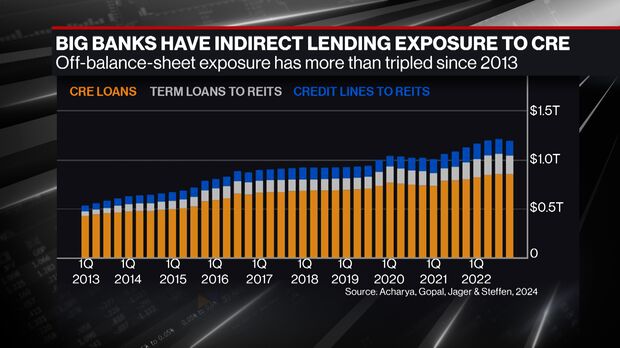
The collapse of the commercial real estate market is also threatening small and mid-size banks. They are the primary lenders in that industry. Small banks hold 67% of all commercial real estate loans. Developers typically only paid the interest on real estate loans. They would refinance when the principle came due. But high interest rates are making that unaffordable. As a result, there is an exponential increase in defaults. These nonpayments are hammering the bottom line of small banks. 3

Follows US Downgrade

Earlier this month, Fitch Ratings downgraded the credit rating of the United States from “AAA” to “AA+.” Fitch cited the nation’s growing debt and continued partisan standoffs over the debt limit. Fitch Ratings said these political standoffs have prompted spiraling national debt and a lack of confidence in the US government to manage it.

Moody’s and Fitch are exposing an unwelcome truth about the banking industry and the United States government. They are both becoming more unstable. Once solid secure repositories for investors, both banks and the US are becoming riskier and riskier investments. For those who are interested in securing their retirement funds, safe haven assets like precious metals offer a safer alternative. A Gold IRA from American Hartford Gold can preserve your wealth as the bedrock of the US (and world) financial system cracks. Contact us today at 800-462-0071 for a personalized gold solution.


Notes:
1. https://www.fool.com/investing/2023/08/15/moodys-downgrades-10-banks-heres-what-investors-ne/
2. https://finance.yahoo.com/news/why-bond-rating-downgrades-are-the-last-thing-banks-need-right-now-204145044.html
3. https://www.fool.com/investing/2023/08/15/moodys-downgrades-10-banks-heres-what-investors-ne/

Crisis Builds as Credit Card Debt Breaks $1 Trillion

Crisis Builds as Credit Card Debt Breaks $1 Trillion

  • Credit Card debt hit a record-breaking $1 trillion
  • High interest rates, increasing delinquencies and 401(k) hardship withdrawals signal a growing crisis
  • Experts advise moving into secure long-term assets like physical precious metals

Credit Card Debt Hits Record Level

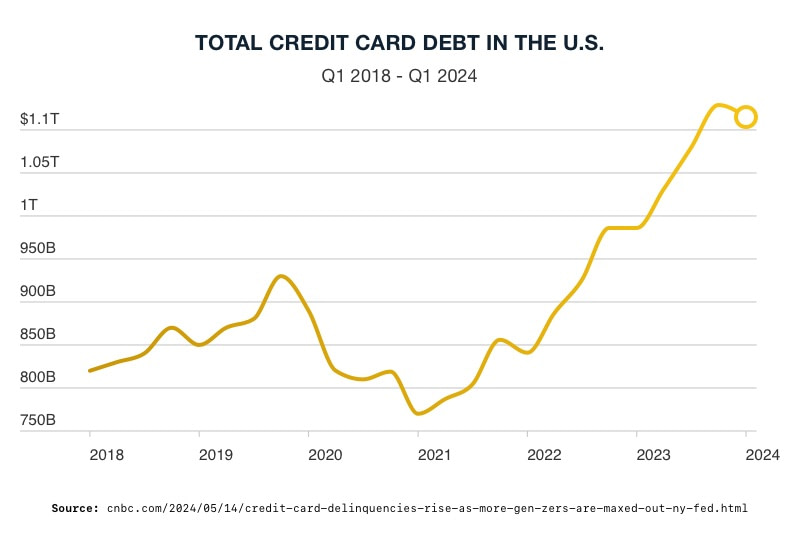
For the first time ever, American credit card debt has skyrocketed to a record-breaking $1 trillion. This alarming milestone sheds light on the increasing reliance on credit cards during these economically challenging times. Amidst rising living costs, credit cards have become lifelines for covering essential necessities such as food and fuel. The mounting debt has consequences for individuals and the country.

During the second quarter, credit card balances surged by a staggering $45 billion. They contributed to an overall household debt increase of $2.9 trillion since 2019. How consumers are managing debt is changing. A Bankrate.com analysis indicated that nearly 50% of individuals now carry debt from one month to the next. That marks a 39% increase from a year ago. The shift is tied to the surging cost of living. Credit cards are increasingly relied upon as a financial safety net.1

Credit Card Debt Sets New Record, Surpassing $1 trillion2

This surge in debt is occurring s as interest rates reach a 22-year high. The average credit card is now charging an interest rate of over 20%. This figure marks a new record, surpassing the previous high of 19% set in 1991. Credit Karma has seen credit scores fall by an average of 13 points since the Fed started raising interest rates.3

Matt Schulz is the chief credit analyst for LendingTree. He emphasized the gravity of the situation. He said, “One trillion dollars in credit card debt is staggering. Unfortunately, it’s only going to go up from here. What’s driving it is inflation, higher interest rates and just generally how expensive life is in 2023.”4

As the cost of living continues to rise, Bank of America is reporting a surge in hardship withdrawals from their 401(k) accounts. They reflect the growing financial distress faced by individuals. This trend raises concerns about the sustainability of household financial situations. Schulz said, “There’s also only so much hard debt that people can handle before delinquencies really spike.”5

The latest New York Fed report highlights that new delinquencies are climbing after a period of historic lows. Credit card delinquencies have reached levels not seen since the first quarter of 2012.

The resumption of student loan payments is expected to add to the stress. A New York Fed research group wrote “rising balances may present challenges for some borrowers, and the resumption of student loan payments this fall may add additional financial strain for many student loan borrowers.”6

Crisis Builds as Credit Card Debt Breaks $1 Trillion

Impact of Credit Card Debt

While interest rates have reached unprecedented highs, it appears that more debt is languishing unpaid for months on end. As a result, personal debt is growing exponentially. It becomes harder and harder to pay off. Americans are becoming trapped in everyday debt with limited relief in sight. The rise in debt coincides with dwindling savings and the depletion of pandemic-era financial cushions. Cash balances in checking and savings accounts among around 9 million Chase customers have hit their lowest levels since April 2020.7

Economists anticipate a cutback in consumer spending as debt mounts. This can hasten the onset of a recession since 70% of the economy depends on consumer spending.

Influential figures like Elon Musk have voiced their concerns. Musk notes, “For a lot of people, they’re just really breaking even every month. In fact, if you look at the rise in credit card debt, they are, in fact, not breaking even every month, like credit card debt is — is looking kind of scary.”8

With credit card debt reaching unprecedented levels, surging interest rates, and depleting savings, the financial strain is evident across the board. This surge in debt unfolds amidst an ongoing banking crisis. The potential for massive defaults could further disrupt bank stability. The need for a balanced portfolio is becoming vital in these uncertain times. As individuals seek ways to preserve their wealth, many are turning to gold as a means of safeguarding their financial security. A Gold IRA can protect your funds from the nation’s growing debt crisis. Contact American Hartford Gold today at 800-462-0071 to learn more.

Notes:
1. https://www.cnn.com/2023/08/08/economy/us-household-credit-card-debt/index.html
2. https://www.cnn.com/2023/08/08/economy/us-household-credit-card-debt/index.html
3. https://www.foxbusiness.com/economy/credit-card-debt-hits-1-trillion-first-time-ever
4. https://www.foxbusiness.com/economy/credit-card-debt-hits-1-trillion-first-time-ever
5. https://www.foxbusiness.com/economy/credit-card-debt-hits-1-trillion-first-time-ever
6. https://www.cnn.com/2023/08/08/economy/us-household-credit-card-debt/index.html
7. https://finance.yahoo.com/news/elon-musk-warns-peoples-credit-150612177.html
8. https://finance.yahoo.com/news/elon-musk-warns-peoples-credit-150612177.html

Buffet Indicator Flashes Stock Crash Warning

Buffet Indicator Flashes Stock Crash Warning
  • The “Buffet Indicator” is signaling that stocks are overvalued and due for a crash
  • The crash could be caused by overvaluation, recession, and shrinking money supply
  • Warren Buffet advises seeking safer long-term investments

Buffet Indicator Warning

As the Nasdaq saw remarkable gains exceeding 30%, and the S&P 500 has close to a 20% increase, an ominous warning emerged from the legendary investor Warren Buffett. His favorite market gauge, known as the “Buffett Indicator,” is flashing red signals. It is suggesting that stocks might be overvalued, and a potential crash is looming.1

The indicator just hit 171%. It reflects the exuberance of investors betting on artificial intelligence, anticipated rate cuts, and a soft-landing scenario. Given Buffett’s endorsement of this gauge as “probably the best single measure” of stock valuations, his concerns have garnered attention. He is not alone in expressing caution about the stock market’s current state. As experts echo this warning, it becomes crucial to take appropriate measures to safeguard your retirement funds.

US Total Market Capitalization as % of GDP2

The indicator takes the total market capitalization of all actively traded US stocks. It then divides that figure by the official estimate for quarterly gross domestic product (GDP). Investors use it to compare the overall value of the stock market to the size of the national economy.

Buffet said stocks would be fairly valued at a 100% reading. You should aim at buying them at 70% or 80%. He warned it would be playing with fire to purchase them close to the 200% mark.

The gauge today is calculated using the Wilshire 5000 Total Market Index for the value of all traded stocks. The index jumped 22% this year. Market capitalization is now at $46.32 trillion.3 That was divided by the GDP estimate of $26.84 trillion from the Bureau of Economic Analysis. The result was a startling measure of 171%. The gauge proved accurate last year. It plummeted from over 210% in January 2022, to below 150% by September as stocks fell accordingly. 4

Reasons for a Crash

There are several reasons why the market could crash.

Overinflated valuations – as the Buffet Indicator show, stocks are expensive on an overall basis. Besides a period from 2020 to 2021, stocks haven’t been priced so high since the dot-com bubble in the early 2000s.

Recession forecasts – the Fed is saying a recession can be avoided and a ‘soft landing’ achieved. However, a recent Bloomberg survey found that 63% of economists still expect an economic downturn within the next 12 months. The stock market often begins to decline even before the economy does.5

Money supply – the M1 money supply includes all physical currency in circulation. The M2 money supply adds in deposits in savings or money market accounts. Since 1870, every single time the M2 money supply has fallen by 2% or more, a major economic downturn followed. In three cases, depressions occurred, including the Great Depression. As of now, the M2 money supply has dropped by more than 4%. If you believe history over economists, recession in on the way.

Warren Buffet and his namesake indicator aren’t alone in their negative forecast. John Hussman is President of Hussman Investment Trust and an asset-bubble expert. He thinks the S&P 500 risks a 64% collapse. This is due to extreme valuations and “unfavorable market internals.”

Hussman said stocks enjoyed an impressive rally in 2023. The S&P 500 has rallied 19% so far this year. That takes its gains since the end of 2008 – the year of the global financial crisis – to more than 400%. The price-earnings ratio of the index, one of the valuation metrics tracked by investors, has climbed to about 26 from last year’s lows near 19.6

Hussman attributes the rise to cooling inflation, fading recession fears, and growing interest in AI. He concludes a steep plunge in stocks is necessary to get market conditions back to normal. He summed up his prediction by saying, “Yes, this is a bubble in my view. Yes, I believe it will end in tears.”7

“Rich Dad, Poor Dad” author Robert Kiyosaki also warned about a collapsing market. He tweeted, “too many signs point to a severe stock market crash. If your future depends on stocks and bonds, please be careful, possibly ask for professional advice.” He continued, “Afraid depression coming.”8

Buffet Indicator Flashes Stock Crash Warning

What to Do

When it comes to protecting your financial future, forewarned is forearmed. Many are riding the current stock market wave, convinced good times are here again. But some of the world’s most preeminent investors are warning otherwise. Buffet says forget trying to time the market. He’s putting Berkshire Hathaway’s money in cash and long-term investments. The idea is to focus on the future. And one of the most secure long-term assets is physical gold. A Gold IRA from American Hartford Gold can protect the value of your portfolio from a crashing stock market. Contact us today at 800-462-0071 to learn more.

Notes:
1. https://www.fool.com/investing/2023/07/16/reasons-stock-market-sink-2nd-half-warren-buffett/
2. https://www.fool.com/investing/2023/07/16/reasons-stock-market-sink-2nd-half-warren-buffett/
3. https://markets.businessinsider.com/news/stocks/warren-buffett-indicator-ai-tech-stock-market-outlook-forecast-crash-2023-7
4. https://markets.businessinsider.com/news/stocks/warren-buffett-indicator-ai-tech-stock-market-outlook-forecast-crash-2023-7
5. https://markets.businessinsider.com/news/stocks/warren-buffett-indicator-ai-tech-stock-market-outlook-forecast-crash-2023-7
6. https://markets.businessinsider.com/news/stocks/stock-market-crash-sp-500-64-percent-john-hussman-bubble-2023-7
7. https://markets.businessinsider.com/news/stocks/stock-market-crash-sp-500-64-percent-john-hussman-bubble-2023-7
8. https://markets.businessinsider.com/news/stocks/kiyosaki-rich-poor-dad-stock-market-outlook-crash-economy-depression-2023-7

Recession Risk Increases with Latest Rate Hike

Recession Risk Increases with Latest Rate Hike
  • The Fed approves 11th rate hike since 2022
  • Economy faces rate-driven recession risks
  • Gold prices surge amid rate hike uncertainties

Fed Issues Another Interest Rate Increase

The Federal Reserve approved the 11th interest rate hike since March 2022. The benchmark borrowing rate is now at its highest level in twenty years. While investors are hoping it will be the last one for a long time, the Fed is making no such promises. Instead, the economy could soon be facing a rate-driven recession.

Last month, the Fed held interest rates steady in a range between 5% and 5.25%. That was the first pause after 10 increases raised them from near zero. The market has already priced in this latest hike. Wall Street is riding a wave of optimism despite warnings of more hikes from the central bank. The Dow Jones Industrial Average jumped more than 5% over the past month alone.1

There is a growing consensus among investors that the Fed has gone far enough and could unnecessarily push the economy into recession. The annual inflation rate declined to 3% in June, down from 9.1% a year ago. Kathy Jones is the Chief Fixed Income Strategist at Charles Schwab. She said, “The Fed should be done already. They’re walking a difficult line here. To me, the decision would be, hey, we’ve done enough for now, and we can wait and see. But apparently the folks at the Fed think they need one more at least.”2

Federal Reserve officials obviously have a different opinion. Core inflation, which excludes volatile food and energy prices, posted its smallest monthly increase in more than two years in June. It rose less than .2% from the prior month. Fed officials have been counting on a slowdown in core inflation because goods and shelter prices are slowing sharply.

But overall hiring and economic activity has been too strong for central bank officials to support this being the last hike. The Fed is going to take a data-driven approach whether to continue raising interest rates. Officials want to see evidence that economic activity is slowing, even if inflation subsides somewhat faster than projected.

Fed Chair Powell said that the central bank is not yet fully confident that inflation is defeated. Even if rates don’t rise again, they will most likely stay elevated for a long while. Powell said, “We intend to keep policy restrictive until we’re confident inflation is coming down sustainably to our 2% target, and we’re prepared to further tighten if that’s appropriate.” Powell pointed out that core inflation is still running above 3%.3

Recession Risk Increases with Latest Rate Hike

Future Rate Hikes

Powell indicated that the central bank is willing to wait things out as it follows the latest data. “We have to be ready to follow the data, and given how far we’ve come, we can afford to be a little patient, as well as resolute,” he said.4

The Fed will determine future rate increases meeting by meeting. Chair Powell said the FOMC gave no guidance on the potential for further rate increases at future meetings.

“We’re going to be going meeting by meeting and as we go into each meeting, we’re going to be asking ourselves the same questions. So, we haven’t made any decisions about any future meetings, including the pace at which we consider hiking, but we’re going to be assessing the need for further tightening that may be appropriate … to return inflation to 2% over time.”5

Fed Guided by History

Inflation is at its most severe levels since the 1980s. Back then, the Fed backed off the inflation fight too soon. As a result, the economy suffered through a stagflation of high prices and weak growth.

“The worst outcome for everyone, of course, would be not to deal with inflation now [and] not get it done. Whatever the short-term social costs of getting inflation under control, the longer-term social costs of failing to do so are greater and the historical record is very, very clear on that,” said Powell.6

Gold & Rates

In the middle of July, gold hit its highest price since May.

Golds hit its highest price since may7

Traditionally, gold has an inverse correlation with the US dollar. As inflation recedes, investors expect a halt in rate hikes. As result, the dollar becomes less attractive for market participants. When this happens, people turn to assets like gold. Plus, news about a potential new gold-back currency created by the BRICS alliance, has also supported the demand for gold.

Gold growth may stall if there are more hikes. However, this only a near future consideration. It’s expected that towards the end of 2023 and in 2024, as the Fed’s rate cycle comes to an end and the US economy slows down, the dollar will weaken against other major currencies. This could potentially result in a growth of gold prices. Gold increases during times of recession according to historical data. With the future of rate hikes, and in turn, the economy, up in the air, those with retirement funds can investigate a Gold IRA from American Hartford Gold. It can protect your portfolio from the damage caused by interest rate increases. Contact us today at 800-462-0071 to learn more.

Notes:
1. https://www.cnbc.com/2023/07/25/heres-what-to-expect-from-the-federal-reserve-meeting-wednesday.html
2. https://www.cnbc.com/2023/07/25/heres-what-to-expect-from-the-federal-reserve-meeting-wednesday.html
3. https://www.cnbc.com/2023/07/26/live-updates-fed-decision-july-2023.html
4. https://www.cnbc.com/2023/07/26/live-updates-fed-decision-july-2023.html
5. https://www.cnbc.com/2023/07/26/live-updates-fed-decision-july-2023.html
6. https://www.cnbc.com/2023/07/26/live-updates-fed-decision-july-2023.html
7. https://www.kitco.com/commentaries/2023-07-25/Gold-reaches-its-2-month-high-before-the-Fed-Meeting-What-can-we-wait-for-after-that.html

Corporate Debt Defaults Threaten 401(k)s

  • Almost $1 trillion in corporate debt defaults are predicted by Bank of America
  • The bankruptcies are driven by record interest rates and a shrinking economy
  • The surge in defaults can bring down stock prices and devalue retirement portfolios

Surging Debt Defaults

The growing threat of corporate debt defaults poses a significant risk to retirement funds. Experts are bracing for a tsunami of defaults as credit conditions tighten and companies struggle to manage heavy debt loads. The impact of rising interest rates and credit downgrades is already being felt. The number of troubled companies facing bankruptcy is swelling. The economic consequences could surpass those of previous financial crises. Fortunately, there are actions that can defend the value of retirement funds.

The credit crunch and impending recession could result in $1 trillion of corporate debt defaults according to Bank of America. They say a 15% corporate default rate is a distinct risk. B of A calculates that even an 8% default rate could translate into $920 billion of losses.1

US corporate debt defaults in 2023 have already surpassed last year’s totals. Fifty-five American firms have defaulted on their debt so far. That’s a 53% increase from all of 2022. Moody’s Investors Service says global debt defaults could keep surging as financial conditions continue to tighten. The global default rate could reach 13.7%, surpassing the 2008 financial crisis. And Deutsche Bank see defaults hitting 11.3%. That is only slightly lower than the all-time-high seen during the Great Recession.2

Corporate Debt Defaults Threaten 401(k)s3

“It’s safe to bet there will be more defaults,” says Mark Hootnick. He is the co-head of capital transformation and debt advisory at Solomon Partners. Until now, “we’ve been in an environment of incredibly lax credit, where, frankly, companies that shouldn’t be tapping the debt markets have been able to do so without limitations.”4

At the moment, troubled companies are being affected. Regional financial institution Silicon Valley Bank, retail chain Bed Bath & Beyond and regional sports network owner Diamond Sports are among the largest bankruptcy filings so far this year, according to S&P Global Market Intelligence. But experts expect even stable companies to run into trouble when it comes time to refinance due to high interest rates.

Causes of Corporate Debt Default

The debt defaults are caused by several factors. Companies are facing uncertain economic conditions and heavy debt loads. Refinancing that debt is becoming more challenging. High interest rates are making new debt very expensive. In addition, banks are tightening credit conditions since the collapse of Silicon Valley Bank. Companies are also facing downgrades to junk credit ratings, resulting in higher borrowing costs.

“Capital is much more expensive now,” said Mohsin Meghji, founding partner of restructuring and advisory firm M3 Partners. “Look at the cost of debt. You could reasonably get debt financing for 4% to 6% at any point on average over the last 15 years. Now that cost of debt has gone up to 9% to 13%.”5

Corporations shouldn’t expect debt relief anytime soon. The Federal Reserve indicated at least two more rate hikes this year. They aim to keep raising rates until their 2% inflation target is hit.

NY Fed US Recession Probability Index predicting 68% of recession by April 2024.6 Recession risk is fueled by continued rate hikes. The recent banking crisis also increased recession risks. Banks are taking losses on their dropping bond portfolios and steep deposit flight. Bank of America analysts say when the recession arrives doesn’t matter. Even if it doesn’t start until 2024, the default cycle will only be delayed, not canceled.

S&P Estimate Corporate Default Rates to rise by 20243

Dangers of Default

Rising corporate debt defaults present a significant risk to the global economy. The impact of rising interest rates is yet to be fully felt. While some companies may be able to navigate through the challenges with debt restructuring, not all will survive.

Corporate debt defaults most often lead to an increased desire to sell shares and a consequential drop in stock prices. The desire to sell is fueled by several reasons. Shareholders lose confidence in the stock as they perceive financial distress or mismanagement. And the indication of higher risk has investors demanding higher returns for holding the stock. This can lead to a decrease in the stock’s price to adjust for the increased risk. Additionally, credit rating downgrades and liquidity concerns add more selling pressure. These negative effects extend beyond the defaulting company. Overall market sentiment may also be impacted, causing broader declines in other companies’ stock prices.

Thus, it can be seen, corporate debt defaults can drive down stock prices. Retirement funds that are composed of securities are vulnerable to significant losses. To protect the value of such funds, their owners can diversify their holdings with safe haven assets. Precious metals such as gold can hold their value as bankruptcies pull down the stock market. A Gold IRA from American Hartford Gold is structured to protect portfolio value in the face of a growing debt crisis. Contact us today at 800-462-0071 to learn more about how to safeguard your future.

Notes:
1. https://markets.businessinsider.com/news/bonds/recession-credit-crunch-us-economy-debt-default-bank-of-america-2023-5?utm_medium=ingest&utm_source=markets
2. https://markets.businessinsider.com/news/bonds/corporate-debt-defaults-recession-credit-crunch-financial-crisis-default-rate-2023-7
3. https://www.reuters.com/markets/long-feared-corporate-debt-woes-start-hit-home-2023-07-18/
4. https://www.cnbc.com/2023/06/24/high-interest-rates-economic-uncertainty-boost-corporate-defaults.html
5. https://www.cnbc.com/2023/06/24/high-interest-rates-economic-uncertainty-boost-corporate-defaults.html
6. https://markets.businessinsider.com/news/bonds/recession-credit-crunch-us-economy-debt-default-bank-of-america-2023-5?utm_medium=ingest&utm_source=markets

When Will the Dominance of the US Dollar Collapse?

The Date When US Dollar Dominance Will Collapse
  • A former CIA advisor predicted that US Dollar hegemony will end on August 22nd
  • On that date, the BRICS alliance will announce a rival gold-backed currency
  • As the new currency is adopted, analysts predict the value of the dollar will plummet and gold will surge

End Date of US Dollar Supremacy Predicted

Before summer is over, US dollar supremacy will disintegrate. That is, according to James Rickards. He is an investment banker and former CIA and Defense Department advisor.
Rickards predicts that the status of the US dollar as the world’s reserve currency and medium for exchange will formally collapse on August 22nd. On that date, the BRICS alliance will announce the launch of their new currency, signaling the end of the American empire.

Rickards isn’t alone in his assessment. Many analysts have been speculating about a new global currency to challenge the US dollar’s role as the world’s reserve currency. In late March, Former Goldman Sachs chief economist Jim O’Neill said that the US dollar’s dominance is destabilizing global monetary policies. He added that a BRICS currency, challenging the U.S. dollar’s dominance, would bring stability to the global economy.

Reasons for Collapse

Rickards bases this prediction on several factors. One is the weaponization of the dollar against Russia amid the conflict in Ukraine. Other countries saw what happens if they run afoul of US policy. They want to take preemptive measures to avoid the impact of sanctions. By abandoning the dollar, the potency of sanctions is diluted.

A second factor is the United States’ $31 trillion national debt. Economists foresee a time where interest on the astronomical debt consumes the entire budget. The US would enter a ‘doom loop’ of endless borrowing at higher and higher interest rates. With no money to spend, the economy will collapse, and the dollar will become worthless.

And a third, most notable factor, is the BRICS group plan to enter the next phase of dedollarization – the launch of a rival currency.

“On August 22, about two-and-a-half months from today, the most significant development in international finance since 1971 will be unveiled,” Rickards wrote. He cites that date because it is when the BRICS Leaders Summit will unveil plans for substituting the dollar in global trade. Of note, August 22, 1971, was the day the US dropped the gold standard.1

Rickards believes the rollout of a major new currency could weaken the role of the dollar. The US dollar would be displaced as the dominant trade and reserve currency. This change could occur within just a few years. The currency shift would affect world trade, direct foreign investment and investor portfolios in “dramatic and unforeseen ways.” Rickards warned the currency could set off an “unprecedented geopolitical shockwave.”

The Date When US Dollar Dominance Will Collapse

Who Are the BRICS?

At its core, the BRICS alliance consists of Brazil, Russia, India, China, and South Africa. Eight other countries have applied for membership. Twelve more have expressed interest in joining the bloc. Of note, Saudi Arabia is one of those countries. Saudi Arabia helped make the US dollar the supreme currency through the petrodollar system. Requiring oil to be traded exclusively in dollars cemented US dominance. With Russia and Saudi Arabia as BRICS members, two of the three largest energy producers with be aligned (the US is the other member of the energy Big Three). The new currency could seize the preeminent role in the energy trade and the benefits that go along with it.

The BRICS countries make up 30 percent of the world’s surface. They produce 50 percent of the globe’s wheat and rice. And they control 15 percent of the planet’s gold reserves. It accounts for 40 percent of the world population. Economically, the BRICS control almost a third of the world’s GDP.

In other words, the BRICS are a substantial and credible threat to Western hegemony. Their new currency has the resources and infrastructure to succeed. And as it is embraced by the globe, it will be able to eventually overthrow the dollar’s preeminence.

Rickards explains that the new currency must offer a safe store of value to be successful. For people to adopt it, the currency should rival the security found in the US bond market. To achieve this credibility, the BRICS are proposing to tie their currency to gold.

He sees “this entire turn of events—introduction of a new gold-backed currency, rapid adoption as a payment currency, and gradual use as a reserve asset currency—will begin on August 22, 2023, after years of development.” The dollar will be effectively removed from a large portion of global trade. Its value will decrease. The effects of which could result in collapsing stock prices, hyperinflation, and a shrinking economy. 2

Gold

The BRICS currency plan could spark a new bull market for gold. The Russian government confirmed the new currency will be backed by gold.

Gold has been playing an outsize role in the dedollarization movement since 2022. Central banks worldwide have been buying gold at a historic pace to diversify their reserves away from the US dollar, as seen below:

Central Bank Demand 3

Analysts see a gold-backed currency as the next natural step in the new currency’s evolution. Many see China’s record gold purchases as an attempt to bring credibility to the yuan.

The global fiat money system could be in for a major disruptive shock. A gold-backed currency may lead to a sharp devaluation of many fiat currencies. As a result, it could catapult up goods prices on those fiat currencies.

The launch of a gold-back BRICS currency could fundamentally shift the entire global economic order. Uncertainty will increase as the dollar loses its dominant role. And assets denominated in dollars, like stocks and bonds, face a major devaluation. Retirement funds that aren’t diversified away from such assets are sitting on huge potential losses. For those who want to secure the value of their portfolios, now is the time to investigate gold. A Gold IRA from American Hartford Gold can protect the value of your funds and reap the rewards of a rising gold market. Learn more before August 22nd arrives. Call us today at 800-462-0071.

Notes:
1. https://mronline.org/2023/06/09/ex-cia-advisor-predicts-date-when-u-s-dollar-hegemony-will-collapse/
2. https://mronline.org/2023/06/09/ex-cia-advisor-predicts-date-when-u-s-dollar-hegemony-will-collapse/
3. https://sophisticatedinvestor.com/wp-content/uploads/2023/07/COMM-central-bank-demand-04062023.png

Bursting Stock Market Superbubble Signals 70% Chance of Stock Crash

Bursting Superbubble Signals 70% Chance of Stock Crash
  • Investment guru Jeremy Grantham warns there is a 70% chance of a stock market crash after the ‘superbubble’ bursts
  • Stocks will drop to their true value after too much money in the system overinflated prices across sectors
  • Precious metals can safeguard portfolio value and position you for post-crash buying opportunities
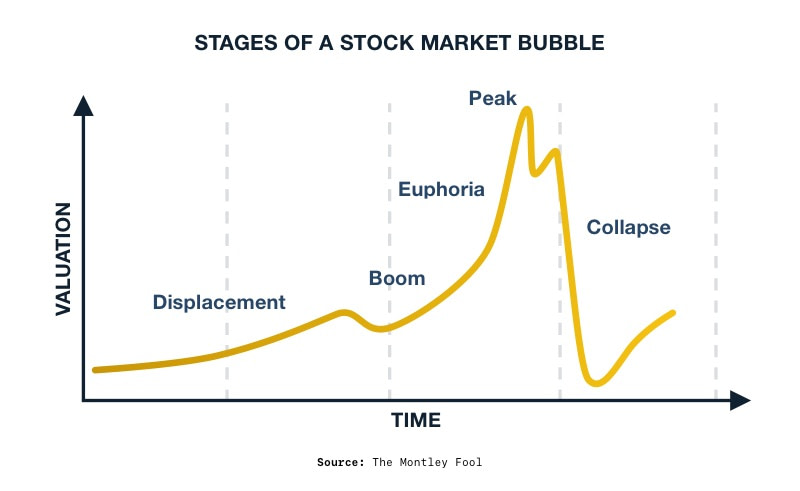
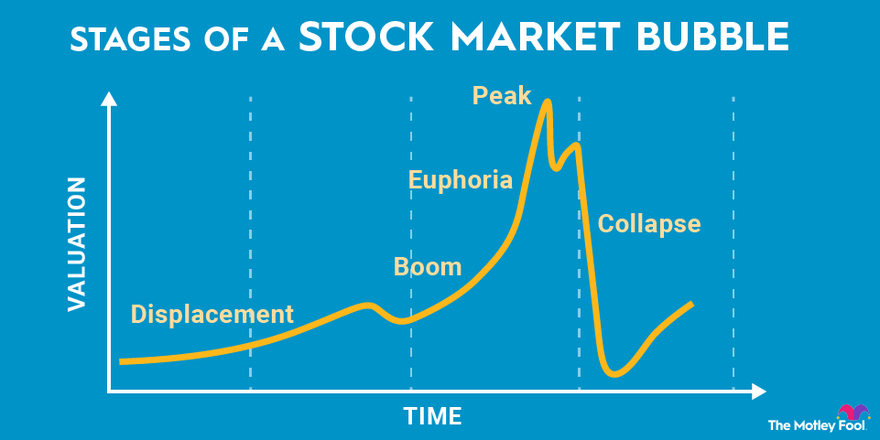
Superbubble Warning Legendary investor Jeremy Grantham warns that the current stock market is on the verge of a major crash. According to Grantham, there is a 70% chance of a crash occurring within the next few years. He believes the market is experiencing a “superbubble” on the brink of implosion.1 But what exactly is a superbubble? A market bubble occurs when prices are too high based on historical metrics. A superbubble takes this concept to an extreme level. It refers to a situation where excessive speculation sends asset prices to multiple times their true value. Superbubbles have led to catastrophic market crashes in the past. These include the stock market crash of 1929, the 1970s economic downturn, and the dot-com bubble of 2000. The events resulted in drastic drops in stock prices, ranging from 50% to a staggering 90%.2 Reasons for Warning A combination of factors is fueling this current superbubble. The primary cause was too much money being pumped into the financial system. This abundance of dollars flooded into various asset classes, commodities, bonds, and goods and services. Easy access to fiat currency over the past 15 years, especially since the 2008 financial crisis, created this liquidity. The response to the 2020 pandemic further accelerated this trend. Reckless government spending and central bank printing becoming the norm. As seen in the chart below: Total Assets of the Federal Reserve 3 Grantham had previously predicted the dot-com crash and the housing bubble implosion. He diagnosed a “superbubble” spanning stocks, housing, and commodities in January 2022. He declared last September that it was likely in its final stages, and a historic crash seemed imminent. The S&P 500 and Nasdaq ended the year deeply in the red — but have rallied 16% and 32% respectively this year. The recent AI-driven surge in the stock market is providing a boost. But Grantham argues that it won’t prevent the superbubble from bursting. It is only delaying the inevitable. He suggests that the S&P 500 could experience a brutal 44% drop from its current level.4 Grantham points out that there are striking similarities between the current situation and previous crashes. He thinks conditions resemble the ones in 1929 and 2000. He sees a dangerous mix of overvalued stocks, bonds, and housing, combining with a commodity shock and a hawkish Federal Reserve. The collapse of a superbubble occurs in several stages. First, there is a setback, followed by a slight rally. Finally, the market reaches its low point as fundamentals break down. The S&P 500 exited the longest bear market since 1948 at the beginning of June. Some analysts, such as those from HSBC and UBS, are already predicting a painful second half of 2023. They see an economic downturn deflating the AI boom and exposing the vulnerabilities of the superbubble. UBS analysts noted equity prices can fall as they confront “slowing growth and stickier inflation.”5 Even though the stock market has experienced a rally in recent months, it doesn’t necessarily mean that the bear market is over. History has shown that bear markets can have temporary rallies before experiencing further downside. Bursting Superbubble Signals 70% Chance of Stock Crash How to Prepare Considering these warnings, it’s crucial to be cautious and prepared for a potential market crash. Grantham himself has bet on bargain assets and positioned against expensive growth stocks. Some analysts see the upcoming downturn as a generational opportunity to make money. But it is vital to preserve your wealth to take advantage of buying opportunities. In times of market uncertainty, assets like gold have often been considered safe havens. Looking back at previous crashes, gold prices experienced notable increases. That’s because investors sought safe-haven assets. For example, during the crash of 1929, gold prices rose by about 27.5% within a year. Similarly, during the dot-com bubble burst in 2000, gold prices increased by approximately 11%. Based on his track record, Jeremy Grantham’s warnings should be heeded. Ultimately, the fate of the current superbubble rests on economic conditions, investor sentiment, and market dynamics. As the saying goes, “history doesn’t repeat itself, but it often rhymes.” By learning from past market crashes, you can navigate the uncertain waters and make informed decisions to safeguard your wealth. Now is the time to carefully evaluate your portfolio. Is it diversified and protected against risk and loss? To learn more how a Gold IRA from American Hartford Gold can secure against a bursting bubble, talk to us today at 800-462-0071.
Notes: 1. https://www.businessinsider.in/stock-market/news/the-stock-market-has-70-chance-of-crashing-in-a-few-years-according-to-legendary-investor-jeremy-grantham/articleshow/101492341.cms 2. https://www.moneyshow.com/articles/tradingidea-59462/explained-the-american-economy-is-now-a-super-bubble/#:~:text=A%20superbubble%20is%20when%20asset,due%20to%20extreme%20speculative%20conditions. 3. https://www.federalreserve.gov/monetarypolicy/bst_recenttrends.htm 4. https://markets.businessinsider.com/news/stocks/jeremy-grantham-gmo-superbubble-ai-stocks-housing-market-bubble-crash-2023-7 5. https://www.foxbusiness.com/markets/us-stock-market-faces-more-challenges-second-half-2023-ubs-warns

Congress Pushes Back Against the Digital Dollar

Congress Pushes Back Against the Digital Dollar
  • A Central Bank Digital Currency (CBDC), aka the digital dollar, would be a national currency controlled by the Federal Reserve
  • Citing threats to personal and economic freedom, Congress is pushing back against the implementation of a CBDC
  • Gold is proving itself to be an effective defense against the threats posed by CBDCs
Recognizing the Central Bank Digital Currency Threat Congress is on the same page as the American people when it comes to the ‘digital dollar.’ Both view the electronic currency as a pitfall rather than a prize. Elected officials are pushing back against plans for a central bank digital currency (CBDC). They are driven by concerns over privacy and economic freedom. The Cato Institute think tank surveyed Americans on CBDCs. The survey showed only 16% favor adopting a CBDC while 34% oppose. But that opposition increases after learning about the potential risks of a CBDC, as seen in the chart below. Percent who oppose CBSCs if it meant....1 Contrary to supporting arguments, CBDC is not a just another form of money. A CBDC is a digital national currency. But it is very different from existing digital forms of the US dollar and cryptocurrency. Relying on cryptography to store and exchange value, cryptocurrency is independent from government. The rise of CBDCs could require the end of cash and cryptocurrency. Unlike cryptocurrency, a CBDC solidifies government control over money and payments. A central bank like the Federal Reserve creates the CBDC. They then handle and control all transactions. By extension, the government can then determine who gets to use money and precisely how they use it. True, paper money is a Federal Reserve liability. But the government can’t control dollar bills once they are in circulation. A CBDC also unravels the current public-private partnership between regulators and banks. A CBDC can remove banks from the financial system. And when the government is the only bank in the land, getting a loan could become a political as well as an economic decision. By automatically monitoring transactions, CBDCs are de facto surveillance tools. China is already using their ‘digital yuan’ as a tool to control their population. Opposition to CBDC Rep Alex Mooney recently introduced H.R. 3712, the Digital Dollar Pilot Prevention Act. The bill closes the Federal Reserve’s Central Bank Digital Currency pilot program loophole. Rep. Mooney said, “CBDCs would threaten the liberties of law-abiding Americans and are being used by authoritarian countries right now to crack down on dissent.”2 Republicans stated the Federal Reserve needs Congressional approval to issue a CBDC. The pilot program gained attention last year after the Fed partnered with major banks to test potential CBDCs. Now, Republicans want a law to prevent the Fed from issuing a CBDC under the guise of a ‘pilot program.’ The National Association of Federally-Insured Credit Unions (NAFCU) declared support for Rep. Mooney’s bill. NAFCU said the Federal Reserve should halt all studies into CBDCs until there are clear regulatory guidelines. Such guidelines should be written by Congress and stakeholders like banks and credit unions. NAFCU fears a CBDC could upend the payments industry. Critics say a CBDC makes the Federal Reserve both a regulator and a competitor for deposits. Some financial institutions fear a massive bank run as investors convert their deposits to CBDCs. Governor Ron DeSantis announced legislation in March against CBDCs. The bill prohibits adopting the use of CBDC as money within Florida’s Uniform Commercial Code. DeSantis said, “The Biden administration’s efforts to inject a Centralized Bank Digital Currency is about surveillance and control.”3 Congress Pushes Back Against the Digital Dollar Gold to the Rescue A CBDC amplifies power of the Federal Reserve to an unprecedented level. In the name of stimulating the economy, the Fed could use CBDCs to stop savings and retirement planning. They’d do this with negative interest rates or issuing money that expires if it isn’t spent within a limited amount of time. A CBDC lets the Fed create or remove money from the system. There would be no need for their current ad hoc interest rate hikes to try and tame inflation. With a click, they could simply erase the oversupply of money from your savings. In contrast, gold stands as a safeguard for personal and financial freedom. Physical gold offers tangible benefits. It is a secure, long-term store of value. Gold provides a hedge against inflation and currency devaluation. Gold ownership remains confidential, protecting personal privacy. Moreover, gold offers independence from cyber threats and technological failures. Individuals can protect their financial destiny and personal freedom by diversifying with gold. Contact us at 800-462-0071 to learn how a Gold IRA can protect your retirement savings from the dangers of the digital dollar.
Notes:
1. https://www.cato.org/survey-reports/poll-only-16-americans-support-government-issuing-central-bank-digital-currency#68-americans-would-oppose-cbdc-government-could-monitor-what-people-buy 2. https://mooney.house.gov/congressman-mooney-introduces-the-digital-dollar-pilot-prevention-act/ 3. https://www.flgov.com/2023/03/20/governor-ron-desantis-announces-legislation-to-protect-floridians-from-a-federally-controlled-central-bank-digital-currency-and-surveillance-state/

Student Loan Debt Impact on Retirement Funds

Student Loan Debt Impact on Retirement Funds
  • The Federal pause on student loan repayment is coming to an end
  • The Supreme Court is deciding the legality of Biden’s loan forgiveness
  • Economic hardship caused by renewed payments may be enough to tip the economy into recession
Student Debt Comes Due America’s higher education bill is coming due, and the economy may pay the price. For more than three years, federal student loan borrowers haven’t had to make monthly payments. Those payments hover between $200 and $300. All told, borrowers are set to resume paying about $10 billion a month. As we speak, the Supreme Court is weighing the merits of Biden’s loan forgiveness. While politicians and borrowers await the Supreme Court’s ruling, analysts fear the economy will suffer, along with retirement funds, no matter what the Court decides.1 Outstanding US Student Debt 2 Student Debt Paused In March 2020, President Trump implemented a student-loan payment pause to give relief during the pandemic. Biden has continued to extend the pause. He most recently extended it 60 days after June 30. In other words, 60 days after the Supreme Court issues a final decision on the legality of Biden’s plan to cancel up to $20,000 in student debt. This most recent extension will most likely be the last. The end of the pause was written into the debt ceiling deal with Speaker of the House McCarthy. Some economists saw the pause as a boon to the economy. The Education Department estimated the pause put $5 billion back in borrowers’ pockets. Money that would have gone to debt payments went into consumer spending instead. Marshall Steinbaum is an economics professor at University of Utah. He said, “it’s pretty clear the payment pause has been very stimulative to the macroeconomy.” Conversely, he followed up by saying the government is going to be put in the position of trying to collect debt that can’t be repaid. And that squeezing borrowers will be bad for the economy. Resulting in what Steinbaum called, “a pretty severe fiscal contraction.”3 Supreme Court Decides Eight million borrowers stand to receive loan forgiveness. The Supreme Court will issue a decision about the legality of the student debt relief this month. Lawmakers aren’t waiting for that decision. They’ve already passed a bill to overturn Biden’s debt relief and end the payment pause. Student Loan Forgiveness Plan4 Tipping the Scales into Recession The economy, while fragile, is recovering from the pandemic. Some analysts think resuming student loan payments may jeopardize that recovery. Mark Zandi is the Chief Economist at Moody’s Analytics. He said, “In a typical economy, the impact of restarting payments wouldn’t tip the US into recession. But in the current environment with the economy as weak as it is, recession risks as high as they are, a couple of tenths of percent can matter.”5 The odds of entering a recession are being debated now. A resilient labor market and strong consumer spending, even after aggressive rate hikes, are giving some hopes of a ‘soft landing.’ Deutsche Bank holds no such hopes. They’ve declared that an economic downturn is 100% inevitable. They base this opinion on a few factors. The short-term benchmark fed funds rate stands at the highest level since 2006. But inflation’s still twice the Fed’s goal. Fed Chairman Jerome Powell warned that more rate hikes will likely be necessary to further cool inflation. Deutsche Bank thinks a recession is needed to finally break ‘sticky’ inflation. Their chief economist stated, “Avoiding a hard landing would be historically unprecedented.” 6 Goldman Sachs sees the end of the pause as a break-even situation. If the Court rules in favor of forgiveness, Goldman Sachs estimates $400 billion in loan balances would be erased. If the Court rules against relief, Goldman predicts the decrease in disposable income would create a drag on public spending. Their calculations show a return to loan payments will equal the loss of consumer spending.7 Borrowers themselves are much less optimistic. A Credit Karma survey found that 43% of borrowers do not feel financially stable and 21% had no savings. A similar survey found that 53% of borrowers said their financial stability depends on loan forgiveness or the federal forbearance period. 26% were using money that would have gone to loan payments for bills and necessities.8 The Federal Reserve Bank of New York found missed debt payments are higher than before the pandemic. This could be a sign of more financial problems for borrowers once the federal forbearance ends. Student Loan Debt Impact on Retirement Funds Economic Impact of Repayment While general spending may decrease across the board, retailers will be particularly hard hit. UBS and JPMorgan both warn of a coming “ice-age for retail” because it caters to millennials, the largest holders of student loan debt. The resumption of student loan payments alone won’t crash the economy. But they may be the straw that breaks the camel’s back and pushes the US into a recession. A recession would bring increased unemployment and reduced corporate earnings. Stock prices, and in turn, retirement funds, could drop as a result. Government relief or not, that bill is going to be paid one way or another. Someone else’s education may result in a drop in your retirement savings. To preserve the value of your retirement funds before this happens, investigate the benefits of a Gold IRA. Contact an American Hartford Gold specialist at 800-462-0071 to learn how you can protect your savings.
Notes:
1. https://www.foxbusiness.com/economy/student-loan-repayments-slam-big-name-retailers-fall 2. https://finance.yahoo.com/news/student-loans-how-will-the-restart-in-payments-affect-the-economy-experts-are-split-182305006.html 3. https://www.businessinsider.com/what-will-happen-to-economy-when-student-loan-payments-resume-2023-5 4. https://finance.yahoo.com/news/student-loans-how-will-the-restart-in-payments-affect-the-economy-experts-are-split-182305006.html 5. https://www.businessinsider.com/what-will-happen-to-economy-when-student-loan-payments-resume-2023-5 6. https://www.usatoday.com/story/money/economy/2023/06/15/recession-inevitable-deutsche-bank/70327467007/ 7. https://finance.yahoo.com/news/student-loans-how-will-the-restart-in-payments-affect-the-economy-experts-are-split-182305006.html 8. https://finance.yahoo.com/news/student-loans-how-will-the-restart-in-payments-affect-the-economy-experts-are-split-182305006.html

Rate Pause: Not Worse, But Not Better

Rate Pause: Not Worse, But Not Better
  • The Federal Reserve opted not to raise interest rates at their most recent meeting
  • The pause is most likely temporary, with the Fed suggesting future rate hikes later this year
  • Pause or no pause, interest rates will continue to inflict pain on Americans
Fed Pauses Rate Hikes After raising rates at its fastest pace in 40 years, the Federal Reserve announced they are hitting the pause button on hikes for now. This marks an end to 10 straight increases. Beyond failing banks and bear markets, the Fed’s inflation taming policy has impacted regular Americans. Rate hikes have driven borrowing costs above 5%. The cost of auto loans, credit cards, and mortgages have all risen higher – leaving consumers with less cash to spend. So, while this pause won’t add to the pain, it is unlikely to help. Federal-Funds Rate Target1 The pause may even be short lived. The Fed left a return to hikes on the table, saying additional rate hikes are probable later this year. The decision to skip a rate increase this meeting was unanimous among officials. The Fed will assess further information and its impact on monetary policy before making future moves. Economic indicators, including the job market and credit conditions, will play a crucial role in determining the size and timing of future rate hikes. Tightening lending standards by banks and potential limitations on accessing credit could dampen economic activity, hiring, and inflation. Some analysts think renewed rate increases could be disastrous. High rates exposed vulnerabilities in the financial system. Resuming rate hikes could shake public confidence by causing more damage like failing banks. Or they could trigger a something that sets the economy into a tailspin. Laura Rosner-Warburton is a senior official at MacroPolicy Perspectives and a former staffer at the New York Fed. She said, “Keeping rates at these levels will pull more skeletons out of the closet.”2 A Pause is No Help Greg McBride is the Chief Financial Analyst at Bankrate.com. “A pause won’t bring borrowing rates lower, particularly for variable rate debt such as credit cards and home equity lines of credit that have increased in step with the Fed’s 10 previous interest rate hikes,” McBride said. Right now, the average APR on a new credit card offer is a towering 23.98%, according to LendingTree. And they are predicted to creep higher in the immediate future, even with the pause. “Elevated inflation and a strong labor market mean the Fed is nowhere close to cutting interest rates, so borrowers will continue to be dealing with high interest rates for months to come, even if the Fed doesn’t hike rates further,” said McBride. 3 An Uncertain Federal Reserve The Federal Reserve may be taking a pause to figure just what exactly is happening with the economy. The Fed started their aggressive rate policy to fight inflation. They know rate hikes can take more than a year to have a full impact. According to some data, that policy is working. Inflation had spiked at 9.1% in June last year. It has fallen to 4% according to the May Consumer Price Index report. Meanwhile, the labor market is booming, home prices are holding up, and consumers are still spending. Core Prices Change from a year earlier 4 But the data isn’t so clear upon closer examination. The most recent US employment report provided a confusing mix of information. Companies added a strong 339,000 jobs in May, but households reported higher unemployment. Inflation, meanwhile, has steadily dropped, but key services sectors — where wages are one of the biggest expenses — are still seeing higher price increases than the Fed would like. The slowing of inflation might have as much to do with easing supply chains and depleted government spending as it does with higher rates. Mortgage rates shot up, putting a significant dent in the market. New listings are down 23%, and pending sales are down 17%. But a housing shortage, combined with the fact that so many homeowners locked in low rates during the pandemic, has meant that prices haven’t dropped significantly. People looking to move have fewer options, and people who own aren’t eager to give up their cheap rates.5 Rate Pause: Not Worse, But Not Better Navigating the Future Despite the Federal Reserve’s decision to pause interest rate hikes, struggling consumers should not expect immediate relief. High borrowing costs across various sectors, coupled with inflation concerns and uncertainties in the economy, will continue to pose financial challenges. Taking proactive steps to pay down debt and manage financial obligations can help individuals navigate these difficult times. So can safe haven assets that protect purchasing power during times of high interest rates. A Gold IRA from American Hartford Gold can preserve the value of your retirement funds as Federal Reserve policy plays out. To learn more, contact us today at 800-462-0071.
Notes:
1. https://www.wsj.com/articles/fed-holds-rates-steady-but-expects-more-increases-b1be87f2?mod=article_inline 2. https://www.politico.com/news/2023/06/12/fed-rate-hikes-pause-00101349 3. https://www.foxbusiness.com/markets/a-fed-pause-likely-wont-help-struggling-consumers 4. https://www.wsj.com/articles/fed-holds-rates-steady-but-expects-more-increases-b1be87f2?mod=article_inline 5. https://www.politico.com/news/2023/06/12/fed-rate-hikes-pause-00101349