







- A former CIA advisor predicted that US Dollar hegemony will end on August 22nd
- On that date, the BRICS alliance will announce a rival gold-backed currency
- As the new currency is adopted, analysts predict the value of the dollar will plummet and gold will surge
End Date of US Dollar Supremacy Predicted
Before summer is over, US dollar supremacy will disintegrate. That is, according to James Rickards. He is an investment banker and former CIA and Defense Department advisor.
Rickards predicts that the status of the US dollar as the world’s reserve currency and medium for exchange will formally collapse on August 22nd. On that date, the BRICS alliance will announce the launch of their new currency, signaling the end of the American empire.
Rickards isn’t alone in his assessment. Many analysts have been speculating about a new global currency to challenge the US dollar’s role as the world’s reserve currency. In late March, Former Goldman Sachs chief economist Jim O’Neill said that the US dollar’s dominance is destabilizing global monetary policies. He added that a BRICS currency, challenging the U.S. dollar’s dominance, would bring stability to the global economy.
Reasons for Collapse
Rickards bases this prediction on several factors. One is the weaponization of the dollar against Russia amid the conflict in Ukraine. Other countries saw what happens if they run afoul of US policy. They want to take preemptive measures to avoid the impact of sanctions. By abandoning the dollar, the potency of sanctions is diluted.
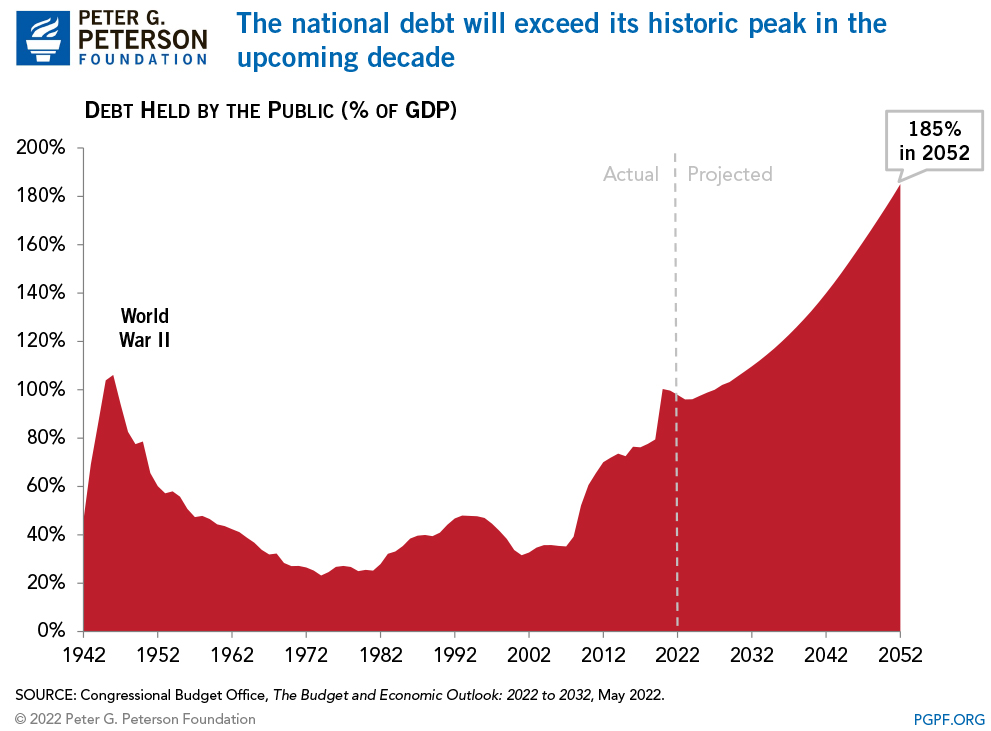
A second factor is the United States’ $31 trillion national debt. Economists foresee a time where interest on the astronomical debt consumes the entire budget. The US would enter a ‘doom loop’ of endless borrowing at higher and higher interest rates. With no money to spend, the economy will collapse, and the dollar will become worthless.
And a third, most notable factor, is the BRICS group plan to enter the next phase of dedollarization – the launch of a rival currency.
“On August 22, about two-and-a-half months from today, the most significant development in international finance since 1971 will be unveiled,” Rickards wrote. He cites that date because it is when the BRICS Leaders Summit will unveil plans for substituting the dollar in global trade. Of note, August 22, 1971, was the day the US dropped the gold standard.1
Rickards believes the rollout of a major new currency could weaken the role of the dollar. The US dollar would be displaced as the dominant trade and reserve currency. This change could occur within just a few years. The currency shift would affect world trade, direct foreign investment and investor portfolios in “dramatic and unforeseen ways.” Rickards warned the currency could set off an “unprecedented geopolitical shockwave.”

Who Are the BRICS?
At its core, the BRICS alliance consists of Brazil, Russia, India, China, and South Africa. Eight other countries have applied for membership. Twelve more have expressed interest in joining the bloc. Of note, Saudi Arabia is one of those countries. Saudi Arabia helped make the US dollar the supreme currency through the petrodollar system. Requiring oil to be traded exclusively in dollars cemented US dominance. With Russia and Saudi Arabia as BRICS members, two of the three largest energy producers with be aligned (the US is the other member of the energy Big Three). The new currency could seize the preeminent role in the energy trade and the benefits that go along with it.
The BRICS countries make up 30 percent of the world’s surface. They produce 50 percent of the globe’s wheat and rice. And they control 15 percent of the planet’s gold reserves. It accounts for 40 percent of the world population. Economically, the BRICS control almost a third of the world’s GDP.
In other words, the BRICS are a substantial and credible threat to Western hegemony. Their new currency has the resources and infrastructure to succeed. And as it is embraced by the globe, it will be able to eventually overthrow the dollar’s preeminence.
Rickards explains that the new currency must offer a safe store of value to be successful. For people to adopt it, the currency should rival the security found in the US bond market. To achieve this credibility, the BRICS are proposing to tie their currency to gold.
He sees “this entire turn of events—introduction of a new gold-backed currency, rapid adoption as a payment currency, and gradual use as a reserve asset currency—will begin on August 22, 2023, after years of development.” The dollar will be effectively removed from a large portion of global trade. Its value will decrease. The effects of which could result in collapsing stock prices, hyperinflation, and a shrinking economy. 2
Gold
The BRICS currency plan could spark a new bull market for gold. The Russian government confirmed the new currency will be backed by gold.
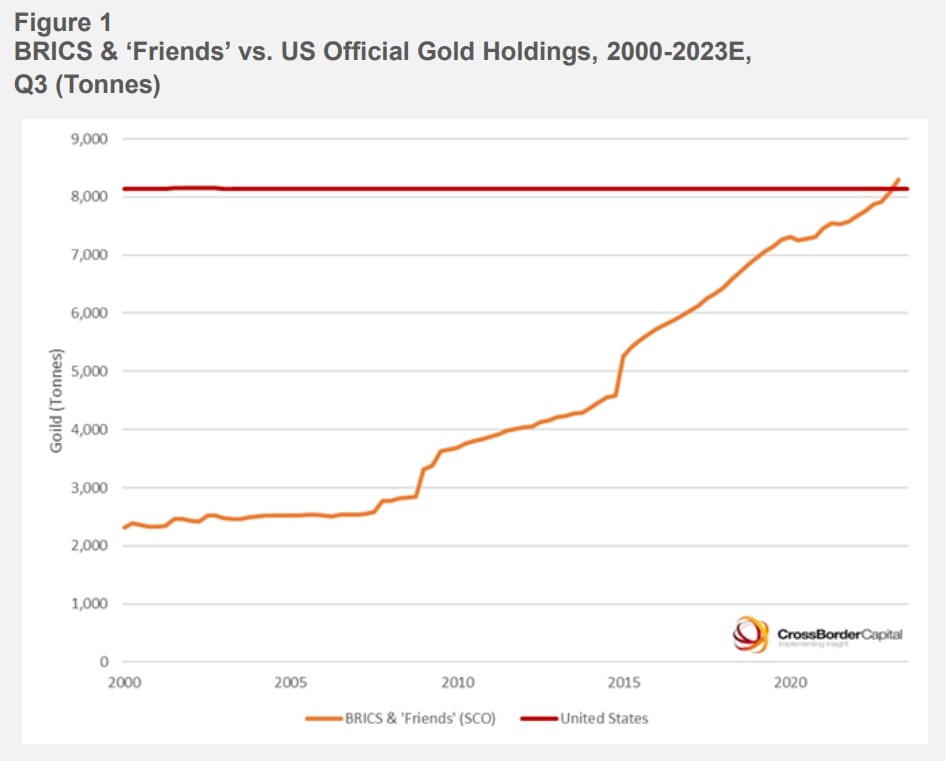
Gold has been playing an outsize role in the dedollarization movement since 2022. Central banks worldwide have been buying gold at a historic pace to diversify their reserves away from the US dollar, as seen below:
3
Analysts see a gold-backed currency as the next natural step in the new currency’s evolution. Many see China’s record gold purchases as an attempt to bring credibility to the yuan.
The global fiat money system could be in for a major disruptive shock. A gold-backed currency may lead to a sharp devaluation of many fiat currencies. As a result, it could catapult up goods prices on those fiat currencies.
The launch of a gold-back BRICS currency could fundamentally shift the entire global economic order. Uncertainty will increase as the dollar loses its dominant role. And assets denominated in dollars, like stocks and bonds, face a major devaluation. Retirement funds that aren’t diversified away from such assets are sitting on huge potential losses. For those who want to secure the value of their portfolios, now is the time to investigate gold. A Gold IRA from American Hartford Gold can protect the value of your funds and reap the rewards of a rising gold market. Learn more before August 22nd arrives. Call us today at 800-462-0071.
3
Grantham had previously predicted the dot-com crash and the housing bubble implosion. He diagnosed a “superbubble” spanning stocks, housing, and commodities in January 2022. He declared last September that it was likely in its final stages, and a historic crash seemed imminent. The S&P 500 and Nasdaq ended the year deeply in the red — but have rallied 16% and 32% respectively this year. The recent AI-driven surge in the stock market is providing a boost. But Grantham argues that it won’t prevent the superbubble from bursting. It is only delaying the inevitable. He suggests that the S&P 500 could experience a brutal 44% drop from its current level.4
Grantham points out that there are striking similarities between the current situation and previous crashes. He thinks conditions resemble the ones in 1929 and 2000. He sees a dangerous mix of overvalued stocks, bonds, and housing, combining with a commodity shock and a hawkish Federal Reserve.
The collapse of a superbubble occurs in several stages. First, there is a setback, followed by a slight rally. Finally, the market reaches its low point as fundamentals break down. The S&P 500 exited the longest bear market since 1948 at the beginning of June. Some analysts, such as those from HSBC and UBS, are already predicting a painful second half of 2023. They see an economic downturn deflating the AI boom and exposing the vulnerabilities of the superbubble. UBS analysts noted equity prices can fall as they confront “slowing growth and stickier inflation.”5
Even though the stock market has experienced a
How to Prepare
Considering these warnings, it’s crucial to be cautious and prepared for a potential market crash. Grantham himself has bet on bargain assets and positioned against expensive growth stocks. Some analysts see the upcoming downturn as a generational opportunity to make money. But it is vital to preserve your wealth to take advantage of buying opportunities.
In times of market uncertainty, assets like
1
Contrary to supporting arguments, CBDC is not a just another form of money. A
Gold to the Rescue
A CBDC amplifies power of the Federal Reserve to an unprecedented level. In the name of stimulating the economy, the Fed could use CBDCs to stop savings and retirement planning. They’d do this with negative interest rates or issuing money that expires if it isn’t spent within a limited amount of time. A CBDC lets the Fed create or remove money from the system. There would be no need for their current ad hoc interest rate hikes to try and tame inflation. With a click, they could simply erase the oversupply of money from your savings.
In contrast, gold stands as a safeguard for personal and financial freedom.
2
Student Debt Paused
In March 2020, President Trump implemented a student-loan payment pause to give relief during the pandemic. Biden has continued to extend the pause. He most recently extended it 60 days after June 30. In other words, 60 days after the Supreme Court issues a final decision on the legality of Biden’s plan to cancel up to $20,000 in student debt. This most recent extension will most likely be the last. The end of the pause was written into the debt ceiling deal with Speaker of the House McCarthy.
Some economists saw the pause as a boon to the economy. The Education Department estimated the pause put $5 billion back in borrowers’ pockets. Money that would have gone to debt payments went into consumer spending instead. Marshall Steinbaum is an economics professor at University of Utah. He said, “it’s pretty clear the payment pause has been very stimulative to the macroeconomy.” Conversely, he followed up by saying the government is going to be put in the position of trying to collect debt that can’t be repaid. And that squeezing borrowers will be bad for the economy. Resulting in what Steinbaum called, “a pretty severe fiscal contraction.”3
Supreme Court Decides
Eight million borrowers stand to receive loan forgiveness. The Supreme Court will issue a decision about the legality of the student debt relief this month. Lawmakers aren’t waiting for that decision. They’ve already passed a bill to overturn Biden’s debt relief and end the payment pause.
4
Tipping the Scales into Recession
The economy, while fragile, is recovering from the pandemic. Some analysts think resuming student loan payments may jeopardize that recovery.
Mark Zandi is the Chief Economist at Moody’s Analytics. He said, “In a typical economy, the impact of restarting payments wouldn’t tip the US into recession. But in the current environment with the economy as weak as it is, recession risks as high as they are, a couple of tenths of percent can matter.”5
The odds of entering a
Economic Impact of Repayment
While general spending may decrease across the board, retailers will be particularly hard hit. UBS and JPMorgan both warn of a coming “ice-age for retail” because it caters to millennials, the largest holders of student loan debt.
The resumption of student loan payments alone won’t crash the economy. But they may be the straw that breaks the camel’s back and pushes the US into a recession. A recession would bring increased unemployment and reduced corporate earnings. Stock prices, and in turn, retirement funds, could drop as a result. Government relief or not, that bill is going to be paid one way or another. Someone else’s education may result in a drop in your retirement savings. To preserve the value of your retirement funds before this happens, investigate the benefits of a
1
The pause may even be short lived. The Fed left a return to hikes on the table, saying additional rate hikes are probable later this year. The decision to skip a rate increase this meeting was unanimous among officials. The Fed will assess further information and its impact on monetary policy before making future moves. Economic indicators, including the job market and credit conditions, will play a crucial role in determining the size and timing of future rate hikes. Tightening lending standards by banks and potential limitations on accessing credit could dampen economic activity, hiring, and inflation.
Some analysts think renewed rate increases could be disastrous. High rates exposed vulnerabilities in the financial system. Resuming rate hikes could shake public confidence by causing more damage like
4
But the data isn’t so clear upon closer examination. The most recent US employment report provided a confusing mix of information. Companies added a strong 339,000 jobs in May, but households reported higher unemployment.
Inflation, meanwhile, has steadily dropped, but key services sectors — where wages are one of the biggest expenses — are still seeing higher price increases than the Fed would like. The slowing of inflation might have as much to do with easing supply chains and depleted government spending as it does with higher rates.
Mortgage rates shot up, putting a significant dent in the market. New listings are down 23%, and pending sales are down 17%. But a housing shortage, combined with the fact that so many homeowners locked in low rates during the pandemic, has meant that prices haven’t dropped significantly. People looking to move have fewer options, and people who own aren’t eager to give up their cheap rates.5
Navigating the Future
Despite the Federal Reserve’s decision to pause interest rate hikes, struggling consumers should not expect immediate relief. High borrowing costs across various sectors, coupled with inflation concerns and uncertainties in the economy, will continue to pose financial challenges. Taking proactive steps to pay down debt and manage financial obligations can help individuals navigate these difficult times. So can safe haven assets that protect purchasing power during times of high interest rates. A
2
The risk seemed minimal at the time. Interest rates were low and property values kept rising. Owners could expect to simply pay off the loan with a new one when the bill came due. Now, many landlords are no longer able to get new loans big enough to pay them back. Fitch Ratings estimates that 35% of commercial mortgages won’t be able to refinance. While many malls and hotels face high default risks, the situation is particularly dire for office owners.
Banks Respond
Banks recognize the danger facing them. They can see the rising risk of default from office tower and mall owners. Decreased demand and lower rental prices are contributing to a decline in property valuations. Banks fear being left with less valuable collateral and insufficient security in the event of default. Such defaults would expose them to potential losses and destabilize their loan portfolios.
Banks are determined to reduce their exposure to the teetering commercial real estate market. They are cutting back on commercial property loans. Doing so could lead to a slowdown in new office construction and impede the market’s recovery.
Some banks are selling off property loans at a discount even when borrowers are up to date on repayments. Wells Fargo is cutting its losses by preparing to offload debts at discounted prices, even from borrowers who have remained current on their repayments. Of its $142 billion in commercial real estate loans, Wells Fargo chief executive said, “We will see losses, no question about it.”3
HSBC is in the process of pawning off hundreds of millions of dollars’ worth of loans at a discount. They are also winding down direct lending to property developers. And PacWest unloaded $2.6 billion worth of construction lending contracts at a loss in May.4
As large banks cut their losses, the
Effects of the Crisis
As the fear of delinquencies rise, commercial real estate stocks are down. An index of publicly traded commercial real estate investment trusts (REITs) has fallen 18.1 percent since this time last year. Fewer commercial buildings are being sold more than three years after the coronavirus surfaced in the US.
The prospect of widespread default and plummeting demand could stifle construction and development in major US cities. Fewer lenders are betting on a quick recovery. With the crumbling of commercial real estate’s crucial role in the economy, a chain of events may be in motion that could end with recession. The 2008 mortgage crisis resulting in stocks dropping by 50%. Retirement savings were devastated. With a potential repeat crisis, the time is now to protect your assets. A
1
Reasons for the slump tie into a lack of investor confidence due to politics. China and US relations soured after the shooting down of a Chinese surveillance balloon. “China’s focus on national security will make the government’s policies less growth-friendly,” Citi analysts wrote in a report on May 30.2
Beijing carried out raids on foreign groups such as Bain & Company, Capvision and due diligence group Mintz. They increased regulation of domestic private businesses as well. Chinese officials appear to be ending their clampdown on the tech sector. Yet, investors still worry that the government could move against other companies.
“They came out with regulation after regulation without warning the market…when you’re a commercial investor, you lose confidence when you see those kinds of things happening,” said a portfolio manager for Janus Henderson Investments.3
JPMorgan has a large investment in China. Chair Jamie Dimon has warned about the effects of the Chinese government’s policies. “If you have more uncertainty, somewhat caused by the Chinese government . . . it’s not just going to change foreign direct investment. It’s going to change the people here, their own confidence….And confidence is very important for growth.”4
The Chinese government says they are prepared to help bolster the economy. Premier Li Qiang said this month more targeted measures were needed to boost demand. And China’s central bank said on May 15 it would provide “strong and stable” support for the real economy.
Why China’s Recession is Our Problem
The slowing of the Chinese economy can impact the United States stock market. Reasons for this include:
Trade Relations: China is one of the largest trading partners of the United States. According to the US Census Bureau, China was the third-largest export market for US goods in 2020, accounting for $103.9 billion in exports. A slowdown in the Chinese economy can impact sectors which rely heavily on exports to China. Such sectors include manufacturing, technology, and agriculture. This can result in lower revenues and earnings, and in turn, lower stock prices.5
China is also the top supplier of goods to the United States. It accounts for 18 percent of total goods imports ($452 billion). A decrease in manufacturing there can result in price increases here.6
Global Supply Chains: Many US companies have complex supply chains that rely on China. If the Chinese economy slows down, it can disrupt these supply chains. This can cause production delays or increased costs for US companies. Such disruptions can affect their profitability and investor confidence. Their stocks could fall as a result. Chinese supply chain snarls during the pandemic are reported to have cost American firms billions.
Investor Sentiment and Confidence: The global financial system is highly interconnected. Events in one country can quickly transmit shocks to other economies. As Dimon pointed out, the stock market is influenced by investor sentiment and confidence. A slowdown in the Chinese economy can be perceived as a sign of broader global economic weakness. This may trigger a sell-off in the US stock market as investors become more risk-averse.
Commodity Prices: China is a major consumer of commodities such as oil, metals, and agricultural products. A slowdown in Chinese economic activity can result in reduced demand for these commodities. Reduced demand can lead to lower global commodity prices. This can impact the profitability of US commodity companies, such as energy or mining. Lower profits often translate into lower stock value. Commodity prices dropped significantly when the 2008 global financial crisis caused a slowdown in the Chinese economy. Oil dropped 80%, copper fell 67%, and corn declined 40%. Interestingly enough, during this time,
3
The Consequences of Defaulting on Debt
If the government defaults, the effects would be devastating to the US and the global economy. Experts largely predict the US credit rating would drop and gross domestic product (GDP) would fall. Social Security and other benefit payments could be delayed, hurting tens of millions of Americans.
Unemployment rates would spike as millions of people potentially lose their jobs. Economists at Moody’s Analytics project that if the government exceeds the debt limit for even a few days, the unemployment rate would jump up to 5%. However, if the breach were to drag on for several weeks, the effects would be much harsher. The unemployment rate could spike to 8% and nearly 8 million people could lose their jobs.4
Interest rates have already been steadily rising due to 10 consecutive rate hikes by the Federal Reserve. An unexpected shock like a debt default would spike interest rates further and likely spark a recession. The cost of borrowing money could become prohibitive.
“If policymakers actually do fail to increase or suspend the limit before the Treasury runs out of cash and defaults on its obligations, interest rates will spike and stock prices will crater, with enormous costs to taxpayers and the economy,” Mark Zandi, Moody’s chief economist, said.5
The housing market would also be severely affected. An already tattered housing market would be sent into a “deep freeze,” according to Jeff Tucker, a Zillow senior economist. Tucker projected that home sales would plummet, mortgage rates would climb to as high as 8.4%, and buyers’ mortgage bills would soar by over 20%.6
Stock prices would also likely plummet and wreak havoc on retirement savings. Moody’s predicted that, under a prolonged default scenario, stock prices would plummet by one-fifth, wiping out about $10 trillion in household wealth.7
If A Deal is A Reached
8
A debt default is not likely to happen. Even under the current gridlocked circumstances, Moody’s Analytics puts the chances of a default happening at 10%.9
If the US manages to avert default, the consequences would still be significant. To pay its bills, the government would need to sell Treasury bills worth over $1 trillion. When the government sells a significant number of Treasury bills, it increases the Treasury General Account. This is essentially the government’s checking account. It will go from $95 billion to $500 billion in a month. The account will hit $600 billion 3 months.10
However, when there is more money in this account, there is less money available for other purposes. It becomes harder for banks to lend to individuals and businesses. Consequently, borrowing money would become more expensive, leading to higher interest rates. The housing market would suffer, with tumbling sales and soaring mortgage rates. Stock prices would also likely crash, causing a significant loss of wealth.
Money markets, often considered a safer investment, could also become casualty in a debt ceiling deal. A new imbalance between the amount of Treasuries issued and the available cash could cause short-term rates to rise. This means the funding for money markets could be disrupted. Investors could be better served moving to safe assets such as
A Temporary Solution
Raising the debt ceiling without addressing the underlying issues is like applying a band-aid to a deep wound.
Renowned investor Ray Dalio said, “Increasing the debt limit the way Congress and presidents have repeatedly done, and most likely will do this time around, will mean there will be no meaningful limit on the debt. This will eventually lead to a disastrous financial collapse.”11
The underlying problem lies in unsustainable spending and increasing
3
Cost to the Economy
The number of financially vulnerable individuals aged 65 and above is expected to increase. From 2020 to 2040, the number is predicted to rise 43%. Alarmingly, approximately 56 million private sector workers lack access to employer-sponsored retirement plans. Many households are left with limited options for building enough retirement funds. Numerous Americans will be facing a lower quality of life during their retirement years.4
The Pew Research Center says the shortage of retirement savings could cost the government $1.3 trillion by 2040. This savings gap could place an immense strain on state and federal budgets. There will be a greater proportion of elderly individuals compared to the working-age population. The expense of Medicare and other programs is expected to be borne by a smaller portion of the workforce. The extra public funding could result in higher taxes. Analysts estimate the projected shortfall would cost $13,600 per household.5
Several states are recognizing the urgent need to address the retirement crisis. They have launched automated savings programs. They allow individuals to set up state-sponsored Individual Retirement Accounts (IRAs). These initiatives are proving successful. Enrollees are saving between $105 and $190 per month. Some analysts believe such initiatives could help reduce the burden on public resources.6
Challenging Economic Landscape
The National Retirement Risk Index highlights the economic challenges faced by working-age households. It shows that about half of the nation’s households may struggle to maintain their standard of living in retirement. One third of households are taking a major hit from the increase in Social Security’s full retirement age. The economy had a period of improvement after the Great Recession. But the uncertainty caused by the pandemic and inflationary pressures undid those gains for many people.
Inflation’s Impact on Retirement Funds
A survey by the Senior Citizens League found inflation is wiping out retirement funds. The percentage of retirees reporting a drain on their savings rose from 20% in the third quarter of 2022 to 26% in the first quarter of 2023. Moreover, a record-high 45% carried credit card debt for more than 90 days.7
“Retirees exhaust retirement savings as they age, but it looks like inflation has sped up the process,” Mary Johnson, a Social Security and Medicare policy analyst at the Senior Citizens League said.8
Record household debt, insufficient retirement savings, and persistent inflation are making retirement planning essential. The strain on retirement funds shows the need for individuals to seek safe-haven assets that can protect their wealth. A
5
Federal Reserve
Analysts believe the new CPI data is giving the Federal Reserve room to alter their policy. The Federal Reserve has been raising interest rates aggressively to combat inflation. The Fed’s rate increases have had significant effects on mortgage rates, auto loans, credit card borrowing, and business loans. Economists fear the rate hikes are driving the country into recession and fueling a recent wave a
Gold
Gold prices rallied after the CPI report came in close to market expectations. Gold’s uptrend depends on a weaker U.S. dollar and lower interest rates. Some analysts believe
Has This Happened Before?
In 2011, Congress narrowly resolved the debt ceiling. Despite a last-minute deal, the stock market went down 14% over four weeks. Because of the crisis, debt-rating agency Standard & Poor’s downgraded the US debt for the first time.5
What is the Impact on Gold?
During the 2011 debt ceiling crisis, gold hit $1,900 an ounce for the first time. It then reached a record high at the time of $1,910 an ounce. Today, gold is aiming to surpass $2,020 as its safe haven appeal grows alongside debt ceiling worries. An extension in the US debt ceiling could result in a downgrade of the US long-term outlook. This would have a negative impact on the US Dollar, Treasury yields, and the S&P 500, all of which can drive the price of gold higher.6
The government is playing a dangerous game of brinkmanship with the economy. If the debt ceiling isn’t resolved, retirement funds may drop off a cliff. People looking to protect the value of their funds should investigate