













- Despite strong national numbers, more than 20 states are already in recession or on the brink of one.
- Economic weakness in a few key states could tip the entire U.S. into a full-blown downturn.
- Protect your savings from nationwide recession risks with the lasting value of physical gold.
Recession is Here
Today’s encouraging headlines, 3.8% GDP growth and 4.3% unemployment, are clouding deep cracks beneath the economic surface. According to new research from Moody’s Analytics, the picture of broad-based prosperity doesn’t apply to all Americans. While national averages suggest strength, most states are struggling to stay afloat. The reality is that much of America is either in recession or teetering on the edge, putting your financial future at greater risk if the downturn continues to spread.
A Divided Economy
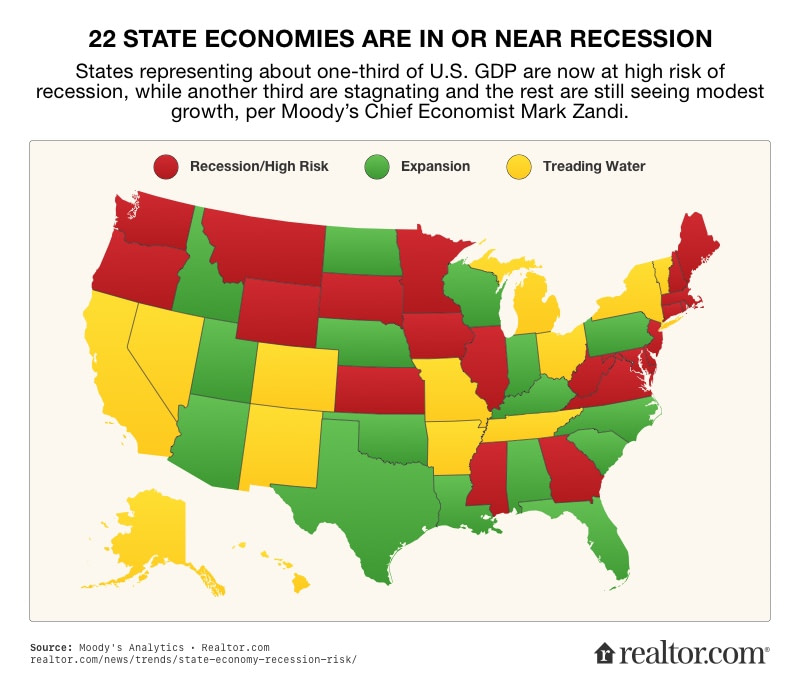
Moody’s Analytics reports that 22 states are now in recession (including DC), 13 are “treading water,” and only 16 are expanding. The overall growth rate of the U.S. is being propped up by a handful of powerhouse states like California, Texas, and New York. They contribute a massive share of national GDP. Without their momentum, the country’s growth numbers would likely look far weaker. Yet even within these states, their economic balance is fragile. And a small shock could push them into negative territory.1
States in Decline
2
Some of America’s largest state economies are already slipping into contraction. Illinois, Georgia, Washington, New Jersey, Massachusetts, and Virginia are all major contributors to national output. Together, they represent more than 18% of the country’s GDP. But today they are listed as being in recession or at high risk of entering one.
At the same time, Texas, Florida, Pennsylvania, and North Carolina are expanding modestly. For now, these states are driving the country’s positive growth. But their strength may not be enough to offset the growing weakness elsewhere.
Debt and Financial Strain
The uneven economic picture is being compounded by record levels of household debt. As of October 2025, Americans owe over $1 trillion in credit card debt. Vehicle loans reached nearly $496 billion and student loans climbed to $1.813 trillion.3
In states already facing recession, rising debt levels are particularly painful. Wage growth has failed to keep up with inflation. Many lower-income households have little or no financial cushion to fall back on. Moody’s Chief Economist Mark Zandi describes these households as “hanging on by their fingertips financially.” This downward debt spiral fuels recession and its spread. 4
The Uneven Impact of Recession
The broad national numbers mask just how unevenly the slowdown is hitting different groups. Zandi notes that many Americans at the bottom of the income distribution are living through recession-like conditions even if they remain employed. While they still have jobs, the security of those jobs is fading. Hiring has slowed, job openings are down, and wage growth is cooling.
The divide is becoming clear. Higher-income households, with investment portfolios and home equity, continue to spend and keep the economy afloat. Meanwhile, lower-income households are struggling to meet everyday expenses and keep up with mounting debt.
Regional Pressures
Some of the hardest-hit regions are those tied to manufacturing, agriculture, and energy. These industries have faced headwinds from tariffs and restrictive immigration policies. The District of Columbia is also experiencing contraction, in part due to mass federal layoffs earlier this year.
Zandi and other economists are watching closely to see whether economic softness spreads from these struggling regions into larger markets. If states like California or New York, were to tip into contraction, the entire national economy could follow.
“Those two states are treading water,” Zandi said. “They’re big states, and if they go into the red then that’ll probably take the national economy with them into recession.”5
Scott Anderson is chief U.S. economist at BMO Capital Markets. He warned that California and New York could serve as the “canaries in the coal mine.” He added, “Which way California and New York go may be the way the nation goes.”6
The Federal Reserve’s Balancing Act
While inflation remains above the Federal Reserve’s 2% target, the central bank cut interest rates last month for the first time in 2025 to stabilize the slowing labor market. Lower rates can encourage borrowing and investment, helping to stimulate growth and slow a recession. But they also risk fueling higher inflation. That means the very policy meant to support workers and businesses can end up eroding the purchasing power of the same households it aims to protect.
Conclusion
Like a patch of bad grass creeping across an entire lawn, recession often starts in just a few places. But once it takes root, it can move quickly, pulling nearby regions down with it. With more than 20 states already in decline and others barely holding steady, localized weakness could grow into a nationwide downturn. As these pressures mount across the country, Americans are increasingly focused on safeguarding their savings and retirement assets.
Contact American Hartford Gold today to learn how a Gold IRA can help secure your financial future against market volatility. Call 800-462-0071 to speak with a precious metals specialist and explore your options for protecting what you’ve worked so hard to build.