














The Role of Central Banks
Gold’s biggest rally in years is being built on relentless central bank demand. Prices continue to break new highs, reflecting a growing global movement among governments to strengthen their reserves with the metal. Here’s why this shift is happening and what you can be doing about it.
A Look Back: How This Gold Rush Began
Gold prices were at a ten-year low in 2022. Then the Russia-Ukraine conflict erupted. The U.S. responded by weaponizing the dollar. This action sparked the fastest rate of central bank gold buying in 55 years. And, in turn, began the largest de-dollarization movement since the end of the Bretton Woods system.
Since then, gold prices have climbed steadily as central banks worldwide shifted toward greater gold accumulation. Reshaping the foundation of the global financial system in the process.
Central Banks Lead the Charge
“Central banks continue to be consistent and strategic buyers of gold, even at record prices, because of the role it plays in strengthening their reserve portfolios,” said Joe Cavatoni, senior market strategist at the World Gold Council. “We’re seeing a structural, not cyclical, change in how central banks view gold — as a key, liquid component of their reserves.”1
A recent World Gold Council survey found that 43% of central banks plan to increase their gold holdings. That’s up from 29% the year before. An overwhelming 95% of reserve managers expect global central bank gold holdings to rise further over the next 12 months. Central banks added 19 metric tons to their global reserves in August alone.2
Who’s Buying and Why
Since 2022, China has made gold purchases for a total of 29 months. Meanwhile, Poland, Turkey, and the Czech Republic have all added to their gold reserves for at least 24 consecutive months. Along with dozens of other nations increasing their holdings, these purchases have created a structural price floor that helps stabilize gold’s long-term value.
There are several key reasons driving these record purchases. Central banks are diversifying away from the dollar. The dollar has depreciated roughly 12% in 2025, reducing its reliability as a reserve asset.
Gold also protects reserves from geopolitical risk and sanctions. BRICS nations are using gold accumulation to reduce exposure to Western-controlled financial systems.
Gold helps preserve value amid high inflation and rising global debt. U.S. debt has soared past $37 trillion, raising doubts about long-term fiscal sustainability.
Gold also serves as a politically neutral tangible asset with no counterparty risk. It bolsters domestic currency credibility. Right now, China is using gold to support the yuan’s international standing.
3
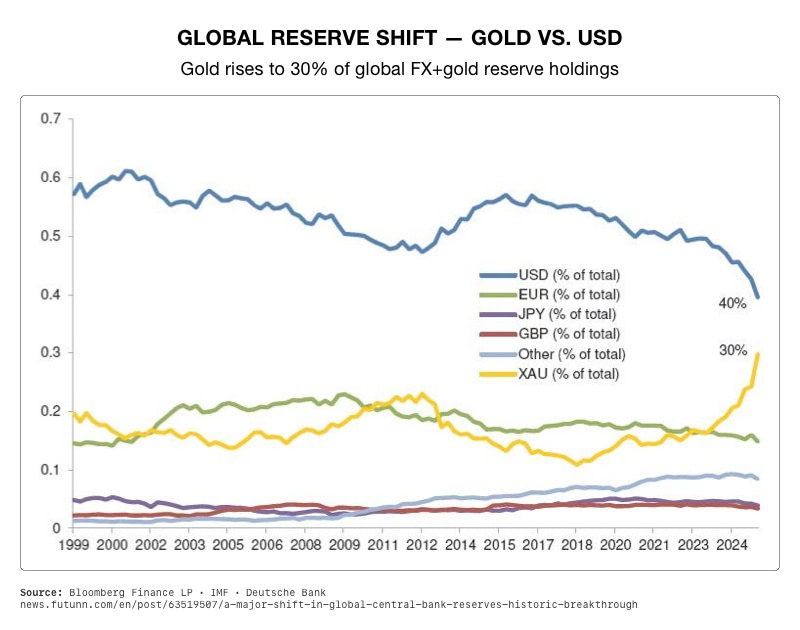
The role of gold in global central bank reserves is undergoing a historic shift. Deutsche Bank reports that gold now accounts for about 30% of global foreign exchange reserves. That’s up from 24% at the end of June. Over the same period, the dollar’s share slipped from 43% to 40%.
If gold climbs another third to around $5,790 an ounce, gold and dollar holdings would each make up roughly 36% of global reserves (assuming no new purchases). In just seven years, gold’s share of central bank reserves has nearly tripled. It is being reestablished as one of the most important assets in the world’s financial system.4
Why the Fed and Treasury Don’t Buy Gold
Unlike most central banks, the Federal Reserve does not buy gold. The reason lies in its structure and purpose. The United States already holds the world’s largest gold reserves, about 261.5 million ounces. These belong to the Treasury, not the Federal Reserve, which has no authority to trade or increase them.
The Fed operates under a fiat system. It manages the economy through interest rates, open market operations, and liquidity tools, not commodity purchases. Its goals of price stability and maximum employment require flexibility in the money supply, which gold ownership would limit. Gold is a Treasury reserve asset, not a monetary policy tool.
The U.S. Treasury also does not buy gold. Its holdings are already large. As the issuer of the global reserve currency, it has no need to diversify away from the dollar. The Treasury’s focus is managing debt and maintaining confidence in fiat stability.
The Global Conversation
As global financial leaders meet in Washington for the annual IMF and World Bank gatherings, gold remains the “topic du jour.” Some economists worry the rally could signal a market bubble. But others see it as a reflection of fading faith in government-backed currencies.
“Every time you doubt governments, you go to gold,” said Axel Weber, former head of Germany’s central bank. Former St. Louis Fed President James Bullard called the run-up “a little worrisome from an inflation perspective.” IMF markets chief Tobias Adrian said the surge reflects how investors are grappling with uncertainty.5
Conclusion
Central banks are buying gold for diversification, stability, and long-term security. Many individual Americans share those same concerns. Bank of America strategists recently reaffirmed gold’s strength. They predicted gold could rise toward $6,000 by spring 2026.
You can take the same protective step central banks are taking—by holding physical gold. To learn how to secure your savings with a Gold IRA, call American Hartford Gold today at 800-462-0071 and speak with a precious metals specialist.