






SPEAK WITH A SPECIALIST
800-462-0071

I WANT TO

Why It’s Not Too Late to Buy Gold

Why It’s Not Too Late to Buy Gold
  • Despite gold’s eight-month rise, long-term trends show there is still opportunity to purchase.
  • Rising government debt, global uncertainty, and central bank demand continue to drive gold prices.
  • Holding physical gold in a Gold IRA can protect your wealth and diversify your portfolio during economic uncertainty.

Gold’s Momentum and Wealth Protection

Like the old saying goes, the best time to do something was years ago, and the second-best time is now: the same goes for gold. Gold has surged for 8 straight months, a streak only matched once before, just before the 2008 financial crisis. 1 Prices have jumped about 75% over the past year, topping $5,000 per ounce in January. Many investors wonder if they’ve missed their chance, but analysts say no, the gold rally is driven by long-term trends, not short-term hype.2

What’s Driving Interest in Precious Metals

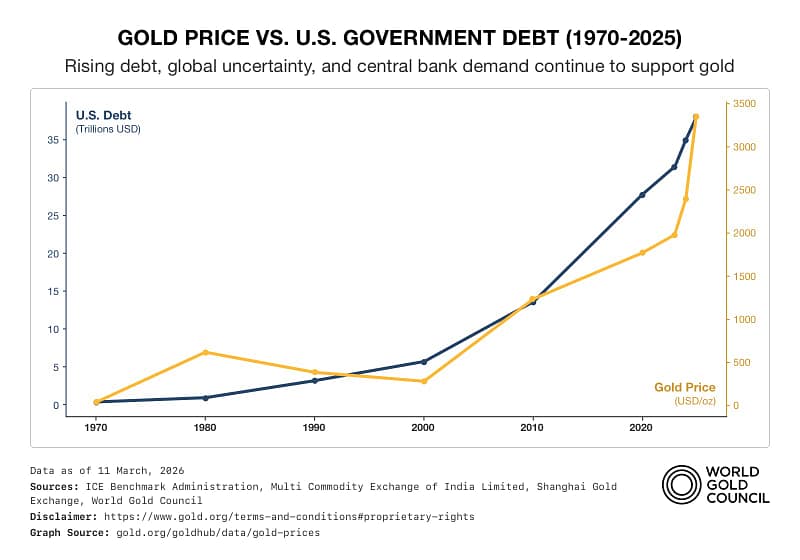
One of the biggest forces behind the rally is the growing level of government debt worldwide.
Why It’s Not Too Late to Buy Gold

3

In the United States, federal debt exceeds 120% of GDP, with annual deficits around 6–7% of GDP. Other major economies, including Japan, the U.K., France, and Canada, also have debt above 100% of GDP.

The IMF projects that total global public debt will top 100% of GDP by 2029, the highest level since 1948. Officials warn this could increase the risk of financial crises and stress the importance of fiscal buffers. The IMF’s Vitor Gaspar notes that debt could reach 123% of GDP by decade’s end, creating a dangerous “fiscal-financial doom loop” similar to Europe’s 2010 debt crisis.4

When debt climbs this high, investors often turn to assets governments cannot create at will. Borrowing more or printing money can weaken a currency and reduce its buying power. In these situations, gold has historically helped protect wealth.

Uncertainty is Driving Safe Haven Demand

War with Iran and chaotic trade policies are adding to uncertainty. Geopolitical and policy risks make investors nervous, as they can trigger sudden market swings and threaten portfolios. In times like these, gold acts as a safe haven, a limited and reliable store of value when confidence in currencies or markets wavers.

Gold’s safe-haven role is backed by history. Since 2020, in months when the S&P 500 fell more than 5%, gold still rose about 2% on average, while U.S. bonds stayed flat.5

Global demand trends suggest room for more investment. India and China together account for nearly 60% of consumer gold demand, while North America and Europe contribute only about 15%. This gap shows that Western investors may still be under allocated to gold.

Central Banks Continue Buying Gold

Demand is also strong from central banks, which hold about 20% of all mined gold and have steadily increased their reserves from 2022 to 2025. Much of this buying reflects de-dollarization. They are diversifying away from the U.S. dollar to protect against a weakening currency and to reduce reliance on Western financial influence.

In 2025, gold became the largest component of global reserves, surpassing U.S. Treasuries for the first time in about 30 years. Central banks often take a long-term view when building reserves: 95% expect global gold holdings to rise in 2026, up from 81% in 2024 and 52% in 2021.6

Why It’s Not Too Late to Buy Gold

Looking Ahead: Gold Price Predictions

Reflecting this strong demand, analysts are projecting higher gold prices. JP Morgan sees gold reaching $6,300 per ounce, Yardeni Research forecasts $6,000, Wells Fargo anticipates $6,100–$6,300, and AI model CoPilot sets an upper bound of $6,220. These projections suggest the current rally could continue even after recent gains.7

New Buyers Are Emerging in the Gold Market

The gold market is also seeing new types of buyers, partly due to stablecoins. These digital currencies are designed to maintain a stable value and are often backed by reserve assets, including gold. For example, Tether has accumulated roughly 140 tons of gold, placing it among the 33 largest gold holders in the world. Stablecoins have grown from about $28 billion in 2020 to over $280 billion in 2025. As these systems expand, they could introduce an entirely new class of gold investors.8

Conclusion

Despite recent ups and downs, many of the factors supporting gold remain intact: high government debt, global uncertainty, and central bank accumulation. The current bull market is ongoing rather than over. History shows that major trends in precious metals often unfold over years, giving investors time to consider adding gold for diversification and protection.

To learn more about how physical precious metals held in a tax-advantaged Gold IRA can protect your portfolio, call American Hartford Gold today at 800-462-0071.
Notes
1. https://finance.yahoo.com/news/gold-just-did-2nd-time-065000363.html
2. https://www.investing.com/news/commodities-news/gold-starts-2026-higher-after-60-surge-last-year-silver-platinum-follow-4427311
3. https://www.gold.org/goldhub/data/gold-prices
4. https://www.bloomberg.com/news/articles/2025-10-15/global-public-debt-set-to-top-post-wwii-levels-by-2029-imf-says
5. https://www.kitco.com/news/article/2026-03-10/blackrock-sees-further-gains-both-gold-and-silver
6. https://think.ing.com/articles/golds-bull-run-to-continue-in-2026/
7. https://www.reuters.com/business/jp-morgan-sees-year-end-2026-gold-price-6300-per-ounce-2026-02-25/
8. https://thedeepdive.ca/tether-buys-27-tons-of-gold-rivaling-central-banks-in-q4/


Market Turmoil Follows Oil Price Surge

Market Turmoil Follows Oil Price Surge

Market Turmoil Follows Oil Price Surge

Global Energy Shock Hits Markets Hard

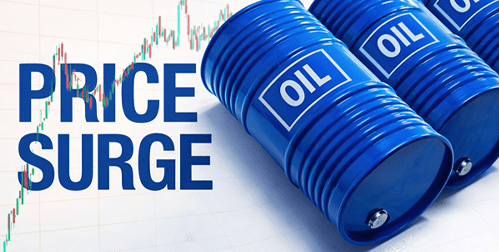
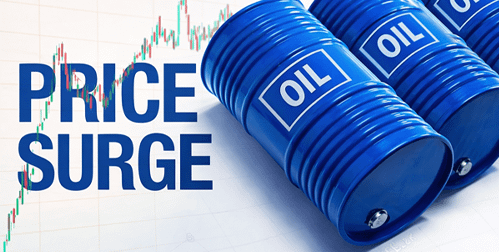
Oil markets erupted on March 9, 2026, as the escalating war between the United States, Israel, and Iran sent crude prices surging. The sudden spike threatened higher prices, tighter budgets, and market volatility, rattling the global economy and potentially your portfolio.

Within days of the conflict expanding, crude prices surged nearly 20 percent. Brent crude jumped above 100 dollars per barrel and briefly approached 120 dollars, marking some of the strongest intraday gains in years.1

The surge came as fears grew that the conflict could disrupt one of the most critical energy corridors in the world, the Strait of Hormuz. The narrow waterway normally carries about 20 percent of the world’s oil and liquefied natural gas shipments. With shipping severely reduced, markets quickly priced in the risk of prolonged global oil and gas shortages.

Oil had already been trending higher before the escalation. But the widening war quickly changed expectations about global supply. Energy analysts warn that continued hostilities and attacks on ships near the Strait could further slow or even temporarily halt exports from Iran and other major Middle Eastern producers.

Energy shocks like this rarely stay confined to the oil market. They can impact inflation, economic growth, and other financial markets around the world.

Oil Shocks Spread

Oil sits at the center of the global economy. Analysts have warned that rising oil prices could push transportation, manufacturing, and food costs higher worldwide. When prices rise rapidly, businesses face higher operating costs while consumers pay more for fuel and everyday goods.

Crude Oil Rises

2

The latest shock has not been limited to crude oil alone. European natural gas futures surged as much as 30 percent during the same trading session. Broader energy costs are set to rise across multiple sectors.

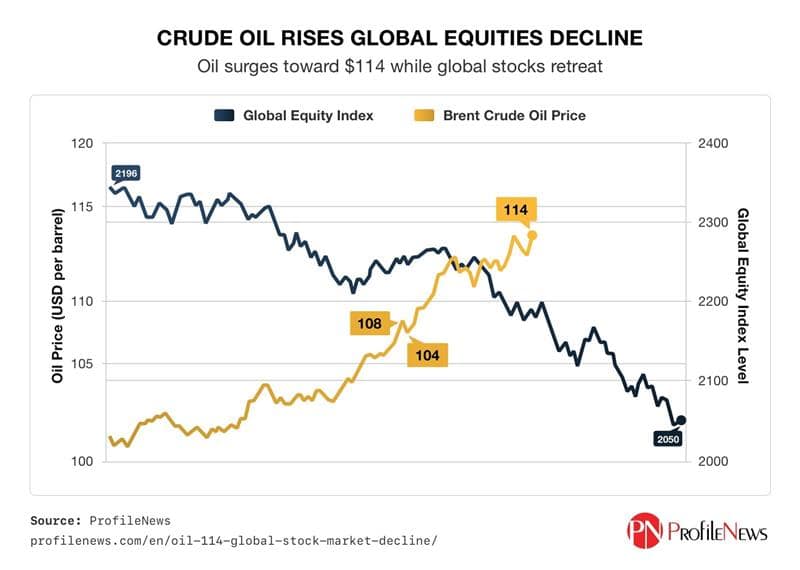
Financial markets have already reacted to the surge. Stock futures dropped sharply as crude prices climbed. Dow futures fell more than 1,000 points. European markets also opened sharply lower as traders priced in the economic risks of an expanding Middle East conflict.

Governments around the world are already scrambling to contain the economic damage. Some countries are exploring fuel subsidies, tax cuts, and other emergency measures aimed at softening the blow for households and businesses as energy prices surge.

Rising fuel prices can push inflation higher while slowing economic activity. Together, they create one of the most feared and stubborn economic challenges: stagflation.

Stagflation Concerns Are Returning

Energy shocks have historically been one of the primary triggers of stagflation. As oil prices climb, businesses face higher costs and consumers reduce spending elsewhere. The result can be slower growth paired with persistent inflation.

History offers an important comparison.

During the 1970s, oil supply disruptions and geopolitical tensions helped trigger one of the most difficult stagflation periods in modern history. Crude oil prices roughly quadrupled after the 1973 embargo. U.S. inflation peaked near 13% by 1980. Growth slowed and financial markets struggled through years of instability.3

Portfolios Pressures

This environment can be especially challenging for retirement accounts. They are often concentrated in equities and heavily weighted toward stock funds that thrive only during steady economic growth.

During conflicts like today’s that pressure oil markets, rising costs eat into corporate profit margins. At the same time, tighter household budgets curb consumer spending, creating a negative cycle that fuels stagflation. Volatility across equity markets is the usual result as investors reassess growth prospects and adjust portfolios. The pattern revealed itself as stocks tumbled alongside the recent oil surge.

For retirement savers, moments like this raise important questions about diversification.

Gold During Economic Shocks

Periods of geopolitical conflict and economic uncertainty often lead investors to reconsider how their savings are protected.

During the stagflation of the 1970’s, gold experienced one of the most dramatic bull markets on record. After the Bretton Woods monetary system ended in 1971, gold traded near $35 per ounce. By January 1980, the price had reached roughly $850 per ounce as investors hedged against soaring inflation. That move represented a gain of about 2,300 percent in less than a decade.4

Unlike stocks and bonds, gold does not depend on corporate earnings or economic growth. Because it is a physical asset that cannot be created by governments or central banks, it has historically been viewed as a store of value during inflation, financial instability, and global turmoil.

Conclusion

The sudden surge in oil prices during the latest Middle East conflict highlights how quickly economic conditions can change. Energy shocks can spread through markets, influence inflation, and create new risks for retirement savings.

To protect your retirement funds, consider putting precious metals in a Gold IRA. Learn more by calling American Hartford Gold at 800-462-0071 today.

Notes
1. https://www.argusmedia.com/zh/news-and-insights/latest-market-news/2798219-crude-futures-surge-20pc-top-111-bl
2. https://www.profilenews.com/en/oil-114-global-stock-market-decline/
3. https://www.federalreservehistory.org/essays/oil-shock-of-1973-74
4. https://www.chicagofed.org/publications/chicago-fed-letter/2021/464


AI Optimism Meets Market Reality

AI Optimism Meets Market Reality

  • Surging AI valuations and record spending raise the risk of a potential market bubble.
  • Elevated expectations leave little margin for error, especially for Americans near retirement.
  • Protecting your finances with physical gold in a Gold IRA can help reduce risk during market volatility.

AI Boom or AI Bubble?

Artificial intelligence has become the market’s dominant story. Trillions in projected spending, record stock valuations, and daily headlines about breakthroughs have fueled a powerful rally in major technology names.

But alongside the excitement, risk is rising. Capital expenditures are surging. Valuations are stretched. And even veteran tech leaders warn that “train wrecks” are inevitable along the way.

For investors, especially those nearing retirement, the question isn’t whether AI is transformative. It’s what happens if today’s expectations prove too optimistic.

History Rarely Rings a Bell at the Top

The late-1990s dot-com boom was powered by genuine innovation. The internet did change the world. But that didn’t prevent the Nasdaq from falling 78% between 2000 and 2002. A $100,000 tech-heavy portfolio lost more than $80,000 in that downturn. Gold, by contrast, rose roughly 25% during that same period.1

Bubbles rarely collapse because innovation fails. They unwind because expectations outpace reality.

The housing bubble followed a similar pattern. Warning signs were visible years before the crash. Risky lending was widely discussed. Markets continued rising anyway—until excess unwound.

Today’s AI cycle carries echoes of both.

Massive Spending, Lofty Expectations

Big Tech companies are planning roughly $650–700 billion in AI-related capital expenditures in 2026 alone. Global data center investment could reach $1.7 trillion by 2030.2

Meanwhile, Nvidia recently approached a $4.8 trillion market capitalization. That valuation implies the company could capture an estimated 15–30% of all U.S. corporate profits by 2036. To generate a modest 10% annual return from these levels, profits would need to rival the current share of the entire U.S. corporate sector.3

That is an extraordinary assumption.

Fund managers are taking notice. Roughly 35% now say AI overinvestment is the market’s top risk, the highest reading in two decades.4

At the broader level, the S&P 500 trades near 28 times earnings, well above long-term historical averages. Earnings yields imply real returns closer to 3.5% going forward, roughly half the long-term norm.

Optimism may still prove justified. But the margin for error is narrowing.

Early Cracks Beneath the Surface

Even within the AI ecosystem, volatility is increasing.

Shares of Adobe and Salesforce have fallen more than 40% from recent highs as AI code agents threaten traditional software subscription models. Block has cut roughly 4,000 jobs. The State Street software ETF has shed approximately $1.6 trillion in value.5

Economist Mark Zandi of Moody’s Analytics assigns roughly 25% odds to a recession if AI investment fails to generate expected returns.

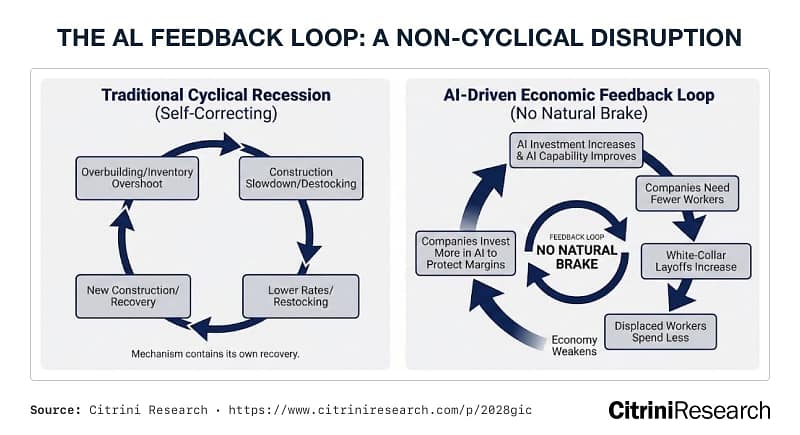
Meanwhile, some analysts warn of a different risk: what if AI succeeds too quickly? Research firms such as Citrini Research have raised the possibility that rapid automation of white-collar roles could pressure employment and consumer demand—even if equity markets remain elevated.

AI Blog Chart

6

Markets do not need a clear catalyst to reverse. Excess alone can be enough.

Why This Matters More After 55

Younger investors have time to recover from major drawdowns. Near-retirees do not.

Data from Vanguard shows many self-directed investors over age 55 hold 70% or more of their portfolios in equities. After stocks returned roughly 17% last year compared to bonds’ 7%, many traditional 60/40 portfolios have drifted closer to 80/20 or beyond.7

That increases vulnerability to a sharp repricing in mega-cap technology stocks, which now represent an outsized share of major indexes.

A reversal in a handful of dominant names could translate into double-digit losses for passive investors almost immediately.

AI Optimism Meets Market Reality

Conclusion

AI may power a new era of innovation. It may also follow the historical pattern of boom, overreach, and correction. Massive spending, concentrated market leadership, and historically high valuations raise the stakes—particularly for those nearing retirement.

The question isn’t whether artificial intelligence will change the world. It’s whether your portfolio is positioned to withstand volatility if expectations change first.

Historically, tangible assets such as physical gold have served as a stabilizing force during periods of equity market stress. Unlike high-growth equities, gold carries no earnings assumptions, no capital expenditure requirements, and no counterparty risk.

Consider shielding the value of your portfolio with physical precious metals. A Gold IRA offers tax-advantaged long-term protection for your retirement funds. To learn more, call American Hartford Gold today at 800-462-0071.
Notes
1. https://www.investopedia.com/how-the-next-recession-may-look-like-the-2001-dotcom-bust-4584237
2. https://finance.yahoo.com/news/big-tech-set-to-spend-650-billion-in-2026-as-ai-investments-soar-163907630.html
3. https://capital.com/en-int/markets/shares/nvidia-corp-share-price/market-cap
4. https://www.businessinsider.com/ai-capex-overspending-bofa-fund-manager-survey-hartnett-2026-2
5. https://www.morningstar.com/news/marketwatch/20260113134/salesforce-and-adobe-see-their-stocks-slide-as-ai-fears-intensify
6. https://www.citriniresearch.com/p/2028gic
7. https://corporate.vanguard.com/content/corporatesite/us/en/corp/vemo/2026-outlook-economic-upside-stock-market-downside.html


Valcambi CombiBar

Valcambi Combibar

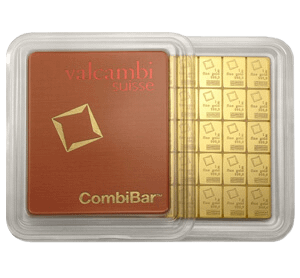
In 2011, Valcambi introduced the CombiBar™, one of the most innovative precious metals investment products available. The Valcambi CombiBar™ is a minted gold bar designed as a multifunctional investment option, offering the unique ability to break the bar into smaller, individually detachable 1-gram pieces.
The gold CombiBar™ is available in several configurations, including 100 detachable 1-gram bars, 20 detachable 1-gram bars, a 1-ounce bar divided into 10 detachable 1/10-ounce pieces, and a distinctive star shape composed of 5 detachable 1-gram bars.

Gold Surges as Middle East Tensions Rise

Gold Surges as Middle East Tensions Rise

Gold Surges as Middle East Tensions Rise

Markets Turn to Gold for Security

When the world goes to war, investors go to gold.

Reports confirmed U.S. and Israeli strikes on Iran on February 28, 2026. The strikes reportedly killed Iran’s Supreme Leader Ayatollah Ali Khamenei. In response, Iran launched missile retaliation and partially closed the Strait of Hormuz, a critical oil route that handles 20% of global oil shipments. And gold’s reaction shows how closely it is tied to conflict, history, the economy, and the value of your money.

When markets opened, investors reacted fast.

Gold prices surged over 2% immediately after the news. Spot gold moved from around $5,100 to $5,300 per ounce. It quickly tested $5,400 as safe haven buying took hold. In early trading on March 1 and March 2, gains reached 5.2% to $5,246 per ounce. There were further spikes toward $5,400 as fears grew about oil supply disruptions.1

At the same time, oil prices jumped 13% to $82 per barrel. Rising oil prices often raise concerns about inflation. And that tends to increase demand for gold.2

Why Gold Moves During Conflict

When global tensions rise, investors look for assets that can hold value during uncertainty. Gold has long served that role.

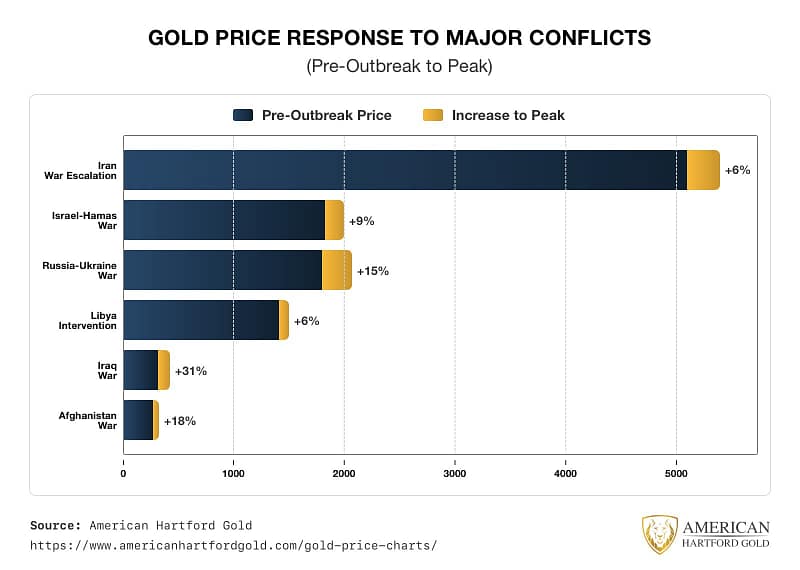
Gold Price Response To Major Conflicts

3

Historical patterns show gold averaging 0.3% gains in the first week of conflicts and 9% over 12 months. During the 1979 Iranian Revolution, gold delivered 150% over a year. These examples show that geopolitical shocks can create lasting moves, not just short bursts.

This latest reaction followed that familiar pattern. Stocks fell while gold rose, highlighting how gold can help balance a portfolio during sudden global events.

Currency volatility also increased following the strikes. When currencies swing and risk assets weaken, gold often benefits as a dollar hedge. But stepping back, gold was already advancing within a structurally supportive macro environment before this weekend. Sovereign debt expansion, central bank buying, and gradual de-dollarization were already in motion. Geopolitics simply fuels trends that were firmly in place.

How Long Could This Rally Last

The initial spike pushed gold up more than $100 per ounce, bringing prices close to $5,400. Some intraday pullbacks followed but further gains toward $5,450 remain possible if tensions continue.

Short term forecasts suggest gold could trade between $5,350 and $5,450 in the next few days with volatility. Over the next month, projections show potential for $5,500 or higher if disruptions persist. Analysts note support around $5,200 to $5,300.4

Gold reaching $6,000 in the coming weeks or months is considered plausible under ongoing tensions, de-dollarization trends, and sustained central bank demand. But without escalation, $6,000 is more realistically an end of year milestone.

Silver and Oil

Silver mirrored gold’s surge with jumps of 8%, though it showed higher volatility. Silver often moves with gold but tends to amplify gains and losses. 5

Oil’s 13% rise to $82 per barrel adds another layer to the story. Higher energy costs can feed inflation. In inflationary or stagflation environments, gold has historically outperformed many traditional assets.6

What This Means for Retirement Portfolios

Market shocks like this can have real consequences for retirement savings. When stocks fall and volatility rises, 401(k) and IRA balances can feel the impact. Gold’s performance during geopolitical events highlights why diversification matters.

Experts often recommend allocating 5 to 10% of a portfolio to gold for diversification. Some suggest 5 to 15% depending on risk tolerance and time horizon. Gold has historically shown low correlation to stocks, meaning it does not always move in the same direction. That can help reduce overall portfolio volatility.

Gold IRAs allow investors to hold physical gold in a tax deferred retirement account. Physical gold in an IRA can offer inflation hedging, liquidity, and protection during stock market downturns. For retirees or those nearing retirement, having part of a portfolio in precious metals can help manage uncertainty.

Conclusion

The situation in the Middle East remains fluid. Sustained upside for gold depends on how the conflict develops and whether oil disruptions continue. Historical examples show that gold can deliver meaningful gains during extended geopolitical stress.

With oil prices rising, currencies fluctuating, and stocks under pressure, many Americans are reassessing their portfolios. Now is an opportune time to learn how a Gold IRA can help protect your financial future. Call American Hartford Gold today at 800-462-0071 to find out more.

Notes
1. https://intellectia.ai/blog/us-iran-war-affect-gold-price-2026-analysis
2. https://www.financemagnates.com/trending/gold-price-tests-5400-oil-jumps-13-as-strait-of-hormuz-shuts-iran-war-rocks-markets/
3. https://www.americanhartfordgold.com/gold-price-charts/
4. https://www.canadianminingreport.com/blog/how-gold-prices-could-react-to-the-iran-war-scenarios-from-goldman-sachs-and-leading-commodity-experts
5. https://intellectia.ai/blog/us-iran-war-affect-gold-price-2026-analysis
6. https://www.financemagnates.com/trending/gold-price-tests-5400-oil-jumps-13-as-strait-of-hormuz-shuts-iran-war-rocks-markets/


Tariff Decision Sparks Economic Uncertainty

Tariff Decision Sparks Economic Uncertainty

  • The Supreme Court ruling reshaped tariff authority and created new uncertainty for businesses, markets, and global trade.
  • Tariffs raise consumer prices, increase inflation risk, and may delay interest rate cuts and economic growth.
  • Physical gold can help protect your finances during inflation, market volatility, and ongoing economic uncertainty.

A Major Legal Decision Reshapes Trade Policy

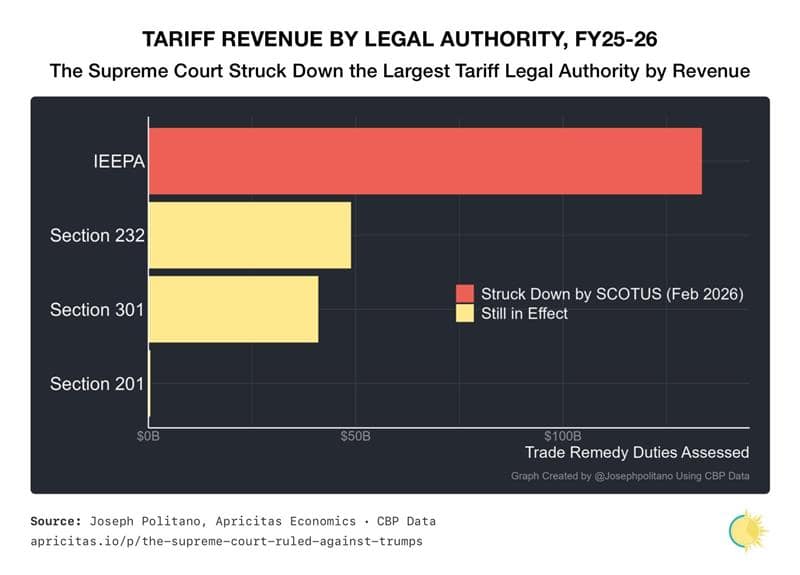
On February 20, the Supreme Court made a decision that reshaped U.S. trade policy. The Court ruled that many of President Donald Trump’s tariffs were unconstitutional. They found that he could not use the 1977 International Emergency Economic Powers Act to impose global tariffs. The ruling reinforced a key constitutional principle, stating that the power to tax lies with the legislative branch.

This decision immediately changed how tariffs could be imposed. The administration responded by using Section 122 of the Trade Act of 1974. It allows temporary tariffs of up to 15% for 150 days. However, Congress must approve any extension after that period.

These legal changes will directly affect prices, the dollar, and the long-term security of personal savings.

Blog Chart

1

Confusion Surrounds New Tariff Implementation

After the ruling, the administration quickly imposed a new 10% global import tariff. U.S. Customs and Border Protection informed shippers that imports would “be subject to an additional ad valorem rate of 10%”. Officials then signaled plans to raise it to 15%.2

This fast-changing situation has created widespread confusion. William Bain of the British Chambers of Commerce described the growing frustration. He said, “There is a weariness about the constant changes, the lack of any clarity and certainty in terms of tariffs… [Businesses] are frustrated and exasperated.”3

When businesses do not know their future costs, they delay hiring, expansion, and investment, slowing economic momentum.

Higher Prices, Inflation, and Greater Pressure on Consumers

Tariffs increase costs for companies that import goods. Those companies often pass those costs on to consumers. Over time, consumers absorb much of the burden.

Data shows just how much consumers carry this burden. Yale’s Budget Lab found Americans have absorbed 31–63% of tariff costs through higher prices. The New York Federal Reserve estimated businesses and consumers pay nearly 90% of tariff costs.4

Tariffs can also increase inflation across the broader economy. When inflation remains elevated, the Federal Reserve may delay cutting interest rates. Higher interest rates make borrowing more expensive, slowing home purchases, investment, and job growth.

Smaller businesses are especially vulnerable. They have fewer resources to absorb rising costs or adjust their supply chains.

Legal Battles and Refund Uncertainty

The Supreme Court ruling invalidated earlier tariffs that ranged from 10% to as high as 50%. This opened the door for companies to seek refunds for an estimated $130 billion in past payments. Hundreds of companies have already filed lawsuits, though the process may take years.

The White House has not confirmed whether refunds will be issued, and the outcome remains unclear. This legal uncertainty creates financial strain for businesses. Companies must operate without knowing whether they will recover past losses or face new tariff costs.

Tariff Decision Sparks Economic Uncertainty

Global Trade Disruptions and Rising Demand for Gold

The ruling has also disrupted global trade relationships. Countries including Japan, Britain, and the European Union now face ambiguity about existing agreements. One Japanese ruling party member described the situation as “a real mess.”5

These disruptions affect supply chains, business confidence, and global markets. Investors have responded by moving toward assets that have historically held their value during unpredictable times.

Gold rose after three consecutive weekly gains. Trade uncertainty and a weaker dollar fueled the rise. Bullion climbed as much as 2.2%, surpassing $5,200 an ounce before settling near $5,180.

Silver also moved higher, rising 3% to the $90 an ounce level. Gold has risen over 18% so far this year, following its best annual performance since 1979.6

Conclusion

The Supreme Court ruling has reshaped U.S. trade policy and sparked new volatility. Temporary tariffs are in place, legal battles continue, and businesses and consumers face higher costs. These changes can increase inflation, delay interest rate cuts, and slow economic growth.

When inflation rises and economic conditions become unpredictable, traditional financial assets may face pressure. Gold’s strong performance shows how investors respond to uncertainty by turning to physical assets with a long history of preserving value.

You can protect your financial future from the impact of trade disruption with physical precious metals. A Gold IRA offers long term protection from economic instability and helps safeguard your retirement savings. Call American Hartford Gold today at 800-462-0071 to learn how physical gold and silver can help secure your financial future.

Notes
1. https://www.apricitas.io/p/the-supreme-court-ruled-against-trumps
2. https://www.reuters.com/business/new-us-tariffs-come-lower-10-rate-2026-02-24/
3. https://www.bbc.com/news/articles/c98qjl76eyroo
4. https://www.bbc.com/news/articles/c98qjl76eyroo
5. https://finance.yahoo.com/news/gold-rises-trump-tariff-defeat-030341452.html
6. https://www.mining.com/gold-price-gains-on-tariff-geopolitical-risks/