













- Silver’s sharp pullback was driven largely by paper trading, margin pressure, and short-term momentum.
- Silver prices are predicted to rise as physical demand remains strong and supply remains tight.
- Physical silver can help protect your finances from inflation, market volatility, and dollar weakness.
Silver’s Paper-Physical Divide
After reaching record highs earlier this year, silver fell sharply from its January peak, dropping roughly 50% to around $60 an ounce. For anyone who watched the metal soar to historic highs only months ago, the reversal has been jarring. But the deeper picture reveals a more encouraging outlook.1
Much of the recent weakness has been concentrated in the paper silver market. Exchange-traded products, margin pressure, and short-term trading can create sharp swings. Physical silver, however, continues to show signs of strength. Industrial demand remains firm as supply remains tight. Analysts still see the potential for higher silver prices if fundamentals regain control of the market.
The Paper Market Shook Silver
Silver’s early-year surge was fast and intense. Some analysts saw the final move higher as more speculative driven rather than fundamentally driven. Paul Mladjenovic, author of Investing in Gold and Silver for Dummies, called the move a “mania” that pushed prices too far, too fast.
Several forces helped fuel the spike and then unwind it. India allowed pensions to invest in precious metals. The move unlocked about $1.7 billion of potential precious-metals demand.2 In addition, China designated silver a strategic asset. They began restricting its exports, limiting global supply. As rates and the dollar firmed, margin requirements tightened and short-term traders began heading for the exits.
Selling then fed on itself. Traders weren’t seeking long term ownership of the metal. They sought profit on contracts tied to silver’s price. Many were simply riding momentum. Then that momentum reversed. And the same paper-market forces that helped push silver higher began pulling it lower. None of that trading activity required anyone to hold an ounce of actual metal.
For retirees and savers, the distinction matters. A paper price can fall because of short-term trading pressure. Physical silver can remain in demand because businesses and governments can’t do without it.
Physical Demand Remains Strong
Silver holds a unique role as both a precious and industrial metal.
Demand continues to come from electronics, solar energy, and AI data centers. Silver’s unique properties make it difficult to replace in tech applications. It is no longer just a commodity to trade. Governments are increasingly treating silver as a strategic “critical material”.3
That creates a clear divide. Traders are focused on Fed signals, the dollar, margin pressure, and technical charts. Physical users are focused on availability, reliability, and long-term need.
Futures markets may be pricing silver like a cyclical commodity, even as physical supply tightens beneath the surface. Over time, that gap between paper price and real-world scarcity could become harder to ignore.
Supply Deficits Add Pressure
Silver supply is not easy to increase quickly. Much of the world’s silver is produced as a byproduct of mining for other metals. Miners cannot always respond to rising silver demand by simply producing more silver.
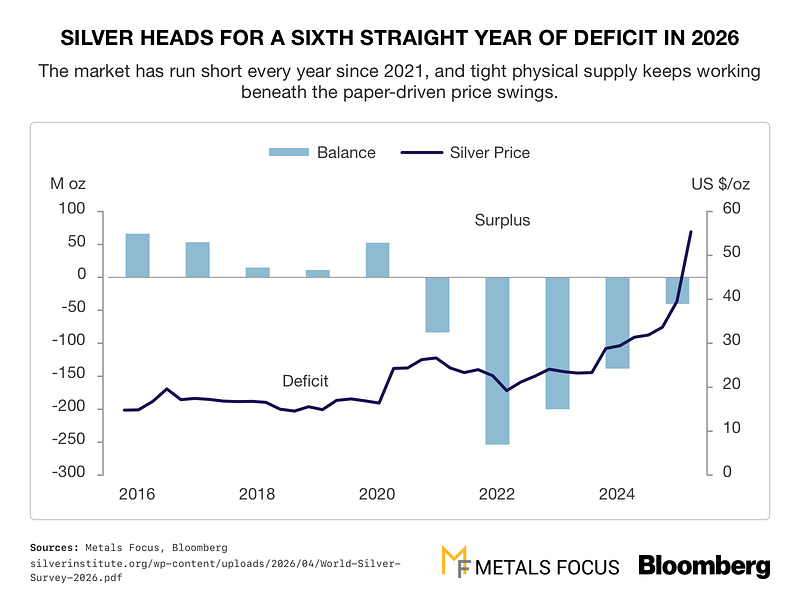
The Silver Institute projects that 2026 could mark a sixth consecutive year of supply deficit. Estimates foresee a shortfall of roughly 46.3 million troy ounces.5
Persistent deficits matter because physical markets eventually balance real supply with real demand. Paper trading can move prices in the short run. Physical shortages can reshape prices over time.
Analysts Still See Upside
Despite silver’s recent drop, several forecasts remain bullish.
J.P. Morgan has projected an $81 average silver price for 2026, driven primarily by industrial demand growth. Mladjenovic has said silver may need to build a base around $58 to $62 before potentially moving toward $80 by year-end and $110 to $130 next year. Investing Haven’s long range forecast is eyeing $140 by 2030.6
None of those forecasts are guaranteed. Fed policy, the dollar, margin requirements, ETF flows, and futures positioning can all create sharp moves. Silver could face more turbulence before any bullish scenario plays out.
If the paper market finishes shaking out weaker hands, silver may be positioned for renewed strength. The price action may look weak today, but the supply-and-demand picture still points to a more durable story.
Conclusion
Silver’s recent decline may be less a rejection of the metal and more a reset after an overheated rally. Speculative pressure pushed prices too far, too fast. The correction removed some of that excess while physical demand remains.
Based on forecasts, the recent weakness may give savers a chance to add silver before physical demand has a greater impact on prices.
If you want to protect your portfolio with physical silver in a Precious Metals IRA, contact AHG today at 800-462-0071.