











- Gold has surged above $4,300 as weaker jobs data, lower yields and a softer dollar reshape the financial outlook.
- Continued central bank buying and changing Fed expectations may provide longer-term support for gold.
- A Gold IRA may help protect your finances as uncertainty surrounding markets, currencies and the economy continues.
A New Tailwind for Gold
Gold has regained momentum in a big way.
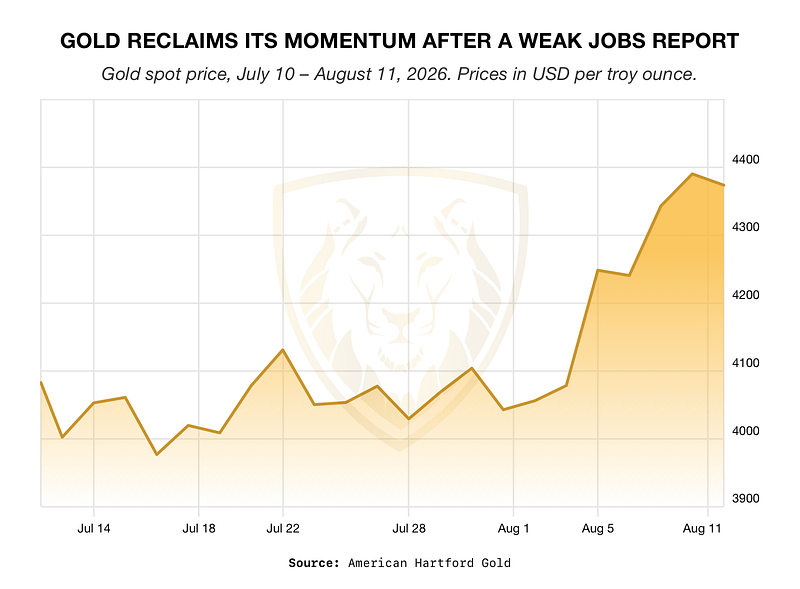
After falling below $4,000 an ounce in late June, gold has climbed back above $4,300, posting its strongest weekly performance since January. The metal gained more than 7% during the week ended August 7 as a surprisingly weak U.S. jobs report changed expectations for the economy and Federal Reserve policy.
Lower Treasury yields and a weaker dollar added support. And continued central bank buying has helped provide a longer-term foundation beneath the market.
Gold has long served as a barometer of confidence, and its latest surge may reflect growing doubts about the broader financial system.
A Weak Jobs Report Changes the Outlook
U.S. payrolls unexpectedly fell by 23,000 jobs during the month. Economists had expected the economy to add about 80,000 jobs. Earlier employment figures were also revised lower by a combined 103,000 jobs, suggesting that the labor market had already been losing momentum.2
The weaker report quickly changed expectations for Federal Reserve policy.
Before the data was released, markets put the probability of another September rate hike at about 57%. Afterward, those odds fell below 44%.
Gold often benefits when rate-hike expectations fade, since lower yields reduce the appeal of interest-bearing assets like Treasuries relative to gold.
The Dollar and Treasury Yields Weaken
The shift in Fed expectations quickly spread across financial markets.
Treasury yields moved lower after the employment report, reducing some of the income advantage available from government bonds.
The U.S. dollar also weakened, with the dollar index falling to around 99.5 following the jobs report.
Because gold is priced globally in dollars, a softer U.S. currency can make the metal more affordable for buyers using other currencies. Dollar weakness can also signal changing expectations about U.S. monetary policy and the economy.
Falling Oil Prices Remove Another Headwind
Energy prices have also played a role.
Earlier this year, elevated oil prices added to concerns that inflation could remain stubborn. Persistent inflation can make it harder for the Federal Reserve to ease monetary policy.
More recently, improving conditions surrounding shipping through the Strait of Hormuz have helped take some pressure off oil prices.
Lower energy costs may give the Fed greater flexibility if the economy continues to weaken.
Geopolitical uncertainty has not disappeared, however. Continued tensions in the Middle East can still encourage demand for assets traditionally viewed as safe havens.
Gold may therefore benefit from easing inflation pressure while concerns about global stability remain elevated.
Central Banks Continue Buying Gold
Central bank demand adds a longer-term backdrop.
According to the World Gold Council’s latest survey, 89% of central banks expect global gold reserves to increase over the next year. A record 45% expect their own institutions to buy more.
Their reasons are also revealing. Ninety percent cited gold’s performance during times of crisis as an important reason for holding the metal.3
China has remained an active buyer. Meanwhile, South Korea recently announced plans to purchase physical gold from domestic producers for the first time in more than a decade.
Central banks appear to see an expanding role for gold as currencies, interest rates and geopolitical conditions continue to shift.
Gold as a Measure of Confidence
The forces behind gold’s rally may look separate at first.
Employment is weakening. Expectations for higher interest rates are fading. The dollar has come under pressure, while governments continue accumulating physical gold.
Together, they point toward a broader issue: confidence.
Gold does not depend on the earnings of a company or the creditworthiness of a particular government. For generations, people and institutions have held it during periods when confidence in traditional financial assets becomes less certain.
The latest rally may therefore be more than a reaction to one economic report. It may represent a broader reassessment of confidence in the financial system itself.
What Comes Next
Inflation will likely provide the next important signal.
If price pressures continue to cool while employment weakens, the Federal Reserve may have more room to keep rates steady or eventually move toward easier policy. Such an environment could continue supporting gold.
Stronger inflation could push expectations in the other direction and create short-term pressure on the metal.
Some major financial institutions nevertheless remain bullish on gold’s longer-term outlook. After gold broke above $4,250 an ounce, UBS strategists reiterated their price target, writing:
“But while the immediate backdrop may remain volatile, the medium- to long-term case for gold still looks supported by several durable drivers. We expect gold prices to rise toward USD 5,000/oz in the first half of 2027.”4
Whether the rally continues or UBS’s forecast proves right, the forces behind it extend beyond a single trading session. Changes in employment, monetary policy and confidence in the dollar can all affect Americans whose savings and retirement portfolios remain closely tied to traditional financial assets.
If you want to protect your portfolio with physical precious metals in a Gold IRA, contact AHG today at 800-462-0071.


