












- BRICS is building payment networks, gold reserves and financial systems that could gradually reduce reliance on the U.S. dollar.
- Growing BRICS financial and geopolitical cooperation could weaken Western influence and create new risks for American retirement portfolios.
- A Gold IRA can help protect your finances as the global financial system becomes less dependent on the dollar.
The Dollar’s Changing Global Role
For decades, the U.S. dollar has sat at the center of the global financial system. International trade, central-bank reserves and cross-border payments have all depended heavily on the dollar and the financial infrastructure surrounding it.
The September 12–13 BRICS summit in New Delhi could mark another step toward changing that system.
BRICS leaders are expected to discuss closer connections between their national payment networks and potentially their central bank digital currencies (CBDCs). The goal is to make it easier for member nations to trade with one another without automatically relying on dollars.
BRICS countries now represent roughly 40% of global GDP. Even a gradual shift in how those economies move money could matter. The dollar does not have to disappear for its dominance to weaken. Every new payment option and local-currency transaction can make it a little less necessary.
Building the Plumbing for Dollar-Free Trade
Reserve Bank of India Governor Sanjay Malhotra recently confirmed that BRICS members are discussing ways to connect national payment systems and central bank digital currencies.1
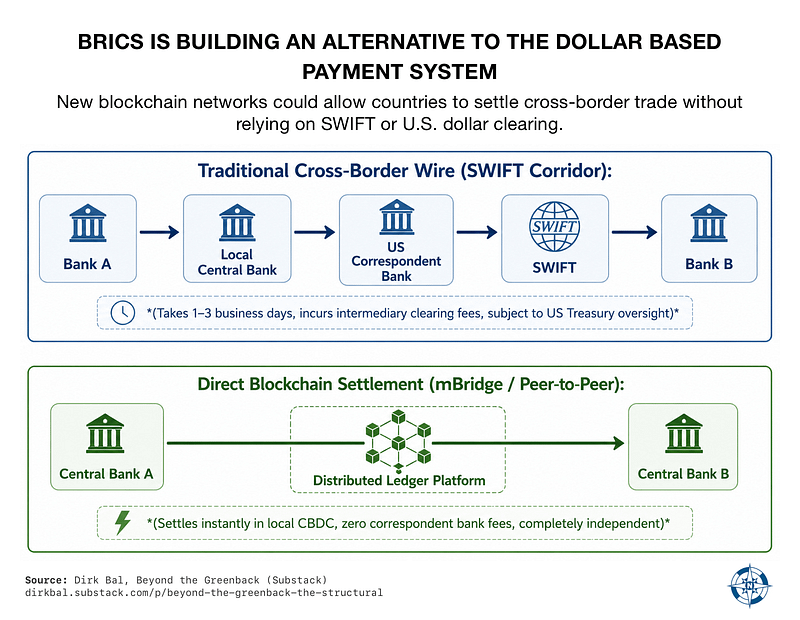
Much of global commerce currently settles in dollars, even when neither party to a transaction is American. The system creates steady worldwide demand for dollars while giving the United States significant financial influence through the networks surrounding its currency.
A functioning BRICS payment network could allow more energy, commodity and other transactions to take place without using dollar-clearing systems.
The technology is no longer entirely theoretical. Project mBridge, a multi-CBDC platform, has already demonstrated real-time cross-border settlement outside SWIFT. Full-scale adoption may still be years away, but the groundwork is being established.
Dollar dominance can erode gradually, transaction by transaction.
A New BRICS Currency Is Not Required
BRICS members do not agree on creating a common currency. India has taken a cautious position, favoring greater use of national currencies in trade instead.3
The disagreement does not prevent countries from reducing their reliance on the dollar.
Trading partners can increasingly settle transactions directly in rupees, yuan or other national currencies. One transaction conducted outside the dollar system makes little difference. Millions of similar transactions can gradually reduce the amount of dollar liquidity needed for global commerce.
Why BRICS Countries Are Building Gold Reserves
Reducing dollar reliance in trade solves only part of the problem. Countries also need an alternative to the dollars held in their reserves.
Gold offers an important option.
Foreign currencies depend on the policies and financial systems of the countries that issue them. Government debt depends on the government behind the obligation. Physical gold has no issuing government and requires no counterparty promise.
For countries seeking greater financial independence, gold provides a reserve asset outside the dollar-based system.
China has been particularly active. The People’s Bank of China reported 20 consecutive months of gold purchases through June 2026, bringing official holdings to approximately 2,346 metric tons. Gold represented about 8% of China’s official foreign-exchange assets.4
An Alternative Gold Market
Russia has proposed a broader BRICS precious-metals system that could eventually include pricing benchmarks and clearing mechanisms. BRICS also support greater precious-metals trade through common quality standards.
But China is already building the infrastructure needed to support a larger role in the physical gold market.
The Shanghai Gold Exchange has become one of the world’s largest gold-trading centers. Placing a strong emphasis on physical bullion, they are positioning themselves to compete directly with London’s OTC bullion market (LBMA ecosystem) and COMEX in New York.5
Deeper BRICS bullion markets could give member nations a place to trade and store gold outside traditional Western centers. It could strengthen their financial independence while reducing the West’s influence over a market increasingly driven by Asian demand.
BRICS Is Cooperating Despite Its Differences
BRICS remains a group of countries with different political and economic interests. However, cooperation can still move forward in other areas.
The Strait of Hormuz crisis could give BRICS a chance to show its growing geopolitical influence. India and China may use the upcoming summit to rally members behind efforts to reopen the strait and support a diplomatic solution involving fellow BRICS member Iran. Such an effort could offer an alternative to U.S.-led diplomacy. Success would strengthen BRICS’ case as a geopolitical counterweight as it works to build greater financial independence from the West.6
Conclusion
Less international dependence on dollars could eventually reduce a major source of structural demand for the currency. Lower demand can pressure the dollar’s value, making imports more expensive, adding to inflation, and complicating the interest-rate outlook. Higher rates can weigh on stock valuations and borrowing, while weaker purchasing power can reduce the real value of retirement savings.
No single BRICS initiative is likely to transform the financial system alone. The larger risk comes as more alternatives to the dollar begin to add up. BRICS countries are building new payment connections, using more local currencies and growing their gold reserves. The dollar does not have to collapse for the global financial order to shift. Tiny drips away from the dollar can add up over time, eventually creating an ocean of change.
If you want to protect your portfolio from the impact of changing global economy, learn more about holding physical precious metals in a Gold IRA. Contact AHG today at 800-462-0071.


