















- Michael Burry believes the AI-driven stock rally resembles the final stages of the dot-com bubble
- High valuations and growing market concentration could leave retirement accounts more exposed than many savers realize.
- Physical gold may help diversify a portfolio that has become heavily dependent on highly valued stocks.
AI Boom Echoes the Dot-Com Bubble
Michael Burry is best known for predicting the 2008 housing crash, a bet later portrayed in “The Big Short.” Now, Burry is warning about another potential bubble.
He recently compared the artificial intelligence stock boom to “the last months of the 1999-2000 bubble.” According to Burry, stocks are rising because of momentum and enthusiasm rather than traditional economic fundamentals.
Burry posted, “The end is nigh,” then added, “the AI narrative is nothing more than mass addiction.”1
Burry is not predicting that artificial intelligence will fail. Much like the internet, AI could transform the economy over time. His concern is whether stock prices and corporate spending have moved too far ahead of the technology’s ability to generate profits.
Spending First, Profits Later
Technology companies are committing enormous amounts of money to AI chips, data centers and supporting infrastructure.
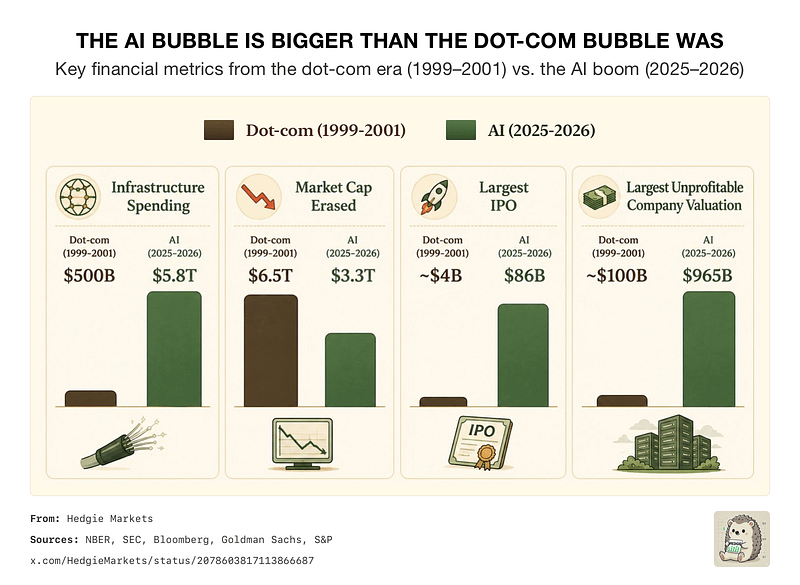
Hyperscaler AI capital spending is reportedly on pace to reach approximately $725 billion this year. Much of it is concentrated among a small number of the largest technology companies. Investors have frequently rewarded announcements of larger AI budgets before companies demonstrate how those projects will produce sufficient revenue.
Burry believes the spending has created a self-reinforcing cycle. Rising AI budgets push related stocks higher. Higher stock prices encourage additional spending and attract buyers who fear missing the rally.
Valuations and Concentration Are Rising
Several widely followed market measurements suggest stock prices have reached historically elevated levels.
The Buffett Indicator compares the total value of the stock market with the size of the economy. It has reportedly climbed above 230%. The measure stood at approximately 140% near the peak of the dot-com bubble.3,4
The cyclically adjusted price-to-earnings (CAPE) ratio for the S&P 500 reached approximately 39.5 in October 2025. A similar level had previously been seen only during the period leading up to the dot-com crash.5
Market concentration has also increased. The ten largest companies in the S&P 500 now account for more than 40% of the index’s total value, compared with approximately 23% in 2000. Nvidia alone has reportedly been responsible for close to one-fifth of the S&P 500’s gains this year.6,7
Recent gains do not prove that a crash is approaching. However, elevated valuations and narrow market leadership may leave the broader market increasingly dependent on a small group of companies meeting extremely ambitious expectations.
Other Market Veterans See Warning Signs
Burry is not the only experienced market observer comparing current conditions with 1999.
Billionaire hedge fund managers Ken Griffith and Paul Tudor Jones have said the current environment feels similar to the final stages of the dot-com boom. Jones has warned that another major rally could push total stock market value to between 300% and 350% of gross domestic product, creating conditions for a painful correction.
Opinions still differ widely. But the disagreement may not be about whether AI has a future. It may be about how much of that future has already been reflected in stock prices.
When Could a Decline Begin?
Burry has not predicted a specific date for a market reversal. He acknowledges that speculative rallies can continue for weeks, months or even years. His mixed forecasting record also shows that investors who identify a bubble too early may still suffer losses while waiting for prices to fall. His broader message is that preparation matters more than prediction.

A Decline Could Last for Years
The dot-com crash offers a reminder of how severe a technology-led downturn can become.
The Nasdaq Composite lost nearly 78% from its March 2000 peak to its October 2002 low. Semiconductor stocks fell approximately 84% between 2000 and 2002. The Nasdaq did not regain its previous record until 2015.8
A modern decline could also affect a wider range of savers. Passive index funds now play a much larger role in retirement accounts than they did in 2000. Many hold substantial positions in the same small group of dominant technology companies. Earlier this year, the Magnificent Seven lost about $2.2 trillion in market value in just one month. Their losses quickly hit millions of retirement accounts.
A prolonged decline could be especially damaging for those, like retirees and people approaching retirement, who do not have the luxury of time to recover.
Conclusion
Gold cannot prevent a market decline, and its price can rise or fall. However, physical gold may help diversify a retirement portfolio because its value does not depend on corporate earnings, AI spending or the performance of a single industry.
During the dot-com crash, gold rose roughly 15% compared to the Nasdaq’s 78% collapse over that same stretch. No one can reliably predict when market enthusiasm will end. Burry’s warning is reason to examine whether too much of one’s financial future depends on the continued rise of a handful of AI-linked stocks. Physical gold can provide added diversification without worrying if Burry wins another big bet against the market.
If you want to learn more about protecting your portfolio with physical precious metals in a Gold IRA, contact AHG today at 800-462-0071.