












- JPMorgan CEO Jamie Dimon warns that expensive stocks and pressured long-term bonds may carry greater risks.
- JPMorgan Research points to gold as a store of value supported by continued central bank buying.
- Physical gold in a Gold IRA can help protect your finances from market, currency, and geopolitical risks.
As Uncertainty Rises, Banks Choose Gold
Jamie Dimon is the CEO of JPMorgan Chase, the largest bank in America. And right now, he says there are two things he wouldn’t touch with his own money: the broad U.S. stock market and long-term Treasury bonds. 1
His reasoning is straightforward. Geopolitical conflict, large fiscal deficits, rising debt, and the possibility of more inflation all make it harder for stocks and bonds to deliver the kind of returns investors have gotten used to. In other words, the usual “safe” choices are not looking especially safe right now. His warning comes as JPMorgan Global Research points to an alternative: physical gold.
Support For Gold
JPMorgan expects gold to average approximately $6,000 per ounce during the final quarter of 2026, with prices potentially reaching $6,300 by the end of 2027.2
Central bank demand is one of the main forces behind that forecast. From 2021 through 2025, central banks purchased an average of approximately 225 tons of gold per quarter. The pace was roughly twice the average recorded between 2016 and 2020.3
Central banks are not short-term traders. They generally buy gold as part of a broader strategy to diversify their reserves, reduce currency risk, and limit their dependence on dollar-based assets. Consistent institutional buying can also help provide a floor of support under gold prices. Even when demand from other buyers slows, central banks may continue accumulating the metal for strategic reasons.
Natasha Kaneva is J.P. Morgan’s head of Global Commodities Strategy. She said, “The long-term trend of official reserve and investor diversification into gold has further to run.”4
Central Bank Buying May Be Understated
Official reports already show strong gold demand. But the actual level of central bank buying may be even higher as some purchases go undisclosed.
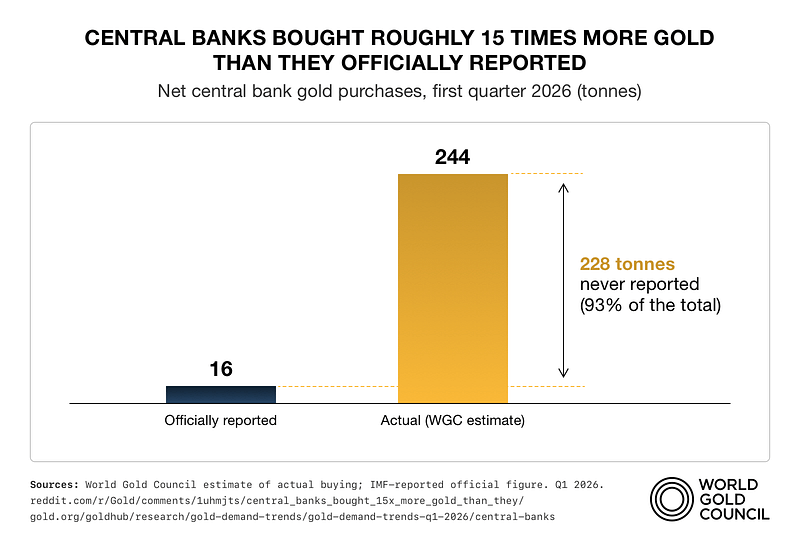
China appears to be one of the largest sources of that hidden demand.
Goldman Sachs estimated that China purchased more than 48 tons of gold through the London over-the-counter market in May. The People’s Bank of China officially reported buying only 10 tons during the same period.
Official figures show China adding approximately 40 tons of gold to its reserves in 2026. More conservative estimates suggest the real total may have been closer to 80 tons.6
The World Gold Council has also used trade flows and London market activity to estimate broader central bank demand. Its analysis indicated that central banks purchased approximately 244 tons during the first quarter of 2026, exceeding the estimated 208 tons bought during the final quarter of 2025.7
China’s activity may be part of a long-term effort to reduce reliance on the U.S. dollar and strengthen its financial position in an increasingly divided global economy.
The strategy gained greater urgency after Western governments froze Russian central bank assets in 2022. Other countries saw that foreign currency reserves could become vulnerable during geopolitical conflicts or sanctions.
Gold does not carry the same counterparty risk. A country that holds physical gold directly does not depend on another government or financial institution to honor its value.
If China and other central banks are purchasing more than official reports indicate, the demand supporting gold could be much stronger than markets recognize.
Gold’s Pullback May Be Nearing Its Floor
Gold has pulled back from its recent highs, but technical analysis from Sprott suggests the decline may be approaching exhaustion.
Paul Wong is a market strategist at Sprott. He found that gold had moved into deeply oversold territory across several technical measures. Oversold conditions can develop when selling becomes unusually heavy and prices fall faster than the longer-term outlook may justify.8
Gold has also historically experienced seasonal weakness during the summer. Previous cycles have often produced lows around late July or early August before demand and momentum returned later in the year.
No technical indicator can identify the exact bottom. However, the current setup suggests gold may be closer to the end of its pullback than the beginning.
Selling pressure may already have removed many short-term traders from the market. A change in Federal Reserve expectations, stress in the bond market, or another geopolitical event could provide the catalyst for renewed momentum.
Conclusion
Central bank buying is helping provide a floor under gold prices. Meanwhile rising debt, persistent inflation, de-dollarization, geopolitical instability, and changing Fed policy could drive the next move higher.
Stocks remain expensive, and long-term bonds face pressure from deficits, inflation, and elevated yields. Even JPMorgan Chase CEO Jamie Dimon has warned that he would not buy the broad stock market or long-dated Treasurys at current prices.
With traditional assets facing greater uncertainty, physical gold can provide diversification and protection outside the stock and bond markets. To learn how a Gold IRA can help protect your retirement savings, contact American Hartford Gold today at 800-462-0071.


