






Key Takeaways:
- Presidential dollars are not made of pure gold. They are only gold in color.
- The presidential series introduced edge inscriptions with the date, mint mark, “E PLURIBUS UNUM,” and “IN GOD WE TRUST.”
- The series created coin varieties with missing and doubled lettering in 2007 and 2008.
The Presidential $1 Coin Program highlights some of history’s most notable political figures. Beginning in 2007, the U.S. Mint released four designs per year in order of service, each displaying a presidential portrait on the front and the Statue of Liberty on the back.
The program piqued public curiosity, and the pieces were widely distributed, generating even more conversation. In this guide, we’ll cover how the presidential coin series came about and dive into individual pieces by year from George Washington to James A. Garfield.
How Did the Presidential Series Begin?
The series launched in 2007 with one motive: to highlight U.S. presidents on dollar coins as a way to honor them and serve as an educational tool on history for the public.
How To Read Edge Lettering
Edge lettering helps set this series apart. The inscriptions include the date, mint mark, “E PLURIBUS UNUM,” and “IN GOD WE TRUST” in the early issues. Then, later, the motto was moved to the front.
Since the edge lettering is applied as a separate step, it can sometimes be missing, doubled, weak, or improperly positioned.
Position A reads upright when the portrait faces up and the edge rolls away from you, and Position B reads upright when the portrait faces down. A missing inscription means a smooth edge all the way around. Doubling looks like a second set of letters.
Weak or partial lettering appears in patches and can stem from die quality issues or hasty production.
Design and Composition
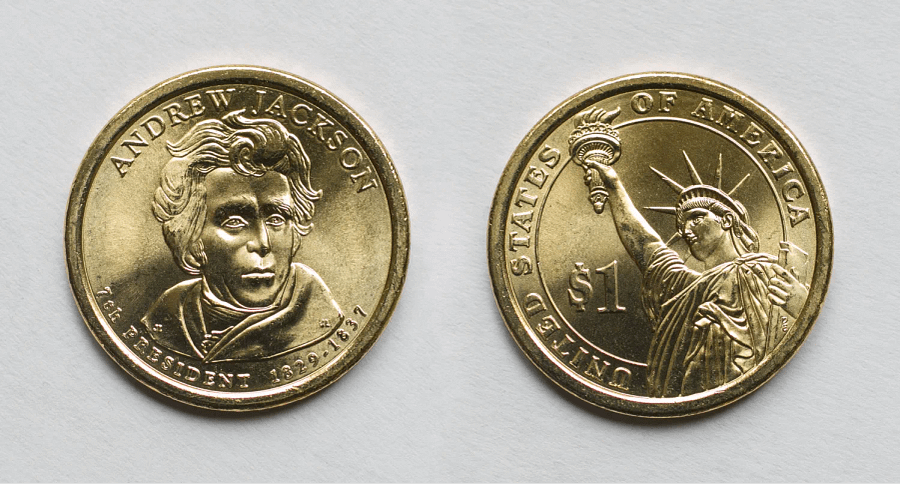
On the front, each president receives a portrait, name, years of service, and order number. The back displays the Statue of Liberty and the denomination $1. This consistency makes it easier to compare portraits and also gives the set a more cohesive look on display.
The metal alloy is what produces the coin’s golden color, and the sheen dulls over time with circulation, making uncirculated examples easier to spot. You can also inspect the edges of a piece to verify color uniformity.
From Washington to Madison (2007)
The first four presidential dollars arrived in 2007, starting with George Washington, and followed by John Adams, Thomas Jefferson, and James Madison. The new edge-lettering process drew significant attention from the public.
At the same time, the U.S. Mint was offering uncirculated and proof sets to collectors. These protected coin surfaces are less prone to wear and often receive higher grades, which is an essential factor for those building premium sets.
George Washington
The 2007-P Washington dollar with the edge inscription missing quickly became the most popular piece in the series. The planchets skipped the edge-lettering step during production, then the coins were struck and shipped with no date or mottos. At first glance, this coin looks normal.
Many discovered the error only after someone suggested looking closer around the edge. The nickname “Godless dollar” came about because “IN GOD WE TRUST” was the text that originally appeared on the edge.
John Adams
Some John Adams dollars show the edge inscription being applied twice, often with a slight rotation between impressions. The result is shadowed or overlapping letters that are easy to spot, no magnification needed.
These coin errors served as a reminder of the importance of inspecting the edges on 2007 coins. Missing edge lettering also appears on some of these dollars, but the doubling is the most common error for this former president’s coin.
Thomas Jefferson and James Madison
Jefferson and Madison saw fewer errors, which means variety hunters are more focused on Washington and Adams. However, high-grade circulation strikes and quality proofs of these 2007 presidential coins can still turn heads, especially when the surfaces are free of wear.
From Monroe to Van Buren (2008)
The second year of the program brought James Monroe, John Quincy Adams, Andrew Jackson, and Martin Van Buren.
Public curiosity remained strong, and the edge lettering error was still a hot topic. Van Buren’s “smooth edge” dollars continued the trend, proving this phenomenon was not limited to the initial launch.
If you’re a collector who enjoys learning about history as you acquire new pieces, 2008 offers an interesting arc, spanning from the Monroe Doctrine to the political climate of the 1830s. The portraits are easy to distinguish, which makes them ideal for new collectors building sets for the first time.
Martin Van Buren
Van Buren’s missing edge lettering error is similar to the story of the Washington dollar.
Again, the coin appears normal at first glance, but after closer inspection, it reveals a smooth edge with no inscriptions. There should be a complete lack of lettering all the way around the coin’s edge. Partially missing letters or weak areas in the text are not what collectors are searching for.
When evaluating these coins, confirm the omission of letters is complete and that their surfaces are clean and bright. Rolling the edge under a light helps avoid mistaking simple wear for a true manufacturing error.
Comparing a normal Van Buren coin to the suspected error coin can make this process easier. The contrast makes the defect obvious when you hold them side-by-side.
James Monroe, John Quincy Adams, and Andrew Jackson
James Monroe, John Quincy Adams, and Andrew Jackson did not generate nationally known errors in the same way as other presidential coins did. Their coins gain attention from being kept in good condition. Circulation pieces with strong luster and minimal contact marks are always highly sought after on the market.
Uncirculated coins from mint sets offer a higher chance of finding pieces with high grades because they were packaged with more care. Proof coins from the mint in San Francisco include mirror-like fields and frosted design details for those who appreciate a premium look.
Since the portraits vary widely in hair texture and detail, the grading process can look a bit different from coin to coin. Jackson’s portrait, for example, has open fields that make any contact marks easy to spot, but Monroe’s hair can hide small marks from view. Even if you never send a coin out for certification, knowing what to look for helps build the best collection.
From Harrison to Taylor (2009)
The 2009 lineup highlighted four presidents: William Henry Harrison, John Tyler, James K. Polk, and Zachary Taylor.
The art style remains consistent, so the primary focus can be on each individual president. This year did not continue the missing-edge errors, which allowed the market to shift focus onto overall condition, strike quality, and other factors.
William Henry Harrison
Harrison’s one-month presidency brought a large amount of public interest. His coin’s portrait gives him a dignified profile with open fields that reveal the piece’s luster. Those same open fields are highly susceptible to marks as coins move through storage bags, hands, and other environments, which is why you’ll want to inspect each coin with care.
Families who are building coin sets with the younger generation often find the Harrison dollar coin to be a great storytelling piece due to the uniqueness of his term.
With this in mind, we know the Presidential dollar series has accomplished what it set out to do — honor former presidents and educate the masses.
Andrew Jackson, James K. Polk, and Zachary Taylor
Andrew Jackson’s portrait has slightly larger open fields where any marks would be quite obvious at a glance. When searching coin rolls, tilt the coin under a lamp to see if the fields remain clean through a full rotation.
James K. Polk’s portrait brings more detail in the hair texture and elements that can hide small signs of wear. Zachary Taylor’s coin rests somewhere between the former two, including enough detail to hide minor marks and possessing clear, open fields.
Proof coins from San Francisco remain a top choice for individuals who desire contrast. Look for mirrored fields and frosted design details on the coin. Uncirculated pieces should have even surfaces without evidence of handling.
From Pre-Civil War to Lincoln (2010)
The 2010 presidential releases included Millard Fillmore to Franklin Pierce and James Buchanan to Abraham Lincoln. This sequence of coins makes a clear connection to the Civil War era, lending it extra significance.
As anticipated, Lincoln commands the most attention, since many collectors and non-collectors alike feel a connection to his story. The U.S. Mint’s variety for 2010 allowed people to enjoy the design in circulation strikes, uncirculated finishes, and proofs. While 2010 did not produce any edge-lettering errors, it did produce interest in building a mini coin set that ends with Lincoln.
The Lincoln Presidential Dollar
Lincoln’s presence in the series was highly anticipated and met with a warm welcome. The portrait represents a calm strength that pairs well with the symbol of Lady Liberty on the back.
Circulation pieces often have wear, so finding an unmarked Lincoln coin would be quite an accomplishment.
The demand for high-grade Lincoln dollars remains because the audience drawn to these pieces is very broad. Even those who never planned to collect and build a full set will still hold on to a top-quality Lincoln dollar as a keepsake, with some planning to pass it down within the family.
Millard Fillmore, Franklin Pierce, and James Buchanan
Millard Fillmore’s portrait has balanced fields that look their best when the planchet is sharply struck.
Franklin Pierce’s coin often carries light contact marks in the open fields, so inspecting it closely under good light is very important. James Buchanan’s portrait offers more texture and can hide small nicks in the surface.
These presidents also expanded the history lesson to include more than a single famous figure. You could conduct a brief review of the Compromise of 1850, the rising tensions over slavery, and the national sentiment that preceded the outbreak of the Civil War in 1861. The mini coin set ending with Lincoln makes the series feel complete.
From Johnson to Garfield (2011)
The 2011 coins feature Andrew Johnson, Ulysses S. Grant, Rutherford B. Hayes, and James A. Garfield. This group carries the story from the initial postwar years into the Gilded Age.
Public demand for dollar coins was significantly lower by this time, but the U.S. Mint continued to ship large quantities for circulation.
By late 2011, officials announced a shift that would send future presidential dollars primarily to collectors instead of commerce, so Garfield became a natural stopping point for many circulation-focused sets.
Ulysses S. Grant and Rutherford B. Hayes
Ulysses S. Grant’s coin often attracts fans outside of the collector realm due to the familiarity of his name. The portrait depicts a strong figure that many learned about in school. When you search and sort through coins, inspect the fields around his cheek and the open space near the rim. Those areas are the first to pick up marks.
Rutherford B. Hayes offers a different appeal with his textured beard and collar details that can hide small nicks and reveal low strike quality. If the beard and collar lines are sharp and the open fields are clean, you have a decent piece in your possession.
James A. Garfield
Garfield’s coin completes the 2011 run. The portrait displays balanced fields with clear luster, making grading much more straightforward. Proofs also depict the design beautifully and can easily complete a four-coin 2011 proof set.
Since the later years of the coin program shifted toward collector channels, many decide to pause at Garfield, then revisit the rest of the series later when they are ready to explore proofs and limited releases.
Acquire Precious Metals With AHG
From Washington to Garfield, Presidential dollar coins can transform American history into something you can hold, trade, and use as an educational tool. The early years of the coin program brought unique varieties, strong portrait design, and public intrigue.
If you’re looking to add to a personal collection, American Hartford Gold has a wide selection of silver and gold bars and coins you can choose from. For those also exploring long-term retirement options, a Gold IRA can help protect the value of your savings.
FAQs
Are Presidential dollar coins made of real gold?
No. They have a gold color to them because of their alloy, not their metal content. The coins are made of a copper core with outer layers that produce their golden hue.
What are the most famous varieties between Washington and Garfield?
The 2007-P George Washington with the missing edge lettering and the 2007 John Adams with doubled edge lettering are in the lead. Martin Van Buren “smooth-edge” dollars from 2008 are close behind.
What is Position A versus Position B on the edge lettering?
These terms are used to describe the orientation of the coin’s edge text relative to its front side. If the portrait faces up and the edge text reads upright, that is Position B. If it reads upside down, that is Position A.
Why do many collectors stop at President Garfield?
In late 2011, the distribution approach shifted. Later, Presidential dollars were produced mainly for collectors instead of being pushed into standard circulation. James A. Garfield is the last president before that change was implemented, so he creates a natural stopping point.
What finish should I buy if I want the best-looking coins?
Proof coins from San Francisco offer deep mirror-like surfaces and frosted design elements, which many people find visually appealing. Uncirculated set coins display a smooth, even surface without the marks commonly found on circulation pieces.
Sources:
Edge Lettering and Numbering | NNP
Washington Presidential Dollar Error Coin Gallery | Spruce Crafts
Monroe Doctrine (1823) | National Archives