






World Economy Faces Mounting Risk
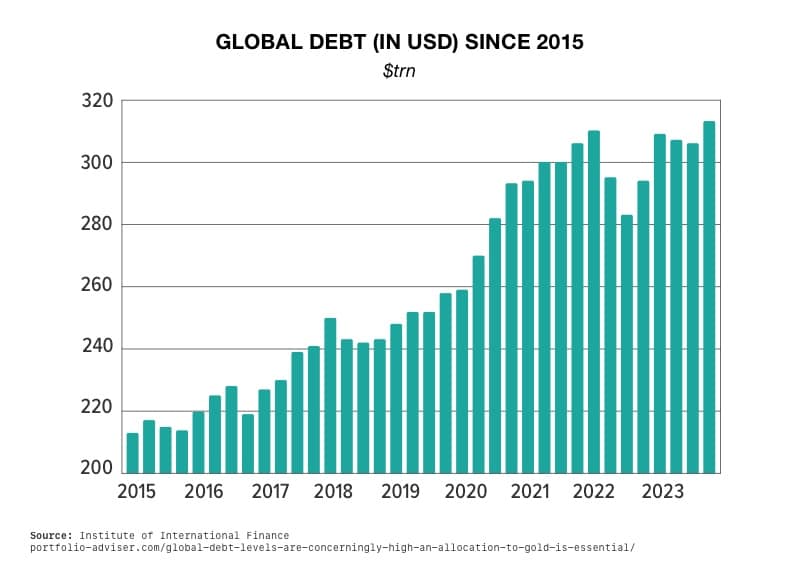
According to a recent report, it’s not just America drowning in debt; it’s the whole world. Total global debt has reached a staggering $337.7 trillion. For context, the World Bank puts global GDP for 2024 at only $111 trillion. Since the pandemic, nations have been living large on borrowed money and borrowed time. Now the global economy is teetering on the edge of collapse. Analysts are asking how much longer the world can keep piling on debt before the system buckles under its own weight.1
And the problem is accelerating. The first half of 2025 alone saw global debt rise over $21 trillion. The global debt-to-output ratio is hovering around 250%.2
It’s even worse for emerging markets. Their total debt climbed by $3.4 trillion in the second quarter to exceed $109 trillion. They now face an unprecedented refinancing challenge. Nearly $3.2 trillion worth of bonds and loans must be repaid or refinanced before the end of 2025. This is coming at a time of tightening and rising borrowing costs. 3
4
Government Debt Drives the Increase
The majority of the debt increase is from government borrowing. Owing $58.8 trillion, the U.S. accounts for the largest share of total global non-household debt. Of that, government borrowing makes up $31.8 trillion. The remainder is from financial and non-financial corporations. China follows the U.S. with $26.1 trillion. Japan ranks third with $11.1 trillion. France and the U.K. complete the top five. 5
The Institute of International Finance (IIF), who produced the report, noted that “the scale of this increase was comparable to the surge seen in H2 2020, when pandemic-related policy responses drove an unprecedented buildup in global debt.” But this debt spike is worrying because there is no global health crisis to justify the borrowing. 6
The IFF said that the U.S. government has fallen into what economists call a “debt trap”. U.S. short-term borrowing now accounts for approximately 20% of total government debt and roughly 80% of Treasury issuance. As a result, the government is increasingly vulnerable to interest rate changes and refinancing risks. 7
The IIF warned that this trend could push politicians to pressure central banks to keep interest rates low. And put the Fed’s independence at risk. If people lose trust in the Fed as an inflation fighter, long-term interest rates can rise, confidence in the currency can drop, and borrowing money can become more expensive.
Bond Markets Under Pressure
The scale of the current debt mountain is undermining global bond markets. They are straining under the weight of massive issuance requirements. In the United States alone, nearly $14 trillion in debt rolled over from G10 countries earlier in 2025. Enormous supply pressures are resulting. Leading voices like Ray Dalio are warning that eventually there simply won’t be enough buyers for our debt. And as a result, rates and inflation will spike.
Already, G7 ten-year yields are near their highest levels since 2011. In the United States, 30-year Treasury yields have exceeded five percent. That level hasn’t been seen since 2007 when Moody’s downgraded the U.S. sovereign credit rating.8
The IIF warned that fiscal strains could intensify as financial markets witness the return of so-called “bond vigilantes”. These investors sell off massive amounts of government bonds when they perceive fiscal mismanagement. Their efforts to enforce fiscal discipline drive borrowing costs way up.
Global Financial System Under Strain
The debt crisis exposes long-standing weaknesses in the global financial architecture. Since the 2008 financial crisis, banks and other financial middlemen have shifted from giving loans mainly to private businesses to buying more government debt. This has created a “sovereign-bank doom loop” risk. A drop in government creditworthiness could hurt the banks. This may force governments to step in to prevent a collapse. That intervention can add even more debt to already stretched public finances.
Conclusion
The global debt crisis of 2025 represents a defining moment for the world economy. Governments and central banks face increasingly limited options. Gold’s meteoric rise reflects investors fleeing risky markets in search of safe havens. The choices made in the coming months will reverberate through the global economy for decades. You can choose to protect the value of your savings today with a Gold IRA. Contact American Hartford Gold at 800-462-0071 to learn more.