












- China’s weakening economy could send new volatility into American markets and retirement accounts.
- As confidence erodes, China is buying more gold and helping create a floor under prices.
- Physical gold in a Gold IRA can help protect your finances from global shocks tied to China’s slowdown.
China’s Gold Lesson
President Trump’s recent trip to China exposed one of the biggest contradictions in the global economy: China is America’s chief economic rival, yet the American economy is still deeply tied to China’s fate. As its economy struggles, China’s central bank and ordinary citizens are buying gold. China’s slowdown may export volatility to America, while its gold buying shows Americans where to turn for protection.
China Is Losing Steam
Behind the diplomatic headlines, China’s economy is showing deeper strain, including a property collapse, weak consumer confidence, deflationary pressure, and rising debt.
The property crisis is the center of the problem. For decades, real estate powered Chinese growth and household wealth. At its peak, property accounted for roughly one-quarter of China’s economy. Now that engine has stalled. Home prices have been falling for years, and major developers remain under pressure.1
The damage reaches far beyond housing. Falling home values make families feel less secure, and less secure families spend less. In April, China’s retail sales rose just 0.2% from a year earlier, the weakest pace since December 2022. A property crisis is becoming a confidence crisis.2
Deflation makes the problem harder to escape. Falling prices may sound good at first, but in a weak economy they can signal shrinking demand. Companies cut prices to compete, then cut wages or jobs to protect profits. Consumers delay purchases because they expect better deals later.
China’s debt burden adds another layer of risk. Local governments borrowed heavily during the boom years, often relying on land sales and property development to fund growth. With the property market weakened, that old model no longer works the same way. By late 2025, China’s total non-financial debt had climbed to roughly 296% of GDP, leaving less room to power growth with more borrowing.3
Taken together, China’s problems point to more than a normal slowdown. The world’s second-largest economy is losing confidence across property, consumers, businesses, and local governments.
Why Americans Should Care
China’s slowdown can reach the U.S. even if most Americans never buy a Chinese stock.
The connection starts with trade. U.S. goods exports to China totaled $106.3 billion in 2025, according to the Office of the U.S. Trade Representative. American farmers, aircraft makers, energy producers, and industrial firms all depend on Chinese demand. When demand weakens, the damage can hit U.S. balance sheets.4
The pressure also reaches American companies through sales and supply chains. Apple, for example, generated more than $64 billion from Greater China in its latest reported fiscal year. China remains a major customer base, not just a manufacturing hub. When Chinese consumers pull back, some of America’s most widely owned companies can feel the impact.
Commodity markets are another transmission point. China is one of the world’s largest consumers of industrial metals, accounting for around 40% of global demand in key markets such as steel and copper. When China slows, raw-material demand can fall, pressuring commodity-linked businesses inside many retirement portfolios.
For Americans with target-date funds, mutual funds, or broad exposure to the S&P 500, those shocks can land inside a 401(k) even without direct investment in China.
China Is Buying Gold
As China’s economy struggles, China is buying gold.
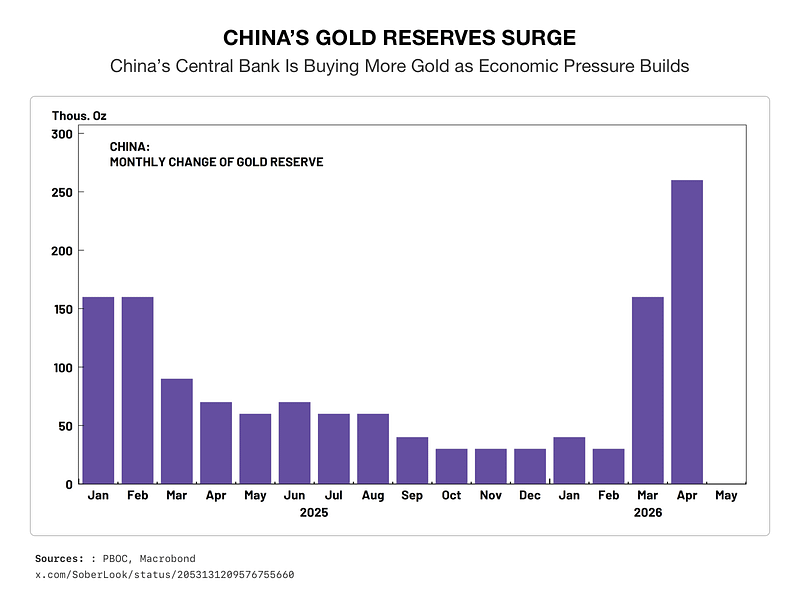
The People’s Bank of China added 8 tonnes of gold in April, its 18th straight monthly purchase. The move lifted China’s official gold holdings to 2,322 tonnes, equal to roughly 9% of its total reserves.
Chinese households are moving toward gold as well. The World Gold Council reported that global bar and coin demand reached 474 tonnes in the first quarter, up 42% from a year earlier and the second-highest quarter on record. Asian investors led that surge. China’s gold appetite also showed up in imports, with net gold imports reaching 316 tonnes in the first quarter.6
When paper assets weaken, Chinese institutions and households are turning to physical gold. The country whose slowdown may threaten the global economy is also helping support the asset many investors use when the global economy feels less secure.
A Floor Under Gold
China’s buying matters because it goes beyond a short-term trade. The central bank buys gold for reserves, diversification, and financial security. Households buy bars and coins because they want something tangible when paper assets weaken.
Together, those buyers can help create support under gold prices. Gold can still pull back after strong rallies, but steady Chinese buying gives the market a deeper foundation than speculation alone.
Major banks see that support continuing. J.P. Morgan recently raised its year-end 2026 gold forecast to $6,300, while Bank of America has pointed to central bank demand as a key force behind gold.
Conclusion
China is exporting volatility to America while, ironically, helping support one of the assets Americans can use to defend against it. Its move into gold is helping provide a floor of support for gold prices at a time when global confidence is under pressure. By buying physical gold, Americans can help secure the value of their savings from global shocks that begin far beyond U.S. borders.
To learn how to help protect your portfolio with physical precious metals in a Gold IRA from American Hartford Gold, call today at 800-462-0071.


