




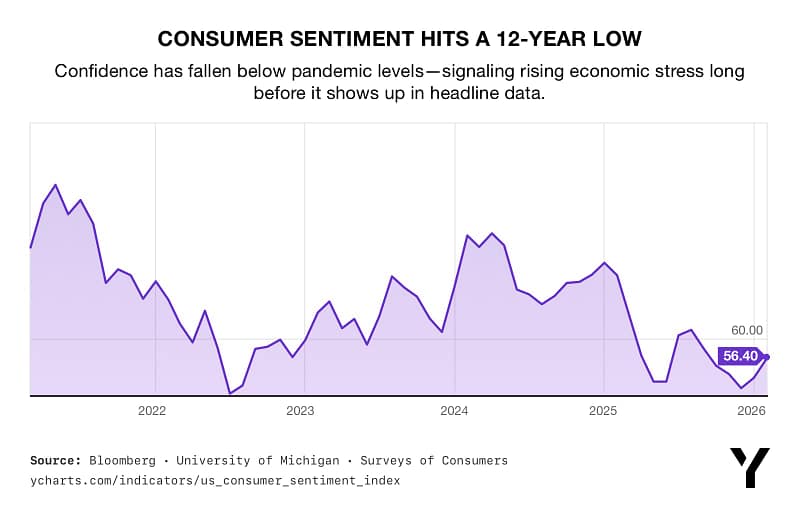
- Consumer confidence has plunged to a 12-year low, signaling rising stress beneath the surface of the economy.
- Americans are growing more cautious as job growth cools and recession expectations increase.
- Many investors turn to physical gold to help protect their finances and preserve purchasing power during uncertain times.
Trouble Beneath the Data
The economy may look steady at first glance, but everyday Americans are telling a very different story. Consumer confidence has dropped sharply, and the shift is commanding attention. While official data still points to growth, the mood across the country suggests that households are becoming more cautious about what comes next.
In January, the Consumer Confidence Index fell 9.7 points to 84.5, the lowest level in 12 years. Even more striking, confidence is now lower than it was during the darkest months of the COVID-19 pandemic. According to Dana M. Peterson, chief economist for The Conference Board, “Confidence collapsed in January as consumer concerns about both the present situation and expectations for the future deepened.” She also noted that all 5 components of the index deteriorated.1
The Expectations Index is one of those components. It fell to 65.1. Eighty is viewed as a potential recession warning. Short term expectations for income, business conditions, and job availability all declined. More Americans now believe a recession is either very likely or already underway.2
3
Why Are Americans So Uneasy?
One reason is the growing disconnect between headline numbers and everyday experience. The unemployment rate remains at 4.4%. Yet anxiety is higher than it was in 2020 when joblessness reached 14.7%. Some economists have described this as “a crisis of confidence that defies traditional economic policy numbers.”4
Part of the concern comes from the job market itself. Growth has cooled noticeably. The U.S. added 584,000 jobs in 2025, compared to more than 2 million the year before. Heather Long, chief economist at Navy Federal Credit Union, called it “the weakest year for jobs growth outside a recession since 2003.”5
Hiring trends reinforce that message. Private companies added just 22,000 jobs in January. ADP chief economist Nela Richardson said, “Hiring is softening. It continues a pattern that we’ve noticed for the past 3 years.” She added that employers are “very reticent to hire in the current economy.”6
When workers feel less secure, confidence can fade quickly.
The Pressures People Feel Every Day
Several factors are shaping this downbeat outlook. Inflation remains top of mind for many households, especially when it comes to essentials like groceries and gas. Even when inflation moderates, lingering high prices can still strain monthly budgets.
Consumers have also pointed to concerns about tariffs, trade tensions, politics, jobs, and health insurance. Add growing anxiety about automation and AI, and it becomes easier to understand why many people feel uncertain about the future.
Americans Are Adjusting Their Spending
Across the country, consumers are becoming more selective about major financial commitments. Many households appear to be adopting a wait and see approach, delaying big decisions until the outlook becomes clearer. As a result, plans to purchase homes, cars, and large appliances are declining.
There is another important trend worth watching. The top 20% of households now account for about 60% of consumer spending. In an economy that is roughly 70% driven by consumer spending, that kind of concentration can be perilous. If that relatively small group is hit by a financial shock, such as a bursting stock bubble, the effects could be devastating to the broader economy.
Looking Beyond the Headlines
Traditional metrics like GDP and unemployment are important, but they often look backward. Consumer sentiment tends to look forward. When confidence weakens across the country, it can signal that people are preparing for a more challenging environment.
Some analysts have described the current moment as an “invisible recession,” where the data may appear stable but the financial stress felt by households is growing.
Periods like this can prompt investors to focus less on short term market movements and more on long term stability. Many look for ways to help protect purchasing power and build resilience into their financial strategy.
Physical gold has historically played that role. Because it is a tangible asset that does not depend on corporate earnings or hiring trends, gold has long been viewed as a way to help balance portfolios during uncertain times.
Conclusion
Consumer confidence is declining, and many would argue for good reason. After all, economic tremors are often felt on Main Street long before they are fully recognized on Wall Street. When households grow cautious, it serves as a reminder that preparing for potential downturns is not just prudent, but essential.
To help preserve your purchasing power and strengthen your long-term financial outlook, consider physical precious metals in a Gold IRA. Contact American Hartford Gold at 800-462-0071 today to learn more.