






Gold Drawn into Trade Wars
Gold has staged a blistering rally this year, rising almost 30%. Fears over inflation and government debt have boosted its appeal as a safe-haven asset. Now, a new development is raising the stakes, and uncertainty, in the global gold trade.
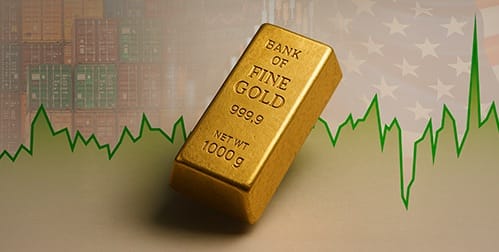
Recently, gold futures climbed to record highs after reports that the United States had imposed tariffs on imports of one-kilogram gold bars. The U.S. Customs and Border Protection (CBP) determined that one-kilogram and 100-ounce gold bars should be classified under a customs code subject to duties. This marks the first-ever U.S. tariff on bullion. The metal is traditionally excluded from such measures because of its role in the financial system.
Gold Prices Surge to Records
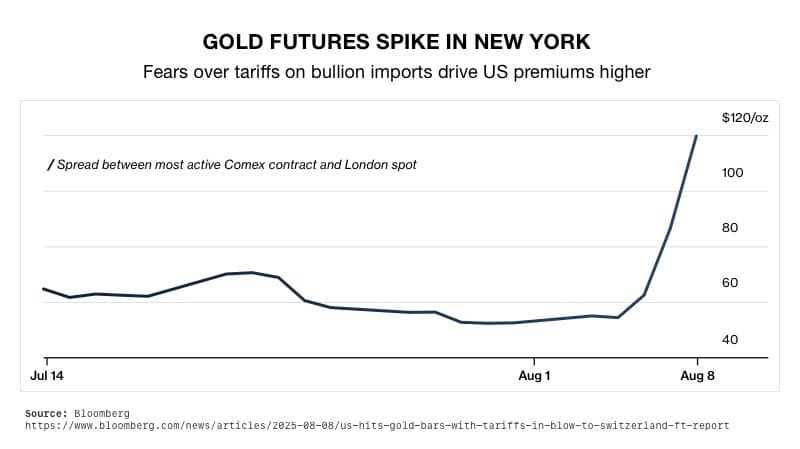
1
Following the news, December U.S. gold futures rose to $3,476.70 per ounce, after briefly touching an all-time high of $3,534.10. Spot gold prices also surged, breaking through $3,400 per ounce. They stayed on track for a second straight weekly gain.2
U.S. gold futures on New York’s COMEX exchange began trading at a premium of more than $100 per ounce compared to spot prices. This price difference can signal that investors are expecting higher gold prices in the future. Analysts warn that this gap could also signal deep shifts in the structure of the gold market and global trade patterns.
Switzerland Caught in the Middle
Switzerland is the world’s largest gold refining hub and a major exporter to the United States. They are directly impacted by tariffs. The Swiss Association of Manufacturers and Traders in Precious Metals warned that the ruling would “negatively impact” the flow of physical gold worldwide.
The group described the move as a “gold tax” disguised as a customs ruling. The levy targets kilo bars, the most common format in U.S. markets and for jewelers. They note that the change could alter the global perception of gold as a neutral store of value. Making gold less of a purely financial asset and more of a geopolitical commodity. Particularly at a time when central banks are buying gold to reduce reliance on the U.S. dollar.
In their view, the U.S. is adding new “toll booths” to the global gold trade. It’s creating wider premiums, encouraging arbitrage, and prompting increased buying by traders.
Short Sellers Squeezed by Tariffs
Gold short-sellers could spark more market chaos. Those holding short exchange-for-physical (EFP) positions may be forced to liquidate. In these deals, they sell gold futures and agree to deliver physical gold later. The new tariffs make that delivery much more expensive. Many may close out their contracts early instead. Closing out requires buying gold to settle the deal. This rush to buy can trigger a sudden cash crunch in London’s bullion market and send demand soaring. The result could be even higher gold prices.
Tariffs Apply Only to Bars, Not Coins
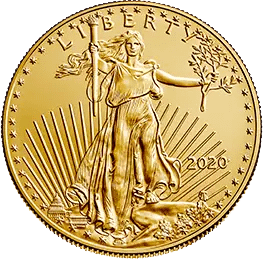
Based on official reports, the new U.S. gold tariff applies only to one-kilogram and 100-ounce bars. There is no indication that gold coins are included in these measures. Gold coins remain regulated under separate customs codes. They are exempt under the current rules.
A Policy Reversal?
The White House had previously said in an April factsheet that gold would be exempt from sweeping import levies. However, the new ruling from CBP has changed that, at least for certain gold bars.
A White House official commented, “The White House intends to issue an executive order in the near future clarifying misinformation about the tariffing of gold bars and other specialty products.” Some market participants believe the CBP may have made an error and hope the ruling will be amended.3
If tariffs remain in place, analysts expect spot prices to rise.
What Happens Next
For now, gold prices have begun to pull back as investors await clarification from Washington. Some traders are betting the tariff will be revised or reversed, while others are positioning for a prolonged impact.
If tariffs stay in place, global supply chains may need to be restructured. Switzerland and other refining hubs will look for new export markets, while U.S. buyers may seek alternative sources or formats of gold.
Conclusion
While tariffs can cause short-term disruptions, gold’s role as a hedge against inflation, geopolitical tension, and currency risk remains intact. In fact, disruptions like this can reinforce gold’s appeal as a safe-haven asset.
As the old saying goes, opportunity lies in chaos. While the situation unfolds, now could be an ideal time to learn if precious metals are right for you. Especially since market signals point to higher prices ahead. Held in a Gold IRA, physical precious metals can protect the value of your portfolio from the impact of trade volatility. To find out more, call American Hartford Gold today at 800-462-0071.