















- Gold may still be in the early stages of a long-term bull market supported by structural demand.
- Central bank buying, currency concerns, and growing private demand could support gold prices for years.
- Physical gold in a Gold IRA may help protect your finances from currency and financial-system risks.
Long Term Forces Drive Gold Higher
Billionaire investor John Paulson recently described gold as being in the “early stages of a long-term bull market.” His comments echo a growing chorus of analysts, fund managers, and central bankers who view today’s gold prices as the opening chapter of a much longer story rather than the peak of a short-lived rally. Multiple forces appear to be converging at once, from central bank buying to fading trust in paper money.1
A Structural Shift, not a Short-Term Rally
Paulson describes the current move as structural, driven by fading trust in paper currencies and steady central bank buying of gold. He frames gold as evolving from a tactical hedge into a core reserve asset, describing it as one of the world’s most important stores of monetary value. Structural trends generally unfold over years. They are shaped by deep economic patterns rather than fleeting headlines. Those who wait for confirmation may find themselves buying well after the early-stage window has closed.
Confidence in Paper Currencies Is Fading
Governments around the world continue to run large fiscal deficits while national debt levels climb. Central banks have also expanded their balance sheets significantly over the past two decades. The Federal Reserve’s balance sheet grew from about $800 billion in December 2005 to roughly $6.5 trillion by December 2025. 2
Those policies can weaken confidence in fiat currencies by reducing purchasing power and raising concerns about future monetary expansion. Savers may see the number of dollars in their accounts remain the same while rising prices gradually reduce what those dollars can buy.
Paulson believes the loss of confidence in fiat money could encourage more people and institutions to view gold as a long-term reserve asset. The metal cannot be printed by a central bank. And its supply grows slowly compared with the potential expansion of government-issued currencies.
Central Banks Are Building a Stronger Foundation
Central banks across the globe have been adding gold to their reserves at a rapid clip. The World Gold Council’s 2026 survey says central banks have accumulated an average of 1,000 tonnes of gold over the past four years, up from 500 tonnes in the prior decade. 3
Many are working to diversify away from the US dollar following years of sanctions, currency swings, and shifting geopolitical alliances. Countries such as China and Russia have led much of this accumulation, treating gold as a neutral asset free from political risk. Chinese net imports of gold in Q1 2026 were nearly three times the previous quarter. 4
Official sector demand of this scale is seen as a long-term shift rather than a temporary reaction to a single crisis. Central bank purchasing has continued even as prices spiked.
Private Demand Is Beginning to Broaden
Earlier stages of the gold rally were supported heavily by central bank buying. Private investors are now entering the market in greater numbers, creating a dual source of demand. The broadening interest reflects a desire among everyday investors to hedge against currency risk and systemic uncertainty.
Physical investment is projected to rise 15% in 2026 to its highest level since 2013. It will surpass jewelry as the top demand category for the first time. 5
Price Targets Suggest Room to Run
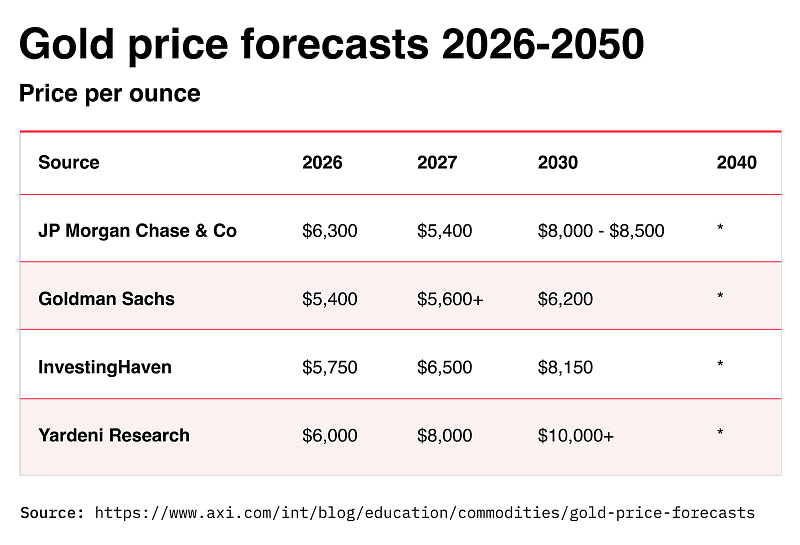
Major financial institutions continue to publish gold price forecasts well above current levels. JPMorgan lowered its fourth quarter 2026 target due to interest rate uncertainty but kept its longer-term bullish view intact. Rockefeller Global Investment Management strategist Doug Moglia takes a more aggressive stance. He is projecting gold above $5500 per ounce in 2027. And near $8000 before 2030, with an overshoot scenario reaching as high as $10,000. Forecasts of this range point toward a market still in an early phase rather than a late cycle peak.7
What Could Slow the Rally
No trend moves in a straight line forever. Several risks could weigh on gold prices along the way. A surprisingly strong US economy paired with contained inflation could prompt the Federal Reserve to hold rates higher for longer. A meaningful reduction in government deficits across major economies could ease fears around currency debasement. Discovery of large new gold deposits could also ease supply constraints over time.
Even so, many analysts argue that entrenched fiscal habits, aging populations, and rising political polarization make sustained deficit reduction unlikely anytime soon. Persistent geopolitical tension also continues to support central bank demand for a reserve asset that sits outside the reach of sanctions. And even with new technology and higher prices, miners are barely able to move the needle of global supply.
Conclusion
Signs suggest gold may still be in the early stages of a long-term bull market, with the forces supporting demand potentially continuing far into the future. Central bank diversification, concerns about paper currencies, and growing private demand could further expand gold’s role in the global financial system.
Retirement planning is also built around long-term thinking. Adding physical gold to a tax-advantaged Gold IRA may help balance risks tied to stocks, bonds, and paper currencies while supporting a more diversified retirement strategy. If you want to protect your portfolio with physical precious metals in a Gold IRA, contact AHG today at 800-462-0071.