

Key Takeaways:
• Wheat pennies were produced by the U.S. Mint from 1909 to 1958, and many are worth well above face value due to their age, design, or date.
• Rare varieties like the 1909-S VDB, 1955 doubled die, and 1943 bronze error can be worth a decent amount in the right condition.
• Evaluating the date, mint mark, overall condition, and other factors can help separate everyday pennies from highly valuable ones.
Wheat pennies have captured collectors’ attention for many years. First released in 1909 to honor Abraham Lincoln, these pennies display two wheat stalks on the back, which is where their name comes from. They were struck up until 1958, then the design was changed the following year.
Most wheat pennies are affordable, which makes them a good starting point for new collectors. A select few, however, can be worth much more. In this guide, you’ll learn what wheat pennies are, factors that impact their value, the most important dates, which precious metal pieces American Hartford Gold has to offer, and much more.
What Is a Wheat Penny?
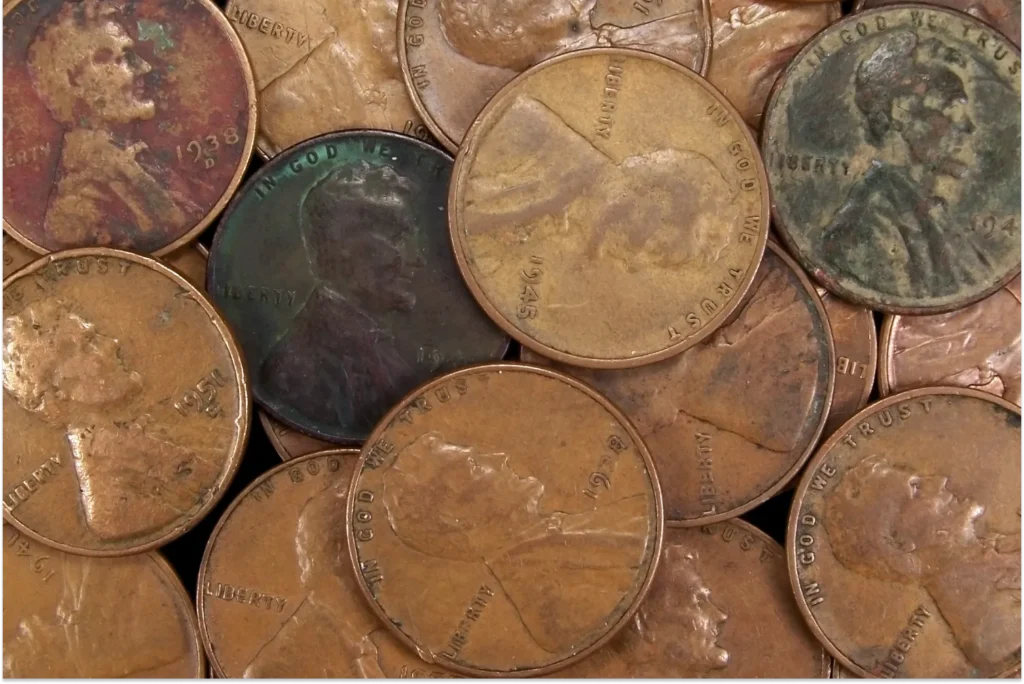
Wheat pennies are Lincoln pennies dated 1909 to 1958 with “wheat ears” on the back. The front shows President Lincoln, and the back features two curved wheat stalks with the words “One Cent” and “United States of America.” The design is by Victor David Brenner, whose initials, V.D.B., appear on some 1909 pieces.
The U.S. Mint produced these pennies in Philadelphia, Denver, and San Francisco. Most were a bronze blend that appeared warm brown or red as they aged. Their composition changed briefly in 1943, when copper’s demand increased due to World War II.
Because of the shift in resource demand, that year’s pennies were made of zinc-coated steel and appeared silver or gray. In 1944, the U.S. Mint returned to a copper-based composition using recycled brass from wartime materials. From 1909-1958, billions of wheat pennies entered circulation, which is why so many can still be found today.
Design, Date, and Composition
The series began in 1909 with two main varieties: the 1909 VDB and the 1909-S VDB, both of which display Brenner’s initials at the bottom of the coin’s reverse. After receiving complaints about the initials being too bold, the U.S. Mint removed them later that year. In 1918, the initials returned in a smaller, less visible style on Lincoln’s shoulder.
The smaller placement remained for the rest of the wheat design’s lifespan, and still appears on more recent Lincoln pennies today. Most wheat pennies are bronze, typically 95% copper with the remainder being tin and zinc. An exception is the 1943 steel penny. It is made of a thin zinc layer with steel underneath and is magnetic.
From 1944-1946, the composition alternated between brass and bronze. The appearance of bronze pennies can vary from chocolate brown to bright red. Color alone does not determine value, but it is one of many traits noted when a coin is being evaluated.
How Do Condition and Grading Affect Value?
Condition is one of the top factors considered when inspecting wheat pennies to determine their value. Coins that have spent many years in circulation, passing through various pockets and hands, tend to have worn spots on Lincoln’s hair, cheek, and other design elements on the back. These circulated pieces are the most common and are not usually worth much.
Uncirculated pennies typically have full design details intact and no wear, provided there were no issues during production. If there were, a penny could have tiny marks from the minting process or storage methods that were used, but the original texture should remain. Since uncirculated pieces are rare, they can be worth more.
Collectors rate coin condition on a scale that goes from well-worn to pristine. They use terms like Good, Very Fine, and Uncirculated to cover the main categories. Third-party grading services also use numeric grades from 1 to 70 to be more precise. If a coin looks unique, it could be worth getting a professional opinion before selling it.
Circulated vs. Uncirculated Pennies
Circulated wheat pennies show friction on the high points of the design. To see for yourself, inspect Lincoln’s jawline, cheekbone, and hair above the ear. On the back, look along the wheat stalk lines and lettering. If those areas are smooth or flat, the coin has wear.
Circulated coins can still be desirable for some, and many collectors enjoy completing their sets with these pieces because they are budget-friendly. Uncirculated pieces have crisp edges on every letter and fine details, like hair, that are easy to distinguish. The wheat lines on the back will be sharp, and the fields around the design will appear fresh and untouched.
Uncirculated coins can have the original red, red-brown, or brown color. In general, more of the original red color means a higher visual appeal. A uniform luster that moves evenly under a soft light is a good indicator that the surface remains untouched by circulation.
What Are Some Coin Dates To Know?
Some dates are harder to find, and that rarity can mean increased value if the coin is in the right condition. The most famous of the series is the 1909-S VDB, which had a small San Francisco mintage of around 484,000. This coin has Brenner’s initials on the back and the “S” mint mark on the front underneath the date. The 1909-S without Brenner’s initials can also hold value.
The 1914-D from Denver and 1931-S from San Francisco are key dates due to their limited production. Key dates are not limited to the earliest years. The 1924-D is in high demand among collectors because only 2.5 million were struck. While this number is quite high, 1924 was over a century ago, making them more difficult to find today.
The 1932-D does not exist for wheat pennies, which helps avoid confusion with other coin series. During the 1940s and 1950s, production increased, so most dates are commonly found today. Even so, coins from those years can be valuable in high grades or when a unique variety surfaces.
What Are Some Famous Penny Varieties and Errors?
The 1955 doubled die obverse shows clear, bold doubling on the date and lettering. Even worn pieces are in demand because the doubling is easy to spot. Another famous penny is the 1922 “No D,” which appears to have no mint mark.
In 1922, Denver was the only mint to produce wheat pennies, and a worn or filled die is why some coins lack the “D.” Additionally, a Philadelphia issue did not exist that year, which made the missing “D” stand out even more. A handful of 1943 bronze pennies and 1944 steel pennies also have special errors.
In 1943, a few bronze planchets from the previous year likely remained in the presses by accident, which produced the rare bronze 1943 penny. In 1944, the same is believed to have happened with steel planchets from 1943, which is why a small number of 1944 pieces are steel. These off-metal errors are extremely rare, so finding one would be quite remarkable.
Why Do Mint Marks Matter?
Mint marks tell you where your coin was made and can sometimes affect its value as well. Philadelphia coins don’t have a mint mark on wheat year pieces. Denver coins display a small “D,” and San Francisco coins have an “S” underneath the date. Understanding how to evaluate mint marks can help ensure you’re not spending money on counterfeit pieces.
In 1922, for example, Denver was the only mint producing pennies, so any 1922 penny without the applicable mint mark might require closer inspection to verify authenticity. In 1909, “S” and “no mint mark” versions existed, both with and without the initials VDB.
Philadelphia, Denver, and San Francisco
Again, Philadelphia wheat pennies don’t have mint marks. Most years are common, though high-grade pieces from earlier years can still be rare. Denver pieces tend to have stronger strikes in some years and weaker ones in others, so they are visually inconsistent.
The “D” mint mark appears just below the date.
For popular dates like 1914-D, the shape and placement of that mark can help confirm authenticity. “S” pennies from the 1940s and 1950s are commonly found in circulated condition, but uncirculated pieces with their original luster intact are difficult to find.
Acquire Precious Metals With AHG
Wheat pennies, originally produced starting in 1909 to honor Abraham Lincoln, still hold value today. Certain dates can be worth well above face value in the right condition. For those looking to source valuable metals, American Hartford Gold offers a wide selection of high-quality pieces.
Additionally, those looking to diversify their retirement holdings may want to explore a Gold IRA, which uses physical gold to preserve the value of financial savings. Start planning for later, today.
FAQs
Which years are considered wheat pennies?
Wheat pennies ran from 1909-1958. The back of the coin shows two wheat stalks and the words “One Cent” and “United States of America.” In 1959, the back was changed to reflect the Lincoln Memorial design.
How can I tell if I have a 1955 doubled die?
To verify whether you have a 1955 doubled die, look for strong, slightly separated doubling on the front in the date and in the words “Liberty” and “In God We Trust.” The doubling will appear bold, not fuzzy. If you see only minor, shelf-like doubling, it is likely a machine error, not a true variety.
Why do some 1943 pennies look silver?
In 1943, the U.S. Mint used zinc-coated steel to conserve copper since the metal was in high demand due to the war.
Do mint marks really matter that much?
They can. Coins with an “S” or “D” under the date can be rarer in certain years, like the 1909-S VDB and 1914-D. Mint marks help focus your search and can also help confirm a coin’s authenticity. In 1922, for example, Denver was the only mint to produce pennies, so any penny from that year without the “D” mark could potentially be fake.
Sources:
Victor David Brenner Biography | Museum of Art | Bates College
1 Cent, United States, 1909 | National Museum of American History
Uncirculated Coins and How to Identify Them | Spruce Crafts