






Key Takeaways:
- Palladium is a bright, silver-white metal in the platinum group that is lightweight with a high melting point. This makes it useful in chemistry and electronics.
- The metal’s limited geographic supply means even small production hiccups can impact global manufacturing chains.
- Anyone who works with precious metals benefits from knowing how this versatile element works.
Palladium plays a major role in modern technology. Discovered just over two centuries ago, the metal quickly found its way into watch springs, hydrogen purification devices, and the catalytic converters that clean billions of car exhaust pipes.
Engineers appreciate palladium’s ability to absorb hydrogen by weight, and jewelers enjoy its bright color that requires no rhodium plating. This article details where palladium comes from, how it’s refined, and what drives its demand.
What To Know About Palladium
Palladium sits in Group 10 of the periodic table alongside platinum, nickel, and iridium. Chemists assign it atomic number 46, and its electron configuration allows the element to bond readily with hydrogen and oxygen.
Chemical and Physical Traits
Palladium is the least dense member of the platinum group. Its density comes in at just above twelve grams per cubic centimeter. This lightness delivers a strength-to-weight ratio that engineers look for when designing fuel-cell stacks or electrical contacts.
The metal’s melting point, 3,100 degrees Fahrenheit, ensures stability at engine-bay temperatures.
Apart from the numbers, palladium’s most valuable property is its ability to absorb hydrogen. The metal soaks up the gas like a sponge, forming palladium hydride. Researchers use this benefit to filter hydrogen streams in chemical plants and safely store the gas in prototype energy systems.
Discovery and Naming
English chemist William Hyde Wollaston isolated palladium in 1803 while analyzing residues from South American platinum ore. He named the new element after “Pallas,” an asteroid discovered the year before. Wollaston’s early sales sparked debate about authenticity until he published detailed preparation notes.
The metal was quickly accepted among instrument makers since it resisted tarnish better than silver. By the Victorian era, palladium had been used in watch balance springs, thermocouples, and the field of decorative inlay work called “niello.”
How Does Palladium Enter the Supply Chain?
Palladium shows up in sulfide deposits formed by ancient magmas. The extraction path spans continents and involves careful coordination between geologists, metallurgists, and refiners.
Primary Mining Regions
The largest palladium reserves lie in Russia’s Norilsk-Talnakh district and South Africa’s Bushveld Igneous Complex. Miners in those regions extract nickel-copper ore that carries platinum group metals as byproducts.
Canada’s Sudbury Basin and Montana’s Stillwater district add North American tonnage, while smaller operations in Finland and Zimbabwe provide supplemental supply. Each mining hub faces its own challenges. Arctic cold shortens drilling seasons in Siberia, and deep-level shafts in South Africa require intensive cooling.
Extraction and Refining Paths
After blasting and crushing the host rock, miners concentrate the ore through flotation, producing a nickel-copper matte that also contains platinum group elements. Smelters then roast the matte at high temperature to separate sulfur from metal.
Subsequent pressure-acid leaching dissolves base metals, leaving a residue rich in platinum, palladium, rhodium, and related elements. Refiners dissolve that residue in aqua regia and use solvent extraction, precipitation, and ion-exchange steps to isolate each metal.
Palladium emerges as a salt called ammonium hexachloropalladate. Chemists convert that salt to metallic sponge through thermal decomposition, then melt the sponge in a vacuum or inert atmosphere to form casting bars ready for fabrication.
What Are Some Use Cases for Palladium?
Automobiles, electronics, and the emerging hydrogen economy rely heavily on palladium’s properties. While jewelry consumers appreciate the metal’s luster, it is catalytic chemistry that absorbs the greatest share of new supply each year.
Catalytic Converters for Cleaner Air
Palladium’s surface speeds up the oxidation of carbon monoxide and unburned hydrocarbons into carbon dioxide and water.
When automakers adopted catalytic converters in the mid-1970s, platinum led the charge. Engineers soon discovered that palladium could perform many of the same tasks at lower cost and with better resilience to fuel additives containing sulfur.
Modern three-way converters often pair palladium with rhodium to balance oxidation and reduction reactions in gasoline engines. Fine grains of the metal disperse on ceramic honeycombs, creating hectares of active area inside a device smaller than a shoebox.
Since each vehicle carries only a few grams, the demand consumes the bulk of annual mine output.
Electronics, Dentistry, and Emerging Tech
Palladium’s ability to form stable alloys with gold makes it essential in multilayer ceramic capacitors found on smartphone circuit boards.
Thin-film coatings of palladium also protect connector pins from corrosion, ensuring reliable data transfer across high-speed networks. Dentists once favored gold-palladium crowns for both strength and biocompatibility.
New advancements involve green energy. Research teams evaluate palladium membranes that allow hydrogen to pass while blocking other gases. Fuel-cell catalysts sometimes substitute palladium for platinum to save money.
Even medicine has joined in, with palladium compounds appearing in experimental drugs that target cancer cells more precisely.
Palladium in Coins and Bullion Products
Although palladium’s industrial story dominates headlines, the metal has carved out a modest niche in the bullion world as well. Investors and collectors value its rarity and bright white color.
Government-Issued Coins
The first government-issued palladium coin arrived in 1966 when Sierra Leone pushed out a series honoring Sir Winston Churchill.
Later entrants included the Soviet Union’s ballerina coins in the 1980s and Canada’s Maple Leaf in 2005. The U.S. Mint joined the field in 2017 with a one-ounce American Palladium Eagle featuring Adolph Weinman’s “Winged Liberty” design.
Production numbers for palladium coins typically stay far below their gold and silver counterparts, making them quite rare. Each issue lists weight and purity, most at .9995 fine, giving buyers confidence. Since the coins carry legal-tender status, they move easily across borders and fit well into various collections.
Bars, Rounds, and Hallmarks
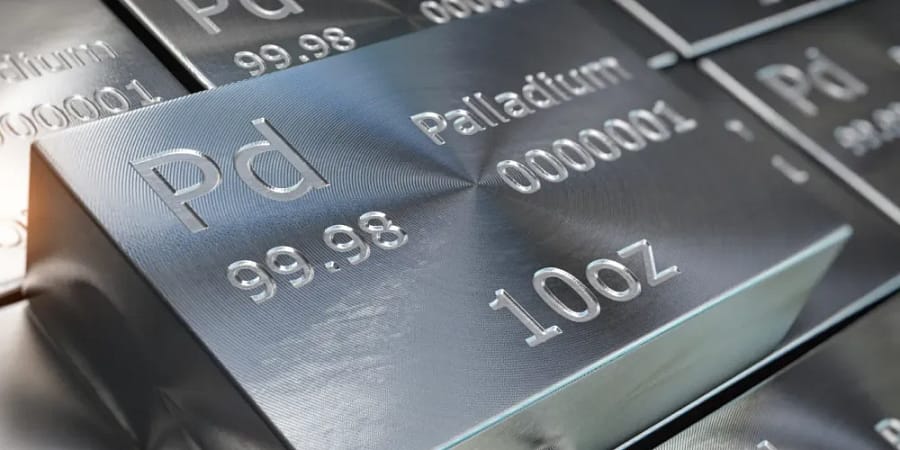
Private refineries cast palladium into bars ranging from one gram to ten ounces. Smaller pieces often carry unique serial numbers and an assay card that confirms purity.
Rounds mimic coin form but hold no face value, allowing manufacturers save on licensing fees while still delivering standardized weights.
Hallmarking traditions trace back centuries, and modern palladium follows suit. Popular hallmarks include PAMP’s Lady Fortuna, Valcambi’s rotating square, and Credit Suisse’s classic “CHI-ESSAYEUR FONDEUR” stamp. These emblems help with liquidity since buyers trust the history. As with coins, .9995 purity remains the international standard.
What Factors Influence Palladium’s Market Price?
Palladium’s value swings more dramatically than other precious metals because industrial demand is directly connected to complex supply chains.
A single announcement from an automaker or a political development in a mining country can shift prices.
Supply Shocks and Geopolitics
With nearly three-quarters of newly mined palladium coming from Russia and South Africa, geopolitical risk is at the forefront.
Sanctions that restrict Russian export routes or labor negotiations that idle South African shafts shrink the available pool quickly.
Since recycling from spent catalytic converters accounts for roughly a quarter of supply, collection rates and smelter capacity also matter. Analysts track stockpile disclosures to gauge buffering capacity. When those inventories run low, traders anticipate tighter markets and push prices higher.
Technology Trends and Substitution Risks
Automakers constantly adjust catalyst formulas to balance performance and cost. If palladium becomes too expensive, engineers can switch to platinum or rhodium in certain engine types. That threat of substitution lowers the chances of price spikes.
The rise of electric vehicles chips away at long-term gas engine demand. Analysts debate how quickly that shift will lighten palladium usage. Offset factors include stricter emissions rules in emerging markets and the metal’s potential role in hydrogen fuel-cell stacks.
Grow Your Portfolio With AHG
When it comes to precious metals, American Hartford Gold has been known as a trusted resource for quite some time. Whether you’re just starting out, looking to expand a collection, or interested in learning more about our Gold IRA, we’re happy to assist.
Our clients come from various backgrounds, and we pride ourselves in matching individuals with gold and silver pieces that not only look appealing in their collection, but also add value and diversity to their portfolio. We’d love to help you next.
FAQs
How rare is palladium compared to gold?
Palladium rests at roughly one-tenth the abundance of gold in Earth’s crust, and its annual mine output is typically less than a tenth of gold’s global production.
How does palladium absorb hydrogen?
The metal’s crystal lattice features spaces that allow hydrogen atoms to slip in and bond loosely, which forms palladium hydride. The process is reversible, making palladium useful for hydrogen storage and purification.
Is palladium jewelry hypoallergenic?
Yes. Pure palladium and high-purity alloys generally do not trigger nickel allergies, and the metal’s natural white color removes the need for the rhodium plating often used on white gold.
Can palladium replace platinum in fuel cells?
Engineers experiment with palladium-based catalysts to lower cost, but performance and durability are still highest with platinum in many cases. Research continues as manufacturers continue to test new theories.
Where can I buy palladium bullion?
Government-issued coins and privately minted bars are available through reputable precious-metals dealers who supply assay-certified products in sealed packaging.
Sources:
What Is a Catalytic Converter and What Does It Do? | UTI
Palladium Hydride Carbon | Pub Chem