












- Market experts warn that overvalued stocks and rising debt may lead to a major correction.
- Leading economic indicators are pointing toward an impending market crash.
- Protect your finances by shifting into physical gold, a proven safe haven in times of crisis.
A Crash May Be Closer Than You Think
2025 has been a year of record highs for U.S. stock markets. Despite inflation, trade tensions, ballooning debt, and economic uncertainty, the S&P 500 has continued its seemingly unstoppable climb. But while market resilience might seem like a reason to celebrate, many seasoned investors and economists see danger on the horizon.
When markets appear “impervious” to bad news, it can signal dangerous complacency. And as valuations continue to stretch further from fundamentals, experts warn that the bigger the boom, the harder the bust.
Warnings from Wall Street Titans
A growing number of respected voices are raising concerns. Michael Burry famously predicted the 2008 financial crisis. Burry now believes many assets are caught in speculative bubbles, and a major correction is imminent. He is letting his actions do his talking for him. He has liquidated nearly all his equity positions in 2025. That includes typically defensive sectors like healthcare and financials.
JP Morgan Chase CEO Jamie Dimon has also expressed concerns about the economy. With new tariffs possibly being reinstated, Dimon warns of incoming inflation. In addition, long-term bond yields are rising. That usually means investors expect more inflation. This can make stocks look less attractive, especially when stock prices are already very high. Higher inflation often results in reduced consumer spending and slower economic growth. And in a worst-case scenario, stagflation, the toxic mix of inflation and stagnation.
Robert Kiyosaki, author of Rich Dad Poor Dad, has gone even further. He compares the current environment to the lead-up to the 1929 crash. He’s abandoning traditional investments and putting his money into gold, silver, and Bitcoin. He also pointed to Warren Buffett and Jim Rogers reducing their exposure to stocks and bonds. Kiyosaki sees it as a signal that savvy investors are preparing for trouble.

The Growing Burden of National Debt
America’s debt problem is another critical flashpoint. This month alone, the national debt jumped by $367 billion to reach an eye-watering $36.6 trillion. Interest payments already consume 13% of the federal budget. They are expected to surpass $1 trillion per year by 2033.
Ray Dalio, founder of Bridgewater Associates, paints a bleak picture. He warns that we’re headed toward an “economic heart attack,” caused by unsustainable borrowing. As the U.S. spends 40% more than it takes in, the government is entering a vicious debt doom cycle. Borrowing more money just to pay off the interest on existing debt.
Dalio warns that if this continues, America could reach a tipping point. Investors will no longer want to fund its borrowing unless interest rates skyrocket. The result? A full-blown financial crisis with global consequences. To avoid default, the U.S. may be forced to inflate away its debt. Effectively devaluing the dollar and all dollar-denominated assets like stocks and bonds.
And if the economy tanks, the Federal Reserve may be too broke to bail it out.
Stock Market Bubbles and Sky-High Valuations
Albert Edwards of Société Général is known for calling the dot-com crash. He says we’re in the middle of an “everything bubble”. One that includes both stocks and housing. He points to the Shiller CAPE ratio being at 38, one of its highest levels ever. The Shiller CAPE ratio is a stock market valuation measure that shows the price of stocks compared to their average earnings over the past 10 years, adjusted for inflation.
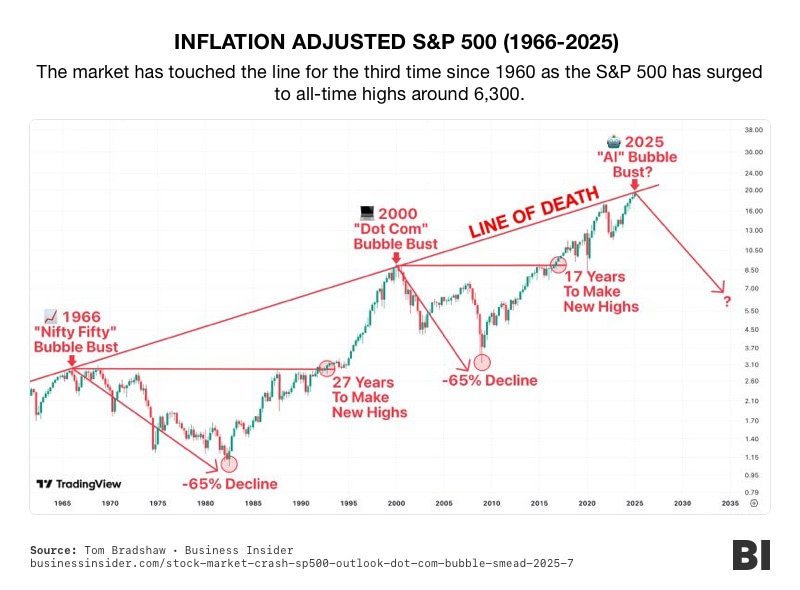
Veteran investor Bill Smead sees parallels to past market bubbles. He points out that today’s S&P 500 returns have hit a resistance line only reached during the market tops of 1966 and 2000 — both followed by devastating crashes. Smead highlights Warren Buffett’s massive cash reserves as further proof that the smart money is preparing for rough times.
 1
1
Several market indicators also point to overheated conditions. One is the Buffett Indicator. It compares the total value of the U.S. stock market to GDP. Today, it stands at around 200%, far above historical norms. A valuation this high makes future returns harder to achieve and increases the risk of a sharp downturn.
Margin debt, money borrowed to buy stocks, is also at record highs. It’s at roughly twice the levels seen in 2022. If a correction hits, forced selling through margin calls could accelerate the decline. This kind of speculation has historically preceded major downturns.
Meanwhile, the economy is showing cracks. Nearly 5% of workers recently made hardship withdrawals from their 401(k)s. A sign that consumers may be under pressure. The labor market is cooling, job openings have declined, and U.S. manufacturing activity dropped sharply in July. The Manufacturing PMI fell to 49.5. It missed expectations and dipped below the critical 50 level that separates growth from contraction.2
Is AI the New Bubble?
One area of particular concern is the AI sector. Stocks like Palantir have soared over 395% in just 12 months. But its price-to-sales ratio now sits at an astonishing 113, compared to a historical average of just 3.2. These sky-high valuations are completely divorced from underlying business fundamentals. According to JPMorgan research, these “AI-associated megacaps” are responsible for about 35% of the S&P 500’s market capitalization. They’ve driven 70% of total returns since 2023. All it would take is one disappointing earnings report for a company like this to see its share price collapse.3
Conclusion
Analysts suggest it may be time to “sell high” and shift into defensive assets. Physical gold has historically been a safe haven during times of market turmoil. Holding physical gold in a Gold IRA offers a way to preserve your wealth, diversify your portfolio, and protect your retirement savings from stock market downturns, inflation, and currency devaluation.
Don’t be left holding the bag when the next crisis hits. Call American Hartford Gold at 800-462-0071 to learn how to safeguard your future with physical gold and silver.


