













America’s credit card has expired, and the markets have already begun to react to the possibility of our country defaulting on its debt. Today the stock market experienced its biggest drop of 2017, plummeting 189 points shortly after opening.
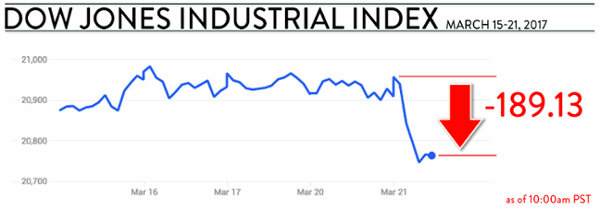
All signs point to an extremely bumpy ride in the weeks ahead.
The March 16 debt ceiling deadline has passed, and already U.S. Treasury Secretary Steven Mnuchin has been forced to suspend contributions to public retirement and disability plans for federal workers.
No wonder Bank of America is calling for $1,400/oz gold prices in 2017 (that’s 16% above current levels).
If Secretary Mnuchin hadn’t acted quickly, the U.S.A. would have been unable to keep under the mandated $20 trillion debt ceiling set by Congress. He calls this financial juggling “extraordinary measures,” and is pleading with Congressional leadership to take action quickly.
“I respectfully urge Congress to protect the full faith and credit of the United States by acting to increase the statutory debt limit as soon as possible,” wrote Secretary Mnuchin to House of Representatives Speaker Paul Ryan.
He is exactly right that the “full faith and credit” of our country is under assault. With China eager to take the U.S. dollar’s place as the world’s reserve currency of choice, the timing of this crisis couldn’t be worse. This is the third debt crisis since 2011, and our national debt is still accelerating! Our creditors won’t take this forever and the health of our country and national currency is clearly at stake.
No matter what accounting tricks Secretary Mnuchin is able to conjure up, the hard financial facts remain: any wiggle room he has will run out completely in October, at which point the U.S.A. will go into default for the first time in its history.
In January, the Congressional Budget Office (CBO) reported that fiscal year 2016 federal spending was $3.854 trillion: meaning we ran a $587 billion deficit. The U.S. national debt now stands at an eye-popping $19.918 trillion!
We are now entering uncharted territory with respect to the U.S.’s debts and the increasingly likelihood of a major financial crisis unless our nation’s suicidal spending spree is reversed.
STOCKMAN: EVERYTHING WILL GRIND TO A HALT
Former Director of the Office of Management and Budget under President Reagan David Stockman is issuing dire warnings to investors regarding the lack of action on March 16, 2017 and after.
In addition to the implications of that failure, Stockman states that there can be no Obama Care repeal or replace, tax cuts and/or infrastructure stimulus if there can be no additional spending (on our already-overstretched credit). If that’s true, what lies ahead could be a political and fiscal bloodbath over a debt ceiling that must be increased… yet no politician want to be seen voting for.
Think of what would happen to the overheated stock market if any of the proposed new spending fails to materialize. According to Stockman, the coming market calamity would likely drive positive price moves for gold and silver.
The new proposed budget does not cover spending on Medicare and Social Security, roughly 70% of the entire federal budget. The president has proposed spending an extra $54 billion on defense, along with $4 billion to fund the border wall with Mexico. The new budget priorities indicate the preference for a more militaristic and aggressive foreign policy.
With geopolitical challenges like the Russian annexation of Crimea, North Korea’s nuclear program and ongoing Middle Eastern conflicts, safe-haven assets like physical gold seem like a wise choice if military conflict breaks out.
GOLD RISES DESPITE FED TIGHTENING
The Federal Reserve has just raised U.S. interest rates for the second time in three months. As we predicted, since the Fed raised rates last week, gold prices have risen.
This is a common – and somewhat counterintuitive – pattern we see almost every time after the Federal Reserve meddles with interest rates. Investors overreact before the announcement and drive gold prices down temporarily. Then, after the announcement, the precious metal gets a bump up in price as investors change their minds.
While higher rates are said to be negative for gold, the Fed seemed to be more dovish than investors expect. This has led the dollar to fall recently while gold has risen.
THE NEXT BIG RALLY IN GOLD:
$1400/OZ AHEAD SAYS BANK OF AMERICA
Bank of America Merrill Lynch commodity strategists believe European elections and protectionism should support gold prices strongly this year. Bank of America analysts forecast gold rising to $1,400 per ounce by year-end, a roughly 16 percent rise from current levels.
Larry McDonald, head of global macro strategy at ACG Analytics, does not believe that the Fed will go through with the three interest rate hikes expected this year and investors in gold should benefit.
Georgette Boele at ABN AMRO believes the dollar has hit a ceiling and will fall further in the short term, which could favor physical gold. CPM managing director Jeff Christian thinks gold is headed to record highs. According to Christian, three years from now gold prices will be at record levels. Christian also believes that silver could trade as high as $21 per ounce later in 2017.
Todd Gordon of TradingAnalysis.com also expects continued higher gold prices on the back of a fairly dovish Fed in 2017.
ICBC Standard Bank’s Tom Kendall says that the current administration’s failure so far to push through promised economic stimulus measures is a telling sign. According to Kendall, if infrastructure spending and tax cuts are pushed further and further out, it gives the Fed more reason to be cautious and that is a vacuum that gold can rally into.
UBS strategist Joni Teves thinks investors have gravitated to gold recently due to its diversification and hedging properties. In addition, lingering uncertainty in geopolitical affairs, the chaos in Washington and the debt crisis have all conspired to keep investor uncertainty high.
GOLD IS THE ANSWER TO BOTH DOMESTIC AND FOREIGN CHALLENGES
We are at a crossroads. As proud Americans, we are sad to report that Washington, D.C. is broken, possibly beyond return. Every indicator, from the strength of our currency to the solvency of our Treasury, is headed in the wrong direction at the moment.
The U.S. government is broke and no one has the political courage to tackle our growing national debt. March 16 was the day we hit the debt ceiling and no one knows what will happen next.
Geopolitical tensions are rising around the world and uncertainty is the rule of the day. Hedge funds and central banks have been quietly adding to their gold holdings and physical gold continues to be the safe haven asset of choice as global tensions escalate.
With gold trading at attractive levels, this is the perfect opportunity for forward-thinking investors to position their retirement portfolios for both domestic and foreign worst-case scenarios.


