












Silver Demand Rising, Supply Tightening
Silver has quietly become one of the most compelling stories in the precious metals market. Physical demand is climbing, global supply is getting tighter, and the forces driving both trends show no sign of reversing. Underneath the short-term price swings, a powerful long-term bull market is taking shape, one built on real-world demand rather than speculation alone. For those looking to diversify, pullbacks are proving to be buying opportunities rather than warning signs.
China Is Driving the Physical Demand Story
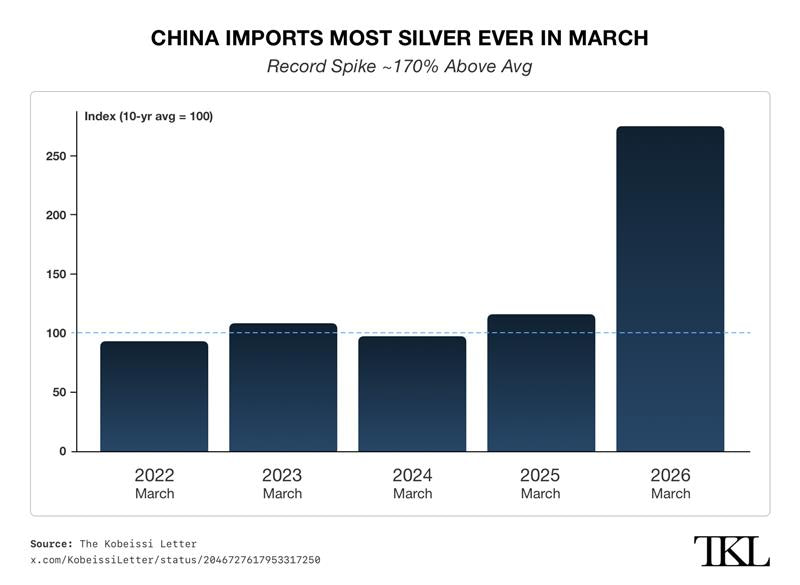
No country is more central to silver’s current surge than China. In March 2026, China’s silver imports jumped 78%. Demand was driven by retail investors scrambling for smaller silver bars and manufacturers securing supply for solar production. Both were urgently trying to front-load purchases ahead of new export restrictions.
1
As of January 1, 2026, China reclassified silver as a “dual-use” (civilian and military) strategic material, placing it under strict export controls. As a result, the global supply chain has tightened, making it harder for overseas buyers to access the metal.
Inside China, the market remains active and competitive. Combined supply at the Shanghai Futures Exchange and Shanghai Gold Exchange reached a three-month high. Even so, real silver bars there sell for 15% more than prices on Western futures markets. Domestic and international buyers are competing for the same limited supply. Prices are rising even as even as inventories slowly rebuild.2
Silver’s “hybrid nature” makes all of this especially important. Because silver functions as both a safe-haven asset and an industrial metal, supply shocks hit harder and faster than in most other commodities. And China sits at the center of both of those demand streams.
The Current Pullback Is Healthy, Not Alarming
Silver moved above $83 earlier this year, then pulled back by about 10%. Analysts generally view that move as a normal correction, not a sign the trend has reversed.
One level to watch is the 200-day moving average, which tracks the average price over the past year and helps show the longer-term trend. As long as silver stays well above that level, the broader uptrend remains intact. Near-term support sits in the high $60s, with prices likely to move within a roughly $70 to $80 range during this correction.3
Some short-term indicators have turned cautious, suggesting momentum has cooled for now. Seasonal softness in May is also common for precious metals. Industrial demand may ease slightly this year, but it still makes up a large share of total usage. The bigger picture remains unchanged, with underlying demand continuing to support the market.
London’s Physical Market Is “Running Out of Room”
The supply strain is no longer confined to China. In London, one of the world’s key pricing hubs, available physical silver is struggling to keep up with demand. Analysts are saying the market is “running out of room,” meaning there is less readily available metal to back a growing volume of trades.4
This creates a disconnect between paper trading and physical supply. Contracts can be bought and sold in large volumes, but the actual metal behind them is more limited. When that gap widens, it can lead to higher premiums and sharper price swings as buyers compete for real inventory.
Earlier this year, tight conditions in London helped drive a rapid move higher in prices as short sellers were forced to cover positions, adding fuel to the rally. These types of squeezes tend to happen when physical supply cannot keep pace with demand.
China’s export restrictions are adding pressure to an already tight system, but the underlying issue is broader. Industrial users, investors, and global buyers are all drawing from the same limited pool of available silver. The takeaway is clear: volatility in a supply-constrained market often reflects scarcity, not weakness.
Where Prices Are Headed
Short term, forecasts suggest silver is likely to hold in the low to mid-$70s, with upside toward the low $80s as the market stabilizes.
Looking further out, J.P. Morgan forecasts a 2026 average of $81 per ounce, with Q4 potentially reaching $85. Bull cases from Bank of America point to a range of $135 to $309 if China’s export curbs hold and solar demand accelerates.5,6
Structural bulls point to six consecutive years of supply deficits, growing EV and solar demand, and central bank buying as the foundation for prices reaching $150 or higher before the decade is out.
Conclusion
The picture is straightforward. Demand remains strong, supply is constrained, and recent pullbacks are widely seen as a buying opportunity. Short-term volatility is part of the process, not a signal the trend has changed.
If you want to protect your savings with physical silver, especially long-term through a Gold IRA, contact American Hartford Gold today at 800-462-0071. Our team of specialists can walk you through your options and help you secure real, physical silver while the opportunity lasts.


