












- The Fed is holding rates steady as inflation remains elevated and economic uncertainty continues to build.
- Higher-for-longer interest rates are increasing pressure on consumers, businesses, and financial markets.
- Physical gold offers a way to help protect your finances from inflation and ongoing economic uncertainty.
No Cuts Amid Growing Uncertainty
Interest rate decisions rarely stay confined to Wall Street. They impact nearly every facet of the economy, and the latest decision shows exactly how.
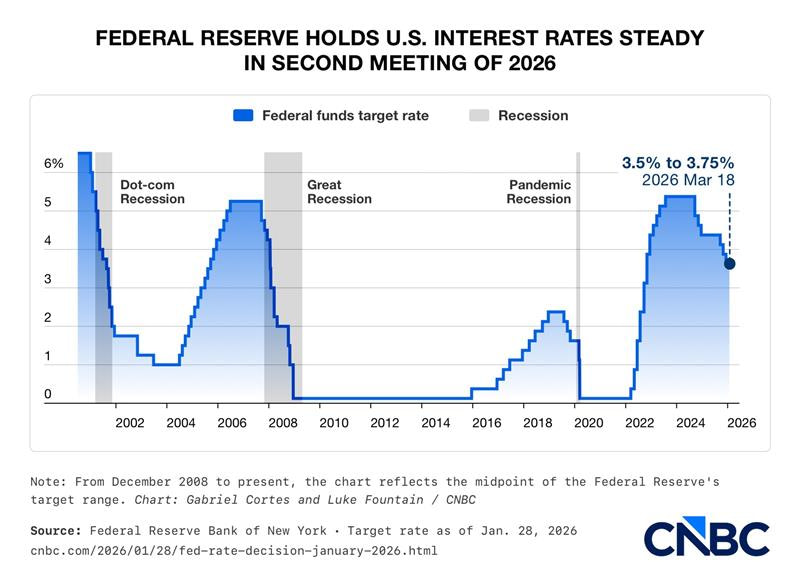
The Federal Reserve held interest rates steady at a target range of 3.50% to 3.75%. The decision reflects growing concern among policymakers over higher inflation forecasts and rising uncertainty tied to tensions in the Middle East. The decision signals rate cuts may be farther off than hoped.1
Moves like this shape borrowing costs, investment returns, and the value of your savings, making interest rates one of the most important forces in both the economy and your personal finances.
2
Inflation Keeps the Fed Cautious
The Fed’s decision comes as inflation remains above its 2% target. Officials now expect inflation to end the year at 2.7%, up from a previous 2.4% estimate. Core PCE inflation is also projected at 2.7%, higher than earlier forecasts. The increases reflect that price pressures are not easing as quickly as hoped. 3
At the same time, new risks are emerging. Ongoing conflict in the Middle East has pushed energy prices higher and added uncertainty to the global outlook, making the Fed less confident about lowering rates.4
Fewer Cuts Ahead
The Fed’s updated projections point to a slower path for rate cuts. Policymakers now expect only one quarter-point cut in 2026. One official even projected a rate hike next year due to the murky inflation outlook. Chair Jerome Powell has not yet given clear forward guidance. Much may depend on how the economy responds to current conditions in the months ahead.5
Pressure Builds Across the Economy
With borrowing costs remaining elevated, higher interest rates will continue to impact both consumers and businesses. Mortgage rates, credit cards, and auto loans are still expensive. Despite some easing, they remain well above levels seen in the years after the financial crisis.
Businesses are also facing tighter financial conditions. As a result, hiring and investment may slow even as demand for loans continues. Job growth has also slowed, with unemployment projected to hold at 4.4%. In addition, more households are falling behind on payments as savings decline.6
The Fed is trying to bring inflation under control without tipping the economy into a downturn. Policymakers are projecting only a gradual path toward lower rates. The outlook has become more complicated as rising energy prices add pressure to both growth and inflation.

Markets Adjust to the Outlook
Markets reacted quickly. The U.S. dollar climbed to a 10-month high against major currencies as investors adjusted to expectations for sustained elevated rates.7
A stronger dollar suggests U.S. interest rates may stay higher than those in other countries, drawing money into dollar assets. Higher rates tend to push money into safer investments like Treasuries and away from riskier assets like stocks, which can weigh on markets and increase borrowing costs.
Some analysts believe the Fed may still face surprises. Inflation could remain elevated longer than expected. Or new shocks may force policymakers to adjust their plans again. The outlook remains increasingly uncertain.
Investment Impact
The current environment presents a mix of challenges. Higher interest rates can slow economic growth and increase volatility in financial markets. Inflation continues to erode purchasing power. These pressures make it harder for traditional portfolios to perform as expected, especially when both stocks and bonds face strain instead of counterbalancing each other.
In uncertain conditions like these, many look for assets that can hold value over time. Gold has often served that role during periods of inflation and economic stress, particularly when real returns on other investments come under pressure.
Even with a stronger dollar in the short term, persistent inflation, geopolitical tension, and long-term fiscal concerns continue to support demand for physical gold. Unlike paper assets, physical gold does not rely on market performance or a third party. It has historically helped preserve purchasing power across economic cycles.
Conclusion
The Fed’s latest decision shows just how unstable the situation has become. Policymakers are holding rates steady while caught between stubborn inflation and a slowing economy, as the risk of stagflation hangs in the background. Rising global tensions and shifting economic signals are making the outlook harder to read by the day. With so many forces pulling in opposite directions, the Fed is left in a wait-and-see stance. No one can say which way the economy will turn next.
Even if the Fed is navigating uncertainty, you don’t have to leave your financial future exposed. For those seeking long-term protection from interest rate uncertainty, a Gold IRA can offer a way to help preserve purchasing power and bring stability to a retirement portfolio. To learn how precious metals in a Gold IRA can help you secure your financial goals, call American Hartford Gold today at 800-462-0071.