






- Jeremy Grantham warns that U.S. stocks may be dangerously overvalued, with the Buffett Indicator near dot-com bubble levels.
- Record margin debt and heavy leverage may make the market more fragile if confidence begins to crack.
- A Gold IRA can help protect your finances from market volatility, currency pressure, and sudden stock losses.
Risk Is Building Fast
The stock market has been on an impressive run, but respected voices are warning that the rally may be standing on shaky ground. Jeremy Grantham recently called the current U.S. market the most expensive in history, while record levels of borrowed money are helping fuel stock purchases. SpaceX’s recent public debut above a $2 trillion valuation has added another sign of how powerful investor appetite for high-growth names has become. At the same time, gold has pulled back sharply from its highs, creating a potential buying opportunity for Americans who want to protect their retirement with a layer of financial insurance.
A Market Built on Stretched Valuations
Grantham’s warning carries weight because the GMO co-founder built his reputation on identifying bubbles before major crashes, including the dot-com collapse and the 2008 housing crisis. He pointed to the Buffett Indicator, which compares total stock market value with GDP, sitting around 235% and rivaling the dot-com peak. He also said market valuations since 2010 have averaged more than 60% above the typical level seen over the prior century.1
Grantham has warned that a future peak-to-trough decline could come closer to 70% than a milder 50% pullback. He also flagged today’s heavy concentration in AI and momentum-driven names, which could make the broader market more vulnerable if confidence shifts. When valuations stretch this far beyond history, the next downturn may go beyond ordinary volatility.
Borrowed Money Is Adding Fuel to the Fire
Stretched valuations are only part of the story. U.S. margin debt hit a record $1.4 trillion in May, up 54% from a year earlier. It climbed roughly 8.5% from April to May alone.2
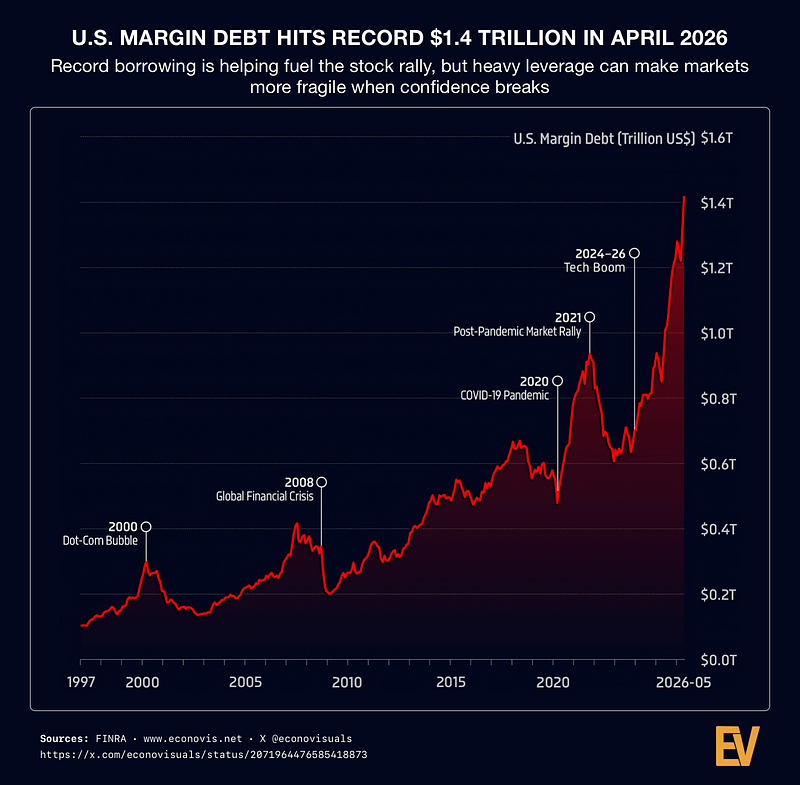
Morgan Stanley warned in June that the stock market has become more dependent on borrowed money than ever before. New York Fed data tells the same story, showing major Wall Street firms now have record exposure to stocks through financing arrangements. The concern is simple: when more of a rally is built on leverage, the market can fall faster once confidence breaks. Especially since much of the risk is overconcentrated in tech.
Barclays analysts estimate leveraged funds purchased close to $300 billion in derivatives over that stretch. Meanwhile, Nationwide strategist Mark Hackett warned that retail traders are layering options on top of leveraged ETFs purchased on margin, creating several stacked layers of exposure. In plain English, stacking leverage products means investors are using borrowed money to buy funds that already use borrowed money or derivatives. Borrowed money can push prices higher in good times, but it may accelerate losses once sentiment turns. Derivative trading helped accelerate the 2008 financial crisis. 4
Gold Just Got Cheaper
While stocks have climbed on leverage and optimism, gold has moved in the opposite direction. Bullion recently fell more than 20% from its highs and reached a six-month low. Higher-for-longer rate expectations, a stronger dollar, and rising Treasury yields have all weighed on gold prices. Capital has also rotated toward equities, especially AI and tech stocks, pulling near-term demand away from defensive assets.
A pullback of this size does not necessarily change gold’s long-term role. Physical gold has historically served as a store of value during inflation, currency pressure, and market stress. Recent weakness may look more like a deep correction after an extraordinary run than a broken case for owning precious metals. The macro case for gold is still intact. A recent survey of the Official Monetary and Financial Institutions Forum showed a majority of central banks see gold trading between $5000 to $6000 within the next six months. 5

Conclusion
History suggests protection works best when added before fear returns, not after markets crack and hedges become more expensive. Gold’s recent discount may give Americans a chance to add protection while prices remain attractive, rather than chasing prices higher during a panic. No one can predict the next market shock with certainty, but waiting for headlines to confirm the danger often means better entry points may have already passed.
Stocks remain historically expensive, record margin debt is adding fragility, and gold has become more affordable just as the case for owning it grows stronger. Diversifying into physical precious metals can help guard against equity losses and currency pressure. A Gold IRA lets you hold physical gold and silver in a tax-advantaged retirement account, adding protection that paper assets alone may not provide.
Now may be the right time to see how physical precious metals fit into your retirement strategy. If you want to protect your portfolio with physical precious metals in a Gold IRA, contact AHG today at 800-462-0071.