














- Gold’s former price ceiling transforms into a new floor, signaling stronger underlying market support.
- Central bank buying, geopolitical uncertainty, and rate expectations continue to reinforce gold’s upward outlook.
- Protecting your finances with physical gold in a Gold IRA can help preserve purchasing power during uncertain economic conditions.
A Structural Shift in Gold
At The Grand Emperor Hotel, the gold floor is literally gone. Management ripped up the real gold bricks from its distinctive lobby floor and sold them for around US$13 million after recognizing what it called “a good opportunity”. Even as gold was removed from the ground in one place, a different kind of floor was forming in the market.
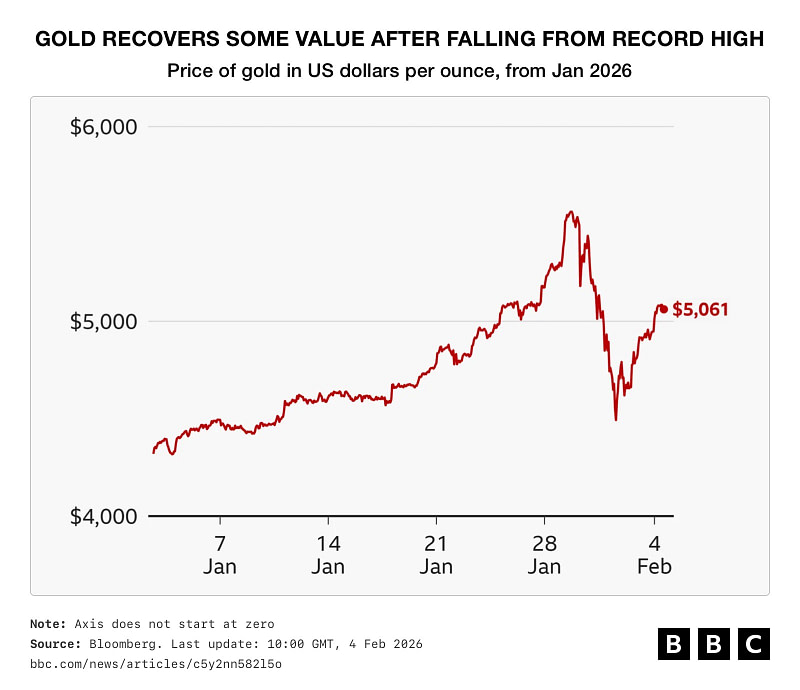
The late January rally driven by speculative demand collapsed abruptly, producing silver’s biggest daily drop on record and gold’s steepest fall since 2013. A leveraged unwind, including CME margin hikes, cleared weak hands and helped solidify a new price floor that continues to hold. With that foundation now in place, the gold appears positioned for its next move higher rather than another retreat.
From Resistance to Foundation
Gold’s relationship with the $5,000 level has clearly shifted. What once acted as resistance is now being treated as a solid base for the market. Analysts describe this area as both a critical support and a psychological threshold, especially after aggressive dip buying stepped in when prices bounced from about $4,550.
Recent trading behavior continues to reinforce that change. Gold has been finding steady support while consolidating between $4,800 and $5,100. Prices have held firm with minimal profit taking, suggesting investors are comfortable maintaining positions instead of rushing to lock in gains. With gold currently trading near ~$5,047, the message is becoming clearer. A level that once capped rallies is now helping hold the market up.1
2
The Structural Forces Supporting Gold
Several powerful forces continue to support gold at these levels. Central banks alone are projected to purchase roughly 800 tonnes in 2026, equal to about 25% of total mine output, a scale of buying that can help absorb pullbacks and steady the market. China alone continues to extend their 15-month buying streak. Central bank accumulation also removes large amounts of supply from the open market, further supporting prices.
The broader backdrop is just as supportive. Rising geopolitical tensions are pushing investors toward safe haven assets like physical gold. In moments of crisis, capital typically migrates toward assets that sit outside the traditional financial system. Physical gold is not backed by a government promise, carries no counterparty risk, and has historically maintained liquidity when other markets seize up. That independence is a primary reason investors have relied on gold for centuries to help protect wealth during periods of geopolitical shock.
Expectations for Federal Reserve rate cuts in 2026 are seen as another sign of support. Kevin Warsh, a potential new head of the Federal Reserve, is described as a dove in hawk’s clothing. He is widely believed to favor lower rates. Historically, lower interest rates reduce the opportunity cost of holding gold and often make the metal more attractive to investors.

Why Wall Street Still Sees Upside
Analysts say the same demand drivers from 2025 remain in place, particularly geopolitical uncertainty and dollar weakness. Meanwhile, declining confidence in fiat currencies continues to push investors toward gold.
Large financial institutions are signaling confidence in gold’s direction despite recent volatility.
“The recent bout of volatility has called into question the value of gold as a hedge against geopolitical and market swings,” Mark Haefele, global wealth management chief investment officer at UBS Group AG, wrote in a note. “We believe such worries are overdone, and that the rally in gold will resume.”3
That view is not isolated. Major banks and asset managers, including Deutsche Bank and Goldman Sachs, are backing a recovery as well.
Forecast upgrades reinforce that optimism. Wells Fargo raised its 2026 target to $6,300 from $4,500, citing lower rates, policy hedges, and central bank buying as key drivers. JPMorgan also lifted its forecast to about $6,300 for Q4 2026. That’s a notable increase from its prior outlook near $5,000. CIBC remains bullish as well. They raised their 2026 average gold forecast to $6,000 and project $6,500 in 2027.4
Conclusion
Gold has crossed an important threshold. What once acted as a ceiling is now functioning as a floor, and that foundation appears well supported. Strong central bank buying continues to absorb supply, safe haven demand remains steady amid global uncertainty, and the dollar debasement trade is keeping gold firmly on investors’ radar. With momentum building, gold is moving higher, making this a compelling time to help secure and potentially grow the value of your portfolio.
If you are looking to secure your portfolio with a Gold IRA, contact American Hartford Gold at 800-462-0071 to speak with a specialist today.