





- Veteran economist Gary Shilling says a U.S. recession by year-end is now “almost inevitable.”
- Consumer weakness, elevated stock valuations, and recession signals are increasing downside risks for markets.
- Physical gold in a Gold IRA has historically helped investors protect purchasing power during recessions and financial instability.
Recession Signals Are Flashing
Veteran economist Gary Shilling isn’t mincing words. The former Merrill Lynch economist said a U.S. recession by year-end is now “almost inevitable” and that investors who aren’t paying attention could be in for a painful surprise. Shilling, who correctly called the 2008 market collapse, is now warning that the S&P 500 could fall as much as 30%. His warning is based on several leading indicators that all point toward a downturn.1
Consumer Strength Is Fading
Consumer spending drives about two thirds of U.S. economic activity. But that engine is weakening. The personal savings rate has dropped to 3.6%, the lowest level since 2022. At the same time, real disposable income growth has slowed to just 0.4% on a yearly basis.2
Households are still dealing with the cumulative effects of inflation. Energy prices alone rose 12.5% year over year in March, largely tied to rising oil costs connected to conflict in the Middle East. As more income goes toward essentials like fuel and food, less is available for discretionary spending.
Housing and Business Investment Have Stalled
Two other pillars of economic growth are wobbling. The housing market remains largely frozen as markets expect interest rates to stay elevated. Despite a brief spike in existing home sales last year when mortgage rates dipped, buying activity has slowed significantly as rates climbed back higher.
On the business side, investment outside of AI has dried up. Capital expenditures grew just 3.9% at the end of last year, down sharply from a peak of over 24% during the pandemic surge. Strip away AI spending, and the broader private sector looks increasingly reluctant to put money to work.3
When both housing and business investment lose momentum at the same time, growth becomes more fragile. These are long-cycle drivers of the economy, and weakness here tends to persist.
Markets Are Priced for a World That May Not Exist
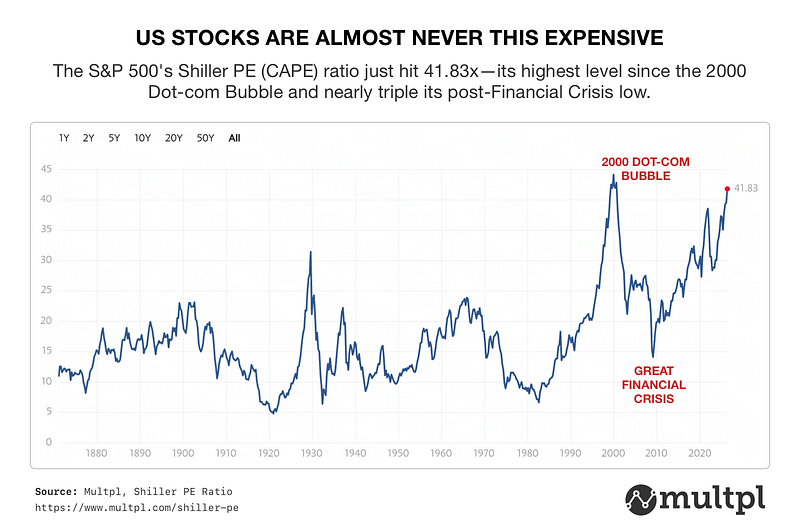
Even as economic warning signs multiply, stock valuations remain at historically extreme levels. The Shiller CAPE ratio is an inflation-adjusted price-to-earnings measure. It stands at 40.11, near levels last seen before the dot-com crash. The Buffett Indicator measures total market capitalization relative to GDP. It currently sits at 232.6%, the highest level ever recorded.4
5
Price-to-sales and price-to-book ratios for the S&P 500 are also at all-time highs. Elevated valuations don’t cause recessions on their own, but they do amplify the damage when sentiment turns. A market priced for perfection has very little cushion when reality disappoints.
“Stocks are very expensive and there probably is a major correction coming somewhere in the relatively near future,” Shilling said.6
Recession Indicators Are Triggering
Shilling isn’t alone in sounding the alarm. The Vicious Cycle Index (VCI) is a recession indicator developed by Moody’s Analytics. The measure combines rising unemployment with declining labor force participation. It has maintained 100% accuracy in predicting U.S. recessions since 1955. The VCI surpassed a critical threshold earlier this year. Moody’s recession probability estimates are now approaching 50% over the next 12 months.7
Consumer confidence hit a record low in April 2026, reflecting growing concern about job stability and future income. Consumer sentiment surveys are registering worse readings than those seen during the 2008 financial crisis or the 2020 pandemic. These shifts tend to reinforce each other. As confidence drops, spending slows. As spending slows, businesses adjust.
Central Banks Are Caught in a Difficult Position
The oil shock from the Middle East conflict is forcing central banks into a difficult corner. Julian Howard is a chief multi-asset investment strategist at GAM Investments. He warned that rate-setters are “on the verge of policy mistake territory.” Raising rates aggressively to fight energy-driven inflation risks tipping already fragile economies into recession. But staying put risks letting inflation run hotter for longer.8
Conclusion
When recession risks begin to build, protecting purchasing power becomes just as important as chasing returns.
Gold has historically performed well during periods of economic stress. During the dot-com bust, gold rose 12%. During the 2008 financial crisis, it gained 6%. When stocks sold off sharply in 2020, gold surged. The pattern is consistent: when confidence in financial markets erodes, investors tend to move toward assets with tangible, lasting value.
Indicators are increasingly pointing toward a recession. Some analysts believe such a downturn could cause stocks to fall as much as 30%, giving Americans good reason to think carefully about how their portfolios are positioned heading into the second half of 2026.
If you want to learn more about protecting your portfolio with physical gold or a tax-advantaged Gold IRA, contact American Hartford Gold today at 800-462-0071.