












- AI is resembling a bubble, reminding analysts of the dot-com era.
- Overvalued stocks and weak AI implementation could spark widespread market losses.
- Protect your finances with physical gold before the bubble bursts.
AI Risks Inflating
Artificial intelligence has sparked investor excitement not seen since the dot-com era. But analysts warn it could be a bubble ready to burst. The market now rests on the shoulders of just seven tech giants, and if they stumble, the fallout could hit the entire economy. And your retirement. Before that happens, Americans should consider protecting themselves with time-tested assets like physical gold and silver.
The Market’s AI Dependence
By any measure, the market is now overly concentrated. Nvidia is the chipmaker powering much of AI’s infrastructure. It accounts for about 8 percent of the value of the entire S&P 500 index. A larger share of the market than any company has held in the past 35 years. This summer, they crossed a historic threshold and became the first company worth more than $4 trillion. There are nine other U.S. companies valued at over $1 trillion. All but Warren Buffett’s Berkshire Hathaway are tech stocks. 1
Just a Few Stocks Driving Growth
Through July, the information technology sector was led by Nvidia, Microsoft, Broadcom, Palantir Technologies, and Oracle. They accounted for nearly 54 percent of the S&P 500’s total return. (Nvidia alone accounted for 26.2 percent) Another tech-heavy sector containing Meta, Netflix, and Amazon contributed 15.4 percent of returns. That means almost 70 percent of the index’s total return came from just two sectors. If any of these companies fail to deliver, it could knock the legs right out from under the entire market.2
Experts warn valuations are increasingly detached from reality and reaching extreme levels. Palantir was the top performer in the S&P 500 this year. It saw its stock price gain more than 100 percent. Its price-to-earnings ratio of more than 570 is about 20 times the average for the S&P 500. As The Economist noted, “Palantir might be the most overvalued firm of all time.”3
Cracks in the AI Story
After a bombshell MIT report, investor faith in AI was shaken. The recent MIT study claimed that 95 percent of companies see no returns from generative AI. The findings revealed:
- Despite $30–40 billion in enterprise investment into AI, most organizations got zero return.
- Half of AI projects ended in failure.
- While 80 percent of businesses explored AI, only 40 percent used it.
- Just 20 percent of AI initiatives reached pilot stage, and only 5 percent made it to production.
- AI would increase U.S. productivity by just 0.5% and GDP by about 1% over the next decade. A fraction of the optimistic forecasts.
The market reacted harshly to the report. The Nasdaq fell and Nvidia shares dropped 3.5%. Palantir lost $73 billion in market value. In total, the U.S. stock market lost $1 trillion in just four days as tech stocks sold off.4
5
The AI frenzy has many observers recalling the dot-com bubble. OpenAI CEO Sam Altman himself compared today’s valuations to the late 1990s, warning that too much money is chasing unproven models. Ray Dalio echoed this caution, saying: “There’s a major new technology that certainly will change the world and be successful. But some people are confusing that with the investments being successful.”6
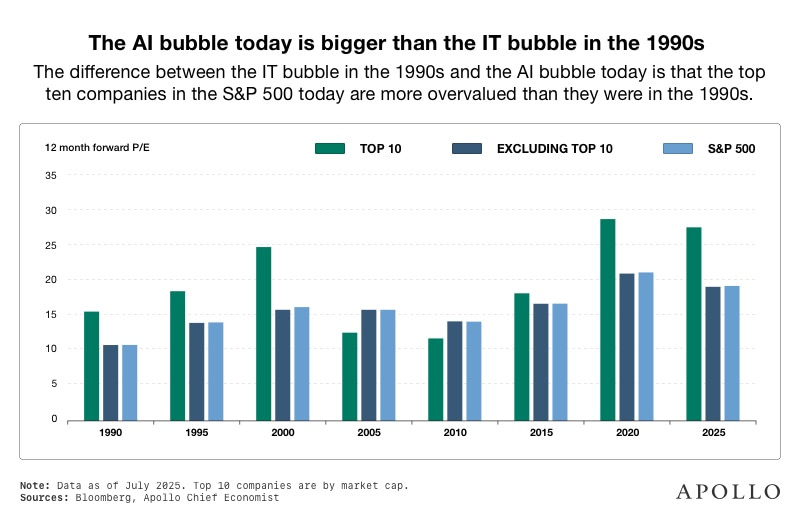
Apollo Global Management chief economist Torsten Slok said the AI surge could eclipse the internet bubble of the 1990s. He pointed out that the 10 largest companies in the S&P 500 are now more overvalued relative to fundamentals than they were at the height of the dotcom era.
Back in 2000, the top technology stocks accounted for 15% of the S&P 500. Today, the “Magnificent Seven” make up more than a third of the index. Meaning the fallout of a crash would be even worse.
Another worrying parallel is the massive infrastructure spending. In the 1990s, telecom companies overbuilt fiber optic networks that bankrupted businesses when demand fell short. Today, AI companies are pouring hundreds of billions into data centers. Projections show that $3 trillion will be needed by 2028. If AI adoption doesn’t scale as expected much of that money may never yield returns.
What If the Bubble Bursts?
If the AI boom proves to be a bubble, the fallout could outdo the dot-com crash. Global venture capital poured $131.5 billion into AI startups in 2024, much of it at risk if expectations collapse. Companies like Nvidia could see trillions in market value erased. And trillions more in planned infrastructure spending could be scrapped. The result: a market correction that could wipe out trillions across stock portfolios, retirement funds, and corporate investments.7
Conclusion
AI may change the world over time, but history shows that markets can move much faster than reality. When expectations exceed results, bubbles form. And bubbles burst.
That’s why diversification matters. If you’re concerned about how an AI-driven bubble could impact your retirement savings, consider a Gold IRA from American Hartford Gold. With gold and silver, you can help protect your wealth against volatility, downturns, and market concentration risks.
Call us today at 800-462-0071 to learn how to safeguard your portfolio.


