
















- Gold can strengthen diversification because it often behaves differently from stocks and other commodities.
- Growing BRICS financial and geopolitical cooperation could weaken Western influence and create new risks for American retirement portfolios.
- A Gold IRA can help protect your finances as the global financial system becomes less dependent on the dollar.
Why Gold Diversifies Differently
Most retirement savers know diversification matters. Spreading money across different assets can help reduce the impact when one part of a portfolio struggles.
Owning several different assets, however, does not guarantee they will behave differently when markets come under pressure. Stocks, commodities and other holdings can fall together during periods of stress, leaving investors more exposed than they may realize.
New 2026 research from the World Gold Council helps explain why gold has historically behaved differently. The forces driving gold demand are different from those affecting most commodities, which can give gold a distinct role in a diversified portfolio.
Gold Is a Different Kind of Commodity
Gold is often grouped with oil, copper and agricultural products. Most of those commodities are consumed as they are used. Their prices can rise or fall sharply when production falls short or supply builds up.
Gold works differently. It is rarely consumed or destroyed. Much of the gold mined throughout history still exists. And it can be recycled, resold or held for decades.
Because so much gold already exists above ground, its price is less dependent on short-term changes in production. Existing gold can come back onto the market when demand rises, moderating the kind of boom-and-bust supply swings seen in many other commodities.
Gold production is also spread across many regions, reducing reliance on any single producing country.
Broad commodity funds may also provide less gold exposure than investors expect. Major commodity indexes generally allocate only about 7% to 15% to gold because their formulas emphasize futures trading and production. Owning a broad commodity fund therefore may not provide meaningful exposure to gold.
A Broader Demand Base Can Matter When Markets Fall
Investors may buy gold for wealth protection. Central banks hold it as a reserve asset. Jewelry and technology create another source of demand during stronger economic periods.
Industrial metals and energy are more closely tied to the business cycle. Gold’s broad demand base can help it behave differently when growth slows or market stress rises.
History offers several examples.
During the fourth quarter of 2018, U.S. stocks fell roughly 14% and broad commodities declined about 9%. Gold gained approximately 8%.
During the first quarter of 2020, stocks dropped about 20% and commodities fell roughly 23%. Gold rose around 6%.
The Numbers Behind Gold’s Long-Term Performance
World Gold Council research found that gold outperformed broad commodity indexes over the 3-year, 5-year, 10-year and 20-year periods examined.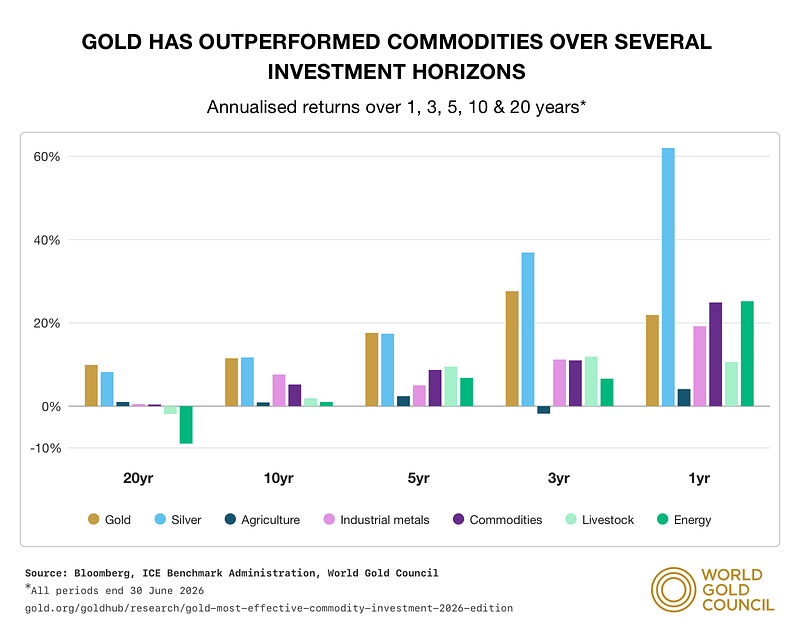
One reason involves the way many commodities are traded.
Commodity investors often gain exposure through futures contracts. Those contracts expire and must eventually be replaced. Moving from one contract to another can create roll costs that reduce long-term returns.
Over the 20-year period studied, gold produced a 9.9% annualized spot return and an 8.9% futures return. Oil generated a negative 0.2% spot return and a negative 7.2% futures return.
While gold can trail commodities over shorter periods, it generally experiences less day-to-day volatility than many major commodities.
Gold has performed well during periods of high inflation and has also posted positive returns when inflation was low. In addition, it is one of the world’s most actively traded assets, with roughly $373 billion changing hands each day.
A Small Gold Allocation Can Have a Large Effect
World Gold Council modeling shows how an asset’s behavior can influence diversification even when the allocation itself is relatively small.
In one hypothetical portfolio analysis, a 5% allocation to gold accounted for about 28% of the portfolio’s total diversification benefit. An equivalent 5% allocation to commodities provided roughly 15%.
The same modeling found that a 5% gold allocation improved annualized returns and reduced volatility across every time period studied.
Over 20 years, the hypothetical portfolio’s maximum drawdown improved from about negative 41% without gold to negative 38.6% with a 5% gold allocation.

Gold and Commodities Move Differently Through Market Cycles
The World Gold Council also examined how gold and commodities performed across different economic environments.
Gold delivered positive average returns across all four market environments studied. Interestingly, gold performed particularly well during risk-off periods, when fear rises and investors look for places they believe may hold up better during market stress.
Broad commodities tended to perform best during economic recoveries, when growth was strengthening alongside inflation and interest rates. Their performance tended to weaken during recessions.
Conclusion
Meaningful diversification becomes more important as retirement approaches, when there may be less time to recover from a major market decline. Research shows gold can help diversify a portfolio because it often behaves differently from stocks and other commodities, especially during periods of market stress. If you want to protect your portfolio with physical precious metals in a Gold IRA, contact AHG today at 800-462-0071.