















- The dollar has lost nearly 30% of its purchasing power since 2020.
- Money supply growth and changing inflation calculations may hide the full extent of the dollar’s decline.
- Physical gold can help protect your finances from inflation and preserve long-term purchasing power.
A Silent Tax
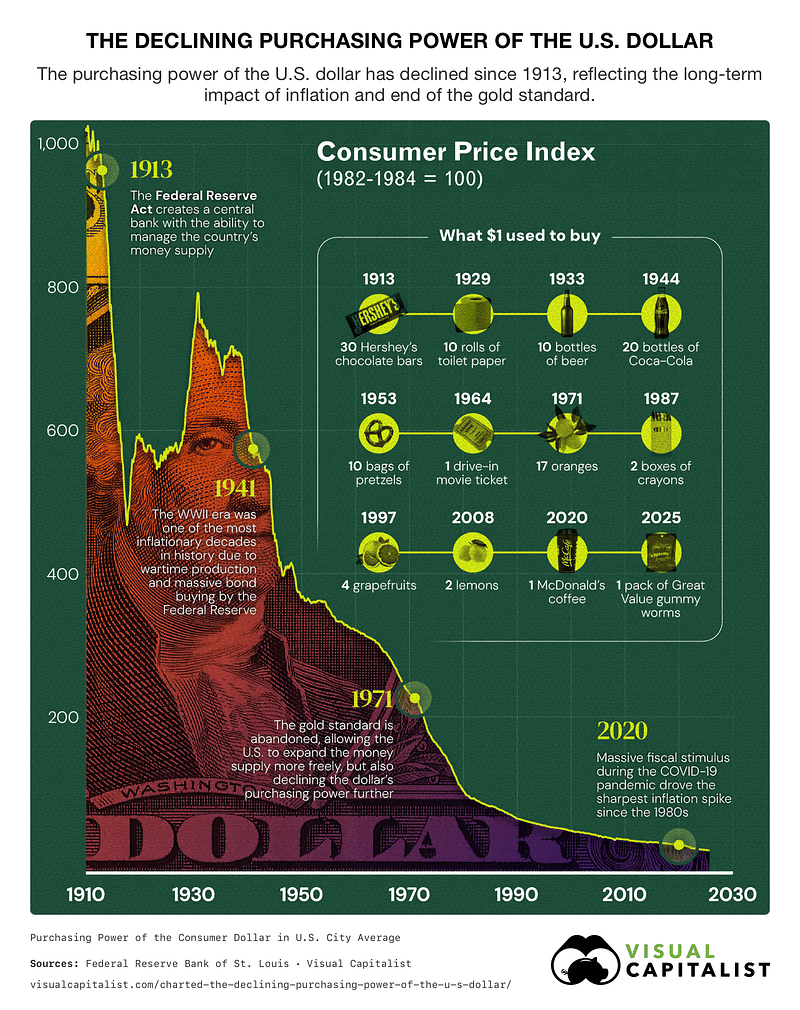
The value of the dollar is easy to overlook because the number printed on it never changes. A $100 bill is still a $100 bill. What changes is how much it can buy.
Since January 2020, the dollar has lost nearly 30% of its purchasing power. What cost $77 then costs about $100 today. The decline happened without a vote or a new law. Gradually rising prices reduced the real value of every dollar held in a bank account, retirement fund, or emergency reserve. 1
A family that got by on $50,000 a year in 2020 needs roughly $65,000 now just to stand still. Families are left to close that $15,000 gap on their own. Data shows they are pulling from savings, taking on debt, or accepting a lower standard of living. Wages may have risen for many people over the same stretch. But a raise that doesn’t outrun a 29% jump in prices functions as a pay cut underneath the surface.
As confidence in the dollar’s long-term purchasing power weakens, more Americans are turning to physical gold and silver. Unlike paper currency, precious metals cannot be created at will and have historically helped preserve purchasing power during periods of inflation and currency decline.
How the Money Got Diluted
An unprecedented monetary policy is behind the dollar’s erosion. The M2 money supply is a measure of the total amount of cash and other readily available money circulating in the economy. It was expanded by more than $6 trillion during the pandemic era. Its growth was unmatched in modern history for its speed and scale. 2
Every dollar already in circulation got a less valuable as trillions of new ones were created. Like adding water to a drink, the volume increases but strength is diluted. Inflation followed as the economy reopened, supply chains struggled, and consumer demand surged. By 2022, it spiked over 9%, the highest reading in four decades.
The pain hasn’t landed evenly. Miami has seen a cumulative dollar decline of 33.6%. San Diego has seen 32.8%. Cities already burdened by high housing costs are now facing an additional squeeze as inflation further erodes the value of every dollar.3
The Official Number May Be the Rosy Version
Even the widely cited 29% figure may understate what’s really happened. Economist John Williams argues that official inflation figures understate the true loss of purchasing power. CPI calculations changed during the 1980s and 1990s. The revised methodology included substitution effects and other adjustments that can reduce the reported inflation rate. Using the earlier method, Williams estimates the dollar has lost closer to 50% of its purchasing power since 2020. Substitution methodology assumes a shopper will swap steak for ground beef when prices climb, then counts that forced downgrade as though no harm occurred.5
A similar story is unfolding right now. The Bureau of Economic Analysis is overhauling how it calculates the PCE price index, the Fed’s preferred inflation gauge. The new approach is taking effect in September and applying retroactively to 2021. Economists at Goldman Sachs and Wells Fargo expect the revision to trim recent core PCE readings by roughly 0.2 percentage points. A shift produced entirely by the new calculation rather than any actual change in prices.6
The Fed Isn’t in a Hurry to Rescue Anyone
June’s Consumer Price Index report showed inflation cooling from 4.2% to 3.5%. It was welcome news after months of pressure from geopolitical tension and rising energy costs. Fed chair Kevin Warsh remains unmoved. He told the House Financial Services Committee that the improvement is just “one data point”. He wants considerably more evidence before treating inflation as under control.7
Markets shouldn’t expect relief soon. At the June 17 FOMC meeting, nine of the 18 Fed officials projected at least one rate hike before the end of 2026. Six of them projecting two. The committee held rates steady. But the median projection now shows the federal funds rate ending the year higher than where it started, a sharp reversal from the Fed’s own forecast just three months earlier.8
Conclusion
Despite the most recent dip in inflation, the dollar’s decline in purchasing power continues with no clear end in sight. The currency has lost close to a third of its value in six years. The true loss may be even larger than reported. The agency in charge of measuring inflation is changing its own methodology that can make the damage look smaller without prices actually falling. Meanwhile. the people setting monetary policy admit they aren’t confident the problem is solved.
Physical gold has spent centuries holding value independent of any single government’s money supply decisions or any statistical agency’s methodology. It cannot be diluted by a printing press. And it does not get revised retroactively by a committee. If you want to learn more about protecting the value of your portfolio with physical precious metals in a Gold IRA, contact AHG today at 800-462-0071.