






The Hidden Dangers of Stablecoins
In recent years, Americans have grown wary of Central Bank Digital Currencies (CBDC), aka, “digital dollars.” Critics rightly argue that they threaten privacy, personal freedom, and financial autonomy. When money exists only as digital data, every transaction can be surveilled, limited, or blocked. And your access revoked with a keystroke.
Thanks to President Trump’s Executive Order 14178, CBDCs have been banned. But what if the same danger is quietly creeping back in another form?
Stablecoins are billed as a “safe” form of cryptocurrency. However, analysts warn that they are a Trojan horse for the same centralized control that a digital dollar would impose. While they claim to solve crypto’s volatility, their real purpose may be to preserve the dollar’s dominance, expand surveillance, and bring Americans closer to an all-digital, government-controlled economy.
Fortunately, there’s a time-tested way to protect yourself: owning physical gold.
What Are Stablecoins?
A stablecoin is a type of cryptocurrency whose value is pegged to a stable asset, usually the U.S. dollar. The goal is to avoid the wild price swings of cryptocurrencies like Bitcoin. The largest stablecoins today are Tether (USDT), with a $140 billion market cap, and USD Coin (USDC), at $25 billion.1 These stablecoins, while issued privately, depend on the official financial system. With only two companies dominating the market, the government can easily force their compliance if they want to stay in business.
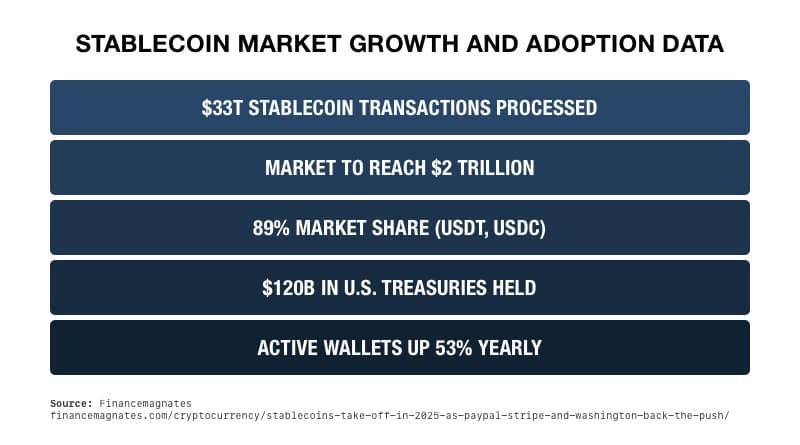
2
This may seem like a good compromise, digital convenience with dollar stability, but the reality is much darker.
Stablecoins are essentially U.S. dollar proxies. They are subject to the same laws, surveillance, and control, plus a few more. Issued on centralized blockchains, the issuer can freeze or confiscate coins at will. The “seize and freeze” feature is already built into the system and has been exercised before.
And because stablecoin transactions are recorded on public blockchains and often tied to IP addresses, they can be easily tracked. Not just for American users, but globally. In effect, stablecoin issuers act as a de facto surveillance arm of the government. They can monitor and control transactions without the need for warrants or subpoenas.
The Infrastructure of Control
Even without a CBDC, the U.S. government already exerts tremendous control over your money. Nearly 92% of dollars already exist only as database entries rather than physical cash. When the government wants to create money, it simply adds digits to its database. 3
Government agencies like the IRS, NSA, and Treasury Department monitor and analyze financial transactions with questionable oversight. Commercial banks enforce restrictions on what you can buy with your own money. Examples of “programmable” money include health savings accounts and EBT cards.
Recent legislation has intensified this framework even further. In March, the Treasury lowered the cash transaction reporting threshold from $10,000 to just $200 in certain areas. Putting over a million Americans under heightened scrutiny.
Stablecoins fit neatly into this architecture. Bills like the STABLE Act and the GENIUS Act grant stablecoin issuance rights to big banks and regulated institutions. They also impose strict Know Your Customer (KYC) and Anti-Money Laundering (AML) requirements. Thereby turning every transaction into a surveillance opportunity. 4
While it looks privatized, the result is a “digital dollar with extra steps.”
Where This Is Headed
The push toward a fully digitized, fully monitored financial system is not just an American phenomenon. In May 2020, only 35 countries were exploring CBDCs. By early 2025, that number had jumped to 134, with 65 already piloting or launching them. Every G20 nation, except the U.S., is now moving toward a centralized digital currency.5
The World Economic Forum and other global institutions strongly advocate for these systems. If the U.S. resists while the rest of the world adopts them, Americans risk being locked out of the emerging digital economy.
Stablecoins may only be a bridge. They acclimate users to digital-only money under centralized control. All while maintaining the illusion of privacy, normalizing surveillance, and paving the way for a full CBDC.
Some even warn that the long-term goal is to tokenize and digitize all assets including cash, stocks, bonds, and real estate. Thereby concentrating control of the entire economy in the hands of a few powerful institutions.
In short: stablecoins are not a solution to the CBDC threat. They are the next step toward it.
Conclusion
This isn’t the first time the U.S. government has targeted Americans’ financial independence. In 1933, Executive Order 6102 made it illegal for citizens to own gold. Americans had to surrender it for devalued paper dollars.
Today, stablecoins may play a similar role. Bringing people into digital systems that can be easily monitored, restricted, or seized when it suits the government’s agenda.
The difference is that now, owning physical gold is legal again. And it remains one of the few assets that exists outside the digital financial system.
Gold is tangible, private, and universally recognized as a store of value. It cannot be hacked, frozen, or erased by a keystroke. It protects your wealth from inflation, surveillance, and the creeping control of digital currencies.
Holding gold in a Gold IRA can give you long-term financial and personal freedom in a world where both are under increasing attack. To learn more, contact American Hartford Gold today at 800-462-0071.