













Expanding Private Equity Risks
Financial crises rarely begin with dramatic headlines. More often, they start with small cracks like liquidity restrictions, valuation disputes, and growing unease among experienced investors. In recent months, parts of the private credit market have shown these exact warning signs.
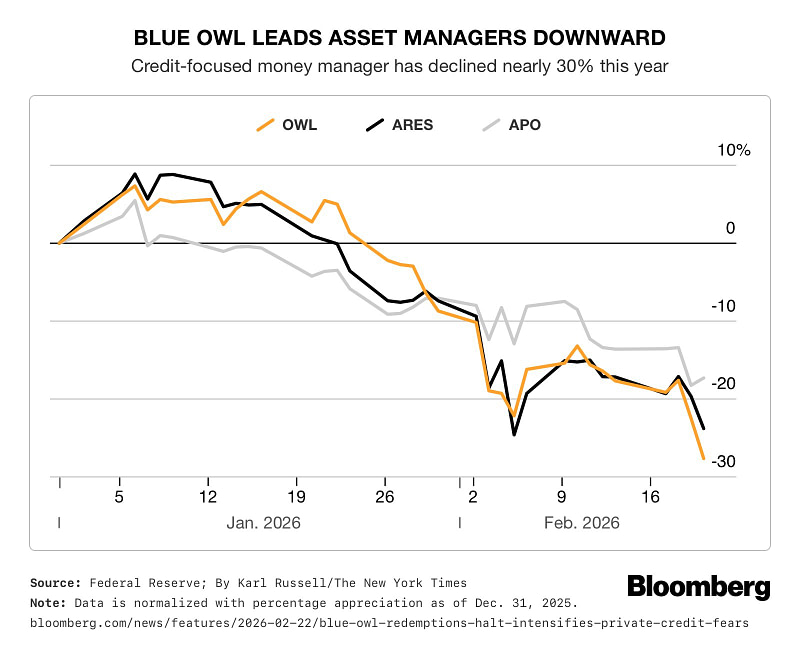
Blue Owl Capital manages over $300 billion in assets. They just halted quarterly redemptions from one of its private credit funds. The firm will now sell roughly one-third of the affected loans to return about 30% of investor capital to all shareholders. Going forward, individual investors can’t control when they withdraw their money.1
The firm called it “an innocuous schedule change”. They say it was intended to speed up the return of capital. Yet the decision is casting a shadow over private equity markets. Blue Owl’s shares fell sharply and triggered broader scrutiny of the whole industry.
The concern isn’t necessarily about one company. It’s about what developments like this may signal in a market that has expanded at extraordinary speed. And increasingly intersects with retirement savings.
A Market That Grew at Remarkable Speed
Private credit has transformed from a niche investment strategy into a central pillar of corporate finance. The market has grown to approximately $1.8 trillion. It has nearly doubled in recent years according to the Federal Reserve Bank of New York.2
This expansion was fueled by changes following the 2008 financial crisis. As regulations limited traditional banks’ ability to extend riskier loans, private lenders stepped in to fill the gap. Private equity was able to offer financing outside public markets, often in exchange for higher returns.
Blue Owl’s Actions Highlight a Core Risk
Private credit funds make loans that are meant to be held for many years. But using borrowed money to buy assets that can’t easily be sold can create hidden risks. Those risks surface when investors suddenly want their money back but the assets can’t be turned into cash fast enough.
Economist Mohamed El-Erian asked, “Is this a ‘canary-in-the-coalmine’ moment, similar to August 2007?”. El-Erian fears that these small problems could be an early sign of bigger trouble in the financial system.4
Part of the problem is that private credit investments aren’t as transparent or easy to sell as public ones. Private firms share less financial information, and values are often based on internal estimates instead of real market prices.
Interconnectedness adds another layer of risk exposure. Moody’s estimates large U.S. banks have lent about $300 billion to private credit providers. Thereby linking traditionally safer financial institutions to these alternative lending structures.5
Retirement Accounts May Be Increasingly Exposed
Historically, private equity and private credit were largely confined to institutional investors. Ones who were able to navigate illiquid markets.
That boundary is beginning to shift.
In August 2025, an executive order directed regulators to expand access to alternative assets. That meant that retirement accounts could gain increased exposure to private market investments.
401(k)s have traditionally focused on liquid, transparent investments. They were meant to provide long-term retirement security. Bringing in complex, hard-to-understand investments that use borrowed money adds more risk to the system. In the past, those risks were mostly taken on by big financial institutions, but now they could start affecting everyday investors.
Many large institutional investors have already put a lot of their money into private credit. Pension funds alone held about 30% of global private credit assets in 2024, totaling roughly $420 billion. With institutional sources largely tapped out, firms are increasingly turning to retail investors to raise the additional capital they want.6
Early Signs of Stress Are Emerging
Private credit has never experienced a full-scale systemic crisis. But warning signs have appeared.
Bankruptcies among heavily financed borrowers have produced losses. JPMorgan Chase disclosed a $170 million loss tied to loans to one such borrower. CEO Jamie Dimon hinted more trouble could be coming from private credit, warning that “when you see one cockroach, there are probably more.”7
These developments underscore a key reality. Private credit’s stability depends heavily on favorable economic conditions. When growth slows, interest rates rise, or business conditions weaken, risks become more visible.
Conclusion
History shows credit markets often serve as early indicators when financial conditions begin to shift.
For retirement savers, maintaining diversification and focusing on stability remains essential.
Physical precious metals held in a Gold IRA can provide diversification outside traditional credit markets and financial structures.
To protect your financial future, learn more about physical precious metals held in a Gold IRA. Call American Hartford Gold today at 800-462-0071 to speak with a specialist and explore your options.


