


Key Takeaways:
• Gold’s bright color, rust-resistance, and the fact that it’s easy to work with stem from its atomic structure.
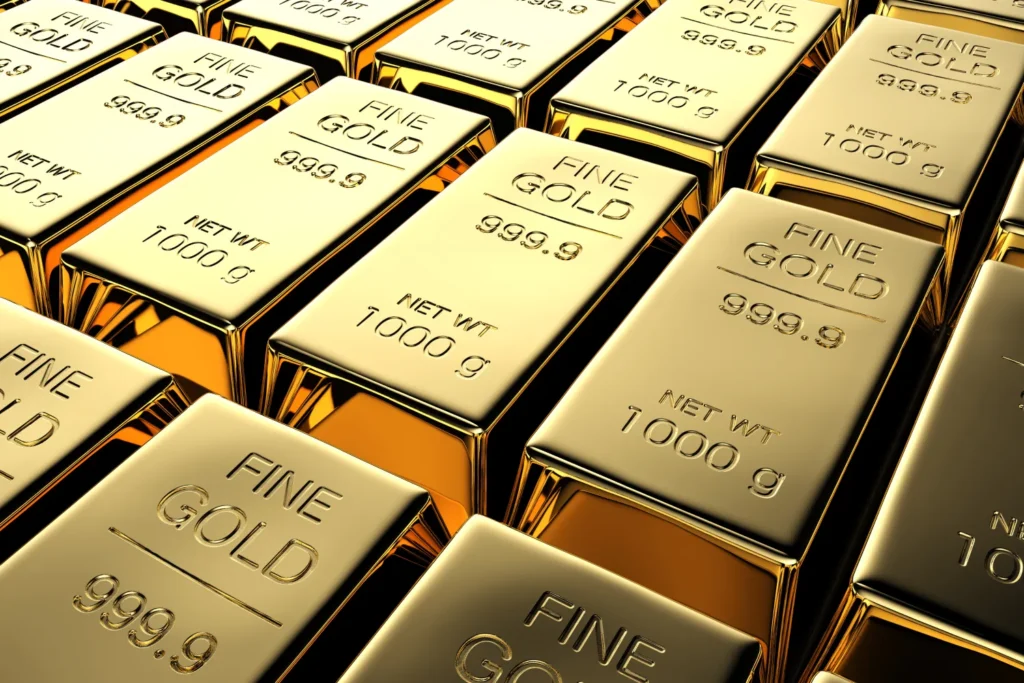
• All the gold that’s ever been mined could fit into one small building.
Gold is commonly used in jewelry and the electronics industry. It is a top choice for jewelry makers and engineers because it maintains its vibrant color over time, bends without breaking, is corrosion-resistant, and is an excellent conductor of electricity.
There are many interesting traits about this metal that consumers may not be aware of. In this article, you’ll discover five facts about gold, how it is used, and how it can be a valuable addition to a portfolio.
1. Gold Does Not Rust
Gold is a noble metal, which means it does not react easily with oxygen or moisture in the air. Iron forms rust and silver can tarnish, but gold is corrosion-resistant. This is how gold jewelry maintains its appearance even after years of wear.
It is also used to protect delicate parts inside electronic devices. High resistance doesn’t mean gold is indestructible. Strong chemicals typically found in a lab can damage it, and thin coatings can wear if they are exposed to friction.
Why Does Gold Appear Yellow?
Gold’s color stems from the way its electrons absorb and reflect light. Most metals reflect all visible wavelengths and appear silver. Gold absorbs a small amount of blue light, which makes the reflected light appear yellow to our eyes.
2. All Gold Ever Mined Would Fit in One Building
When people picture gold, they often imagine endless vaults of it. In reality, the total amount mined to date is more modest. Industry estimates place the world’s above-ground stock at roughly 200,000 metric tons.
Mine production adds only a small percentage of gold to the stockpile each year. Recirculation pushes old pieces back into the system, which helps meet demand without the need for additional mining.
How Do Scientists Estimate the Amount of Gold?
Researchers combine mine records, national statistics, and industry surveys to estimate the amount of gold above ground. They add annual mine production to previous totals, then subtract the losses that cannot be recovered. The numbers are not perfect, but they are consistent enough to show key trends.
3. Gold Is Malleable and Ductile
Put simply, gold can bend and stretch without cracking. A craftsman can hammer gold into a leaf so thin that light passes through it, and that sheet can be used to create finer design details. The same ounce can be stretched into a very long wire.
A gold bezel on a ring can hug a gemstone tightly without breaking because the metal is malleable, allowing it to move where the jeweler wants it to. This same trait helps engineers press ultra-thin layers onto glass or plastic.
What Does Malleability Mean In Practice?
In a studio, malleability means a jeweler can shape a ring or pendant with fewer joins. Fewer joins often mean a piece has fewer weak spots and a smoother look. It also means a company can press thin layers so they’re lightweight while maintaining high performance.
Additionally, when a metal can move under a tool without shattering, you waste less material.
4. Gold Is Reliable in Technology and Space
Gold shows up inside phones, computers, and cars because it is conductive and corrosion-resistant. Thin gold layers on connectors keep signals clear even after many plug-and-unplug cycles. Unlike base metals that build oxide films, gold remains conductive in outside air.
The same advantages help in space and aviation. Gold reflects heat, which protects parts from damage. Engineers combine gold with other materials to keep satellites and telescopes within an appropriate temperature range.
Why Do Engineers Choose Gold Over Copper?
Copper conducts electricity well, but it forms oxides when exposed to outside air. Those oxides increase contact resistance, which can distort signals. A thin gold layer maintains conductivity while protecting the surface of a product. This metal also bonds well to other metals and to certain solders.
5. Most of Earth’s Gold Came From Cosmic Events
Gold forms in astrophysical settings where atoms are quickly packed with neutrons. Scientists point to behavior in supernovae and neutron star mergers as the most likely sources.
Early in Earth’s life, heavy elements like gold likely sank toward the core while the planet was still molten. The gold we can reach in the crust may have arrived later when meteorites delivered a fresh sprinkling in a phase called the late veneer.
The Late Veneer Theory
The late veneer theory states that after Earth’s core formed, a final wave of meteorite impacts brought extra amounts of certain elements to the crust and mantle. Isotope patterns in rocks support the idea that this happened on more than one planet in the inner solar system.
For gold, the theory helps explain deposits that are accessible to miners today. Without that late addition, the majority of gold would have remained far lower than we could ever reach.
Get Yours With AHG
Gold maintains its color because it resists common reactions, like rust. This precious metal can also act as a hedge against inflation during tough market times. Gold has been known to be a reliable safe haven for many years.
If you’re wondering how physical gold can help you in the long term, American Hartford Gold offers a Gold IRA, allowing clients to manage their eligible pieces within a self-directed account. Get started with us today.
FAQs
Why does gold not tarnish like other metals?
Gold’s atoms do not react easily with oxygen or water in normal air, so its surface remains clear.
What do karat numbers mean?
Karat tells you the amount of pure gold in a piece of jewelry. 24 karat is pure gold. 18 karat is 75% gold, and 14 karat is 58.5% gold.
Is white gold the same as platinum?
No. White gold is an alloy of gold that includes metals like palladium or nickel which create a cooler tone. Platinum is a separate metal with its own properties and density. Both can appear similar at a glance, but stamps and weight will reveal to you which is which.
Do electronics manufacturers actually use gold in production? If so, why?
Yes. Thin gold layers protect electrical contacts and keep signals clear because gold is corrosion-resistant. Electrical contacts are conductive components found in devices that complete (or interrupt) an electrical circuit.
This allows a current to flow between parts. When measuring by weight, the coatings are small, but still very important. Gold is used inside many devices, but most of it wouldn’t be visible unless you tore the product apart.
Where did all of Earth’s gold come from?
Gold was formed during cosmic events, then it appeared in the early solar system’s dust and rock. Most of it sank down toward Earth’s core, but some resurfaced later on through meteorites during a phase called the late veneer. It was then concentrated into deposits people can now go mining for.
Sources: