

- The Federal Reserve cut rates 25 points to counter slowing growth and rising unemployment.
- Economists and market veterans warn a 2025 recession may be unavoidable.
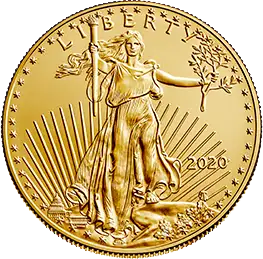
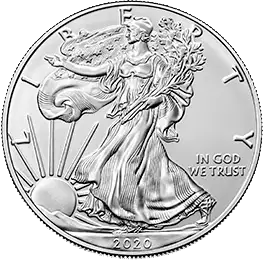
- Protect your finances and purchasing power by diversifying with physical gold.
Rate Cuts: Too Little, Too Late
The Federal Reserve has officially shifted gears. After months of holding interest rates steady, the central bank has now cut its benchmark rate by 25 basis points, signaling a pivot from fighting inflation to supporting employment. The decision has analysts wondering whether the move will be enough to prevent a recession or if the economy is already too close to the edge.1
Signs of Trouble
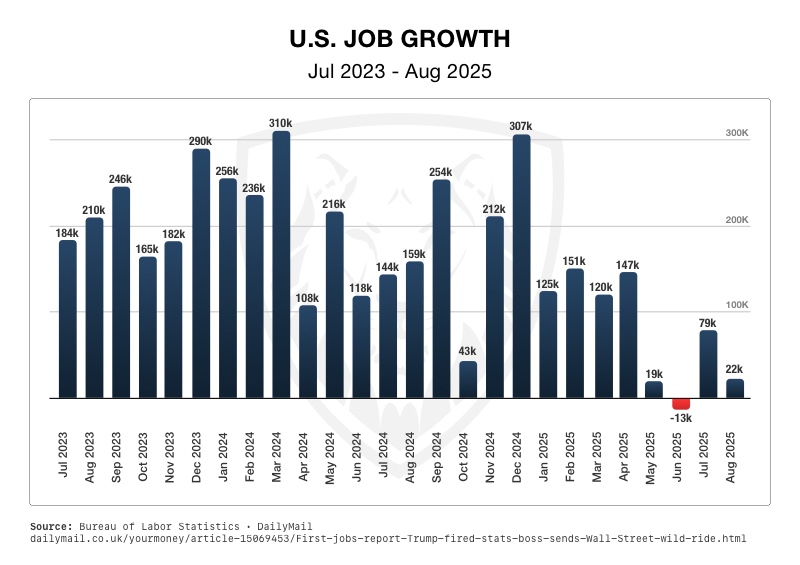
Recent data is painting a troubling picture for the U.S. economy. The August jobs report from the Bureau of Labor Statistics showed that the economy added only 22,000 jobs, far below the 80,000 economists had expected. The unemployment rate climbed to 4.3 percent, its highest level since October 2021. And for the first time since April 2021, unemployed workers now outnumber available job openings.2
3
These are not isolated numbers. JP Morgan recently warned that “a slide in labor demand of this magnitude is a recession warning signal.” Similarly, Arindrajit Dube, an economics professor at the University of Massachusetts Amherst, noted that “the totality of evidence is increasingly pointing to a slowdown in the labor market that could reflect a recession.”4
Credit and Consumer Stress Are Rising
Beyond the labor market, other indicators also suggest economic strain. The average FICO credit score fell to 715 between 2024 and 2025, its biggest drop since 2009. The Fair Isaac Corp. report notes that “delinquency rates on auto loans, credit cards, and personal loans are at or near their highest levels since 2009, during the Great Recession—and are more consistent with an economy in recession than one still in expansion.”5
The decline is especially pronounced among young people, where resumed student loan delinquency reporting has contributed to falling scores. At the same time, Americans are still grappling with high interest rates, which make borrowing more expensive, and tariffs that are adding upward pressure on prices for gas, groceries, and other essentials.
UBS Sees a High Recession Probability
Global investment bank UBS has put hard numbers to these concerns. After reviewing data from May to July 2025, UBS determined there is a 93 percent chance of the U.S. entering a recession this year. The bank’s assessment factored in personal income, consumption, industrial production, and employment.
UBS described the economy as “soggy, soft, weak, yes, but not collapsing.” It also pointed to the inverted yield curve, a reliable recession indicator, which currently sits at 23 percent. Stress in credit markets has pushed the probability of a recession from credit metrics alone to 41 percent.6
Warnings from Market Veterans
Some of Wall Street’s most experienced voices are sounding the alarm. Lloyd Blankfein, former CEO of Goldman Sachs, has warned that the next major crisis could arise from credit markets. He highlighted that credit spreads, the extra yield investors demand over Treasurys, are historically narrow. This suggests that markets may be underestimating risk at a time when economic weakness is spreading.
This echoes concerns from other experts who warn that complacency can precede a downturn, similar to how markets often look strongest just before a major correction.
The Risk of Stagflation
Economists are also raising the specter of stagflation, the combination of slowing growth and rising inflation reminiscent of the 1970s. Moody’s Analytics chief economist Mark Zandi offered a stark metaphor: “Everything is clinging tightly to the lip of the cliff. We had 10 fingers on the edge of the cliff a couple months ago, we now [have] seven fingers. A couple more fingers, then we’re going over the edge.”7
The Fed’s Strategic Shift
The Federal Reserve’s rate cut is designed to counter these negative trends. By lowering borrowing costs, the Fed hopes to encourage consumer spending, boost business investment, and stabilize employment. This marks a clear shift away from its earlier priority of controlling post-pandemic inflation. It reflects growing concern that labor market weakness is now the greater threat.
This move is expected to provide some relief by making credit more accessible, potentially cushioning declines in employment and consumption that could deepen a recession. Market sentiment generally views the rate cut as a positive step toward stabilizing growth.
Can the Rate Cut Prevent a Recession?
While the rate cut is a proactive measure, it is not a guaranteed solution. Monetary policy works with a lag, often taking months to fully impact the economy. Persistent inflationary pressures, tariff-related price increases, and elevated long-term interest rates could limit the stimulative effect.
Economists warn that the September cut is more likely to soften a potential recession than prevent one entirely. If structural issues or external shocks continue to drag on growth, the economy could still experience a mild to moderate downturn in late 2025 or early 2026.
Conclusion
Whether the Fed’s actions succeed in preventing a recession or merely delaying it, Americans should consider strategies to protect their financial well-being. Historically, physical gold preserves purchasing power and hedges against uncertainty during economic weakness. To learn more how a Gold IRA can protect your financial future, contact us today at 800-462-0071.