

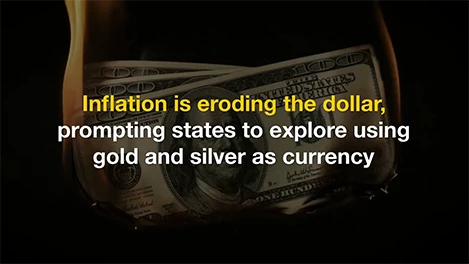

- The declining dollar and inflation are fueling the gold-as-currency movement.
- U.S. states are making legal and tax changes to ease gold and silver use.
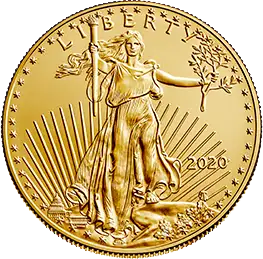
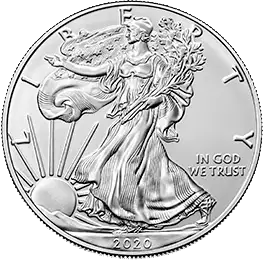
- Physical gold can become more than a savings safeguard; it may act as an inflation-proof currency
Rising Push for Sound Money
As inflation continues to erode the purchasing power of the dollar, an increasing number of U.S. states are rethinking the role of precious metals. The growing Sound Money, aka “gold as currency,” movement reflects a loss of faith in the dollar and the Federal Reserve. As well as a desire for greater economic freedom.
Advocates see gold and silver as “politically neutral, inflation-free money.” More states are advancing policies to make precious metals easier to own, trade, and even spend. For everyday Americans, these changes could provide more options to safeguard the value of their savings.
State-Level Momentum
The pace of legislative activity is accelerating. While a few such bills were introduced annually in the past, more than 30 were proposed in each of the last three years, including 60 so far in 2025. This year alone, 12 states have enacted legislation, while 32 states are currently debating similar laws.1

2
Key policy wins include eliminating sales tax and removing capital gains tax on gold and silver purchases. These measures remove barriers that make gold and silver difficult or costly to use. By cutting taxes and enabling electronic payment platforms, states are making it easier for people to hold and spend their gold investments.
The Texas Turning Point
One of the most significant developments came this year in Texas. Lawmakers passed a groundbreaking law making gold and silver usable as legal tender in everyday transactions. Texans will soon be able to buy, sell, and pay for goods and services using precious metals through digital systems.
These systems will be tied to the Texas Bullion Depository. This facility is the first state-administered bullion depository in the U.S. It will provide secure, audited storage for precious metals that can be linked to debit-style cards. Importantly, the law is voluntary. No business is required to accept gold or silver, and residents are free to continue using fiat currency.
Supporters say the law offers a practical alternative. As Kevin Freeman, a legal tender advocate, pointed out, “Exchange-traded funds can’t be used at the grocery store.”3
Tax Relief and Political Pressure
Most states have already removed sales taxes on bullion. Others, such as Maine, Hawaii, Vermont, New Mexico, and Maryland, are considering similar moves. Voters were previously subject to “triple taxation.” In the past, governments taxed buyers when gold was purchased, again when it was sold, and finally through federal capital gains taxes.
In Idaho, the state legislature passed a bill that would have allowed the State Treasurer to allocate some funds into physical gold and silver, though it was ultimately vetoed. Utah went further, passing legislation allowing its State Treasurer to invest up to 10% of the state’s rainy-day fund in gold. That fund is now valued at $180 million. Wyoming soon followed with its own $10 million allocation.4

Why States Are Acting Now
The motivation is clear. The U.S. dollar has been in steep decline since the start of the year. It is currently trading near multi-year lows. According to the St. Louis Federal Reserve, the dollar’s purchasing power has dropped nearly 27% over the past decade. In the first half of 2025, the U.S. Dollar Index posted its biggest decline since the 1970s.5
Gold prices have surged in response, more than doubling since 2020. Inflows into gold ETFs this year are at levels not seen since 2010. Meanwhile, central banks continue to buy aggressively. UBS Global Wealth Management projects gold prices could reach $3,600 by March 2026 and $3,700 by mid-2026.6
As Jp Cortez of the Sound Money Defense League noted, “States are looking at their balance sheets and saying, ‘We have way too much exposure to dollar-denominated debt… Maybe we need to think about assets that not only have had good returns, like gold and silver, but also carry no counterparty risk.’”7
The Global Context: De-Dollarization
These U.S. state-level moves mirror what is happening globally. Central banks are rapidly increasing their gold holdings to hedge against U.S. sanctions, inflation, and dollar volatility. For three consecutive years, central banks have purchased 1,000 tons of gold annually, with another 1,000 tons projected this year.
Implications for Americans
For everyday Americans, new state laws are making gold and silver more practical than ever. They are removing taxes, boosting liquidity, and opening the door to real-world use. Precious metals can now function like cash in some states. At the same time, offering a stable hedge against inflation in a growing parallel monetary system.
Conclusion
The goal of the sound money movement is not to replace the dollar, but to restore accountability in a system where fiat currencies can be easily debased. By reintroducing gold and silver as legal tender, states are challenging the unchecked power of deficit spending and inflation.
The U.S. dollar’s role as the global reserve currency is not disappearing overnight, but confidence is clearly weakening. A shift is underway. People are losing faith in the dollar and seeking security in precious metals, not only as investments, but as practical, usable money.
You can start protecting the value of your savings today with a Gold IRA. Call American Hartford Gold at 800-462-0071 to learn more.