

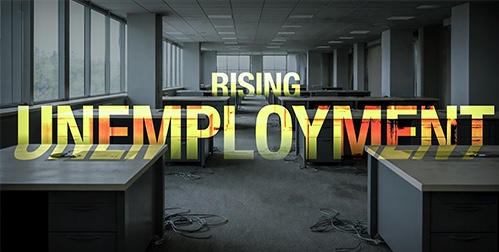

- Rising unemployment and stalled hiring point to a weakening economy and growing recession risk.
- Inflation remains elevated while wage growth slows, increasing financial pressure on households.
- Physical gold in a Gold IRA can help protect your finances during periods of economic uncertainty and market volatility.
Labor Market Weakens
The labor market was quiet for weeks, not because conditions were strong, but because the data was delayed. A prolonged federal shutdown disrupted labor data, canceled the October jobs report, and delayed the November release. Now that the numbers are finally in, the picture is clear. The job market is weaker than expected, and unemployment is rising. The missing information points to a slowing economy that could be heading toward recession, with consequences that will reach every household.
Unemployment rose to 4.6 percent in November, the highest level since 2021. Earlier this year, unemployment was closer to 4.0 percent. That steady climb matters because rising unemployment often signals deeper economic trouble ahead. Even with some job growth in November, the economy added only 64,000 jobs, which did not make up for the 105,000 jobs lost in October. Over the past six months, job growth has stalled, with only about 100,000 jobs added in total.1

2
Why Rising Unemployment Matters
A weakening labor market can slow the entire economy. When fewer people are working, consumer spending drops. Businesses respond by cutting back on hiring and investment. This can create a cycle that leads to a broader recession.
Several warning signs are already present. The economy has lost jobs in three of the past six months. The three-month average of job gains fell to just 22,000 in November, well below the level needed to keep unemployment from rising. With one month left in the year, job creation is on pace to be the weakest since 2020 and before that, the Great Recession.3
Rising unemployment is one of the most closely watched recession indicators. The Sahm Rule recession indicator, triggered when the three-month average unemployment rate rises 0.5 percentage points from its low, is close to being activated again. While unemployment remains low by long term standards, the direction it is moving is raising concern among investors and policymakers.
Inflation Is Still Pressuring Households
At the same time unemployment is rising, inflation has not gone away. Inflation fell to 2.3 percent in April but has since moved back toward 3 percent. The upcoming Consumer Price Index report is expected to show inflation rising to about 3.1 percent.
Wages are not keeping up. Average hourly earnings were up 3.5 percent from a year earlier. That barely matches inflation and marks the weakest wage growth since May 2021. Wage growth peaked in March 2022 and has steadily slowed since then. As inflation rises again, slower wage growth is making everyday expenses harder to afford.4

The Personal Impact of a Weaker Economy
For many Americans, these trends hit close to home. Job losses and slower hiring increase the risk of missed paychecks and reduced income. Fewer people are quitting their jobs, which lowers pressure on employers to raise wages. Hiring has stalled across most industries due to uncertainty around tariffs, inflation, global risks, and consumer spending. White collar layoffs increased this fall, partly due to the adoption of artificial intelligence.
For workers nearing retirement, these conditions can be especially stressful. Job losses can force early withdrawals from retirement accounts. Slower wage growth can reduce the ability to contribute consistently to long term savings plans. Market volatility tied to economic uncertainty can also put pressure on retirement balances.
Federal Response and Lingering Uncertainty
The Federal Reserve has cut interest rates by 0.25 percentage points in three consecutive meetings to support hiring and wage growth. Federal Reserve Chair Jerome Powell has said that strengthening the labor market is key to improving affordability. However, rate cuts take time to affect the economy, and hiring has not yet responded.
Powell also warned that official data may be overstating job creation by roughly 60,000 jobs per month. Combined with the data disruptions caused by the shutdown, investors now have less certainty about the true state of the labor market.
Conclusion
Economic uncertainty has pushed investors to seek assets that can help protect savings. During this period, gold prices found support above $4,300 and rose to around $4,339 an ounce as investors looked for safe haven assets.
Gold has historically been used to help preserve purchasing power during periods of rising unemployment, inflation pressure, and economic slowdown. Unlike paper assets that rely on steady job growth and market confidence, physical gold does not depend on wages or employment trends.
To learn now physical precious metals held in a Gold IRA can help protect your savings from an economic downturn, call American Hartford Gold today at 800-462-0071.